

Wesprim/Veszprém
Wesprim/Veszprém
Etymology
The village is most likely named after Bezprim, the son of Bolesław I the Brave of Poland and his wife, the daughter of the Hungarian Grand Prince Géza.
Location
Wesprim is situated at47° 5' north latitude and17° 54' east longitude, 120 km south-west of Budapest, 45 km from Stuhlweißenburg/Székesfehérvár and 18 km from Lake Balaton.
Topography
A village in the Veszprém Uplands (Veszprémi-fennsík), bordering the Bakony Mountains (Bakony-hegység), the Great Plain (Mezőföld) and the Balaton Uplands (Balaton-felvidék).
Political and administrative affiliation
Hungary. The administrative centre of Veszprém County (Veszprém Megye), the centre of the Veszprém sub-region and the seat of the Archdiocese of Veszprém.
Common symbolism
On the red shield with a green base, a knight on a white steed faces right; he holds a sword in his raised right hand and the bridle in his left. Above the shield is a golden helmet with red bars, surmounted by a crown with five points. Emerging from the crown is a hussar in a blue dolman (hussar’s jacket [dolmány]), holding a sabre in his right hand.
Common nicknames
Wesprim is also known as the ‘City of Queens’, as it formed part of the appanage of the Hungarian queens in the Middle Ages.
Middle Ages

The 13th-century Gisela Chapel.
[Photo: T. Fedeles]

An Avar or Frankish fortress on the castle hill was conquered by the Arpads around 896. Stephen I (the Saint) founded a diocese here in 1009, dedicated to the Archangel Michael. Stephen’s wife, Gisela, resided in Wesprim and was the patroness of the Wesprimtal convent. In the 13th century, the cathedral church (‘Gisela Chapel’) was built in her honour. The settlement remained continuously in the possession of the diocese and the cathedral chapter. The castle built here also served as the county seat. From the 14th century onwards, the bishops of Wesprim served as county governors. The castle withstood the Mongol invasion but was occupied and burnt down a few decades later (1278) by the high nobleman Peter Csák and his troops.
Modern times
During the period of civil war following 1526, Wesprim was occupied in turn by King Ferdinand I (1526–1564) and the rival king, John I Szapolyai (1526–1540). The history of the 16th and 17th centuries was also marked by unrest. In 1552, the Ottomans occupied the town, which subsequently became the seat of a sanjak. Before the Christians were able to recapture Wesprim in 1566, the town and castle were burnt to the ground by the Ottomans. Towards the end of the 16th century, Wesprim once again came under Ottoman rule for a few years. During the uprising led by Ferenc II Rákóczi, Wesprim was laid to waste by Habsburg troops in 1704 for having supported the Kurucs. In the 18th century, reconstruction of the town and the castle began; the cathedral and the bishop’s palace were built in the Baroque style. The first mayoral election took place in the mid-19th century. The settlement, formerly controlled by the Church, was declared a town with an organised council in 1875.
Contemporary History
At the beginning of the 20th century, the town’s development was characterised by rapid industrialisation and the expansion of its educational institutions. Thanks to the chemical industry and the university established on the back of it, Wesprim expanded after 1945. Following the fall of the Berlin Wall, it became a town with county status (1990). To preserve the traditions of the German population of the town and its surrounding area, the Wesprim German Club was founded in 1991.
Population
In 1785, Wesprim had a population of 7,082; by 1857 this had risen to 12,655, and by 1880 it stood at 12,575 (of whom 4.3 per cent were German). Whilst the population stood at around 18,000 in 1930, it rose to over 30,000 by 1970 and to over 66,000 by 1989.[1] In 2009, Vesprim had a population of 63,405.[2] Ethnic composition (2001): Hungarians 94.7 per cent, Germans 1.7 per cent, Sinti and Roma 0.3 per cent, Ukrainians 0.1 per cent, unknown 3.2 per cent.
Economy
The international building products manufacturer Bramac is one of the city’s most successful companies. Tourism is an important sector of the economy (attractions in the city and at the nearby Lake Balaton).
History of Religion and the Church
In the 17th century, the pastoral care of Catholic Christians was provided by laypeople (lincenciatus) and members of the Jesuit mission in Andocs.
Pope John Paul II elevated the diocese to an archdiocese in 1993. Religious affiliation of the population (2001): Roman Catholic 57 per cent, Swiss Reformed 9.7 per cent, Lutheran 3.1 per cent, Greek Catholic 0.5 per cent, other 0.7 per cent. 19 per cent do not belong to any denomination or church; the religious affiliation of 10 per cent of the population of Wesprim was unknown.[3]
Special cultural institutions
Wesprim is home to the Wesprim Petőfi Theatre (Veszprémi Petőfi Színház), the Queen Gisela Museum (Gizella Királyné Múzeum) and the Hungarian Construction Industry Museum (Magyar Építőipari Múzeum).
Education and Science
During the Middle Ages, the Cathedral School in Wesprim provided a high standard of education, as evidenced by the codices in the library. A list of books on loan from the late 15th century has survived.
Veszprém is home to the University of Pannonia (Pannon Egyetem), the Archiepiscopal College of Theology (Veszprémi Érseki Hittudományi Főiskola), the Lovassy László Grammar School and the Vetési Albert Grammar School. In addition, the town is home to the Archiepiscopal Library (Veszprémi Érseki Könyvtár), the County Archives (Veszprém Megyei Levéltár), the Archdiocesan and Cathedral Chapter Archive (Veszprémi Érseki és Káptalani Levéltár) and the Eötvös Károly County Library (Eötvös Károly Megyei Könyvtár).
Everyday culture
The MKB Wesprim men’s handball team has enjoyed international success, having won the European Cup Winners’ Cup twice (1992, 2008) and secured a silver medal in the EHF Champions League (2002).
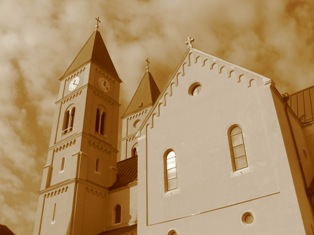
St Michael’s Cathedral, Wesprim.
[Photo: T. Fedeles]

Art History
Wesprim’s architectural monuments include St Michael’s Basilica (Szent Mihály-bazilika), the Bishop’s Palace, the castle quarter and Gisela Chapel.
Music
Veszprém hosts the Veszprém Festival (Veszprémi Ünnepi Játékok) (since 2004) and the Street Music Festival (since 2000).
Bibliography
- József Hungler: Veszprém in the Ottoman Period [Wesprim in the Turkish Era]. Veszprém 1986 (Publications of the Veszprém County Archives 4).
- Zsuzsa Fodor V. (ed.): Science and Art in Veszprém in the 13th–15th Centuries. Veszprém 1996.
- Antal Molnár: The Holy See, Ragusa and the Catholic Missions in Ottoman Hungary 1572–1647. Rome, Budapest 2007 (Bibliotheca Academiae Hungariae-Roma. Studia I).
- János Pfeiffer: A veszprémi egyházmegye történeti névtára (1630–1950). Püspökei, kanonokjai, papjai [Historical Register of the Diocese of Veszprém (1630–1950). Bishops, Canons, Priests]. Munich 1987 (Dissertationes Hungaricae ex historia Ecclesiae VIII).
- László Solymosi: Book Use at the End of the Middle Ages. (Book Lending at the Veszprém Cathedral Library) [Book Use at the End of the Middle Ages (Book Lending at the Veszprém Diocesan Library)]. In: László Szelestei Nagy (ed.): Studies on Medieval Hungarian Book Culture. Budapest 1989 (Publications of the National Széchényi Library, New Series 3), pp. 77–119.
- Konrad Szántó: The Life of Blessed Gisela, the First Queen of Hungary. Thaur 1988.
Yearbooks, journals
- Veszprémi Megyei Múzeumok Közleményei [Bulletin of the Museums of Veszprém County] (1963 onwards)
Web links
- www.veszprem.hu (Veszprém town website)
- www.vmmuzeum.hu (Museums of Veszprém County)
Citation
Tamás Fedeles: Wesprim/Veszprém. In: Online Encyclopaedia on the Culture and History of Germans in Eastern Europe, 2012. URL: ome-lexikon.uni-oldenburg.de/57057.html (accessed 5 September 2012).
Terms of use for this article
Copyright © University of Oldenburg and the Federal Institute for the Culture and History of Germans in Eastern Europe (BKGE), all rights reserved. This work was produced as part of the project ‘Online Encyclopaedia on the Culture and History of Germans in Eastern Europe’ and may be reproduced and published provided the rights holders’ consent has been obtained. Please contact:
If you have any specialist comments or additions to the text, please contact the editorial team, citing relevant literature and source references.