

European Network for Remembrance and Solidarity
European Network for Remembrance and Solidarity
1. Brief description
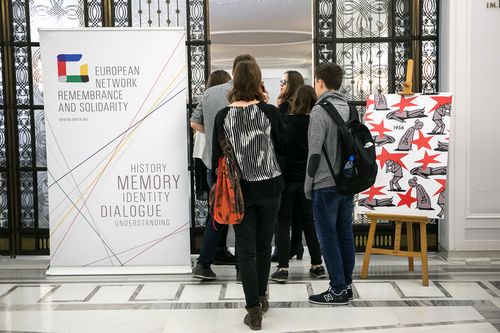
The European Network Remembrance and Solidarity (ENRS), founded in 2005 and based in Warsaw (Warszawa), is a key player in European remembrance culture. Its work focuses on implementing and supporting internationally conceived educational projects and academic initiatives on the history of Europe in the 20th century and its legacy.
2. Objective, scope, remit, key areas
In accordance with the 2005 Declaration (see below), the ENRS was established with the aim of “supporting a joint analysis, documentation and dissemination of the past, guided exclusively by the European spirit of reconciliation, documentation and dissemination of the past, to link the histories of the peoples of Europe, and to contribute to the development of a European culture of remembrance, thereby strengthening friendly relations between the participating states’.
The focus of the ENRS is the “history of the 20th century, a century of wars, totalitarian dictatorships and the suffering of the civilian population – as victims of wars, oppression, conquest, forced migration, and as victims of nationalist, racist and ideologically motivated repression’.
Its tasks are accordingly “to link together initiatives already in place in the individual countries, to organise cooperation between public, state and non-governmental organisations, research institutions and places of remembrance”, as well as “the promotion, financing and implementation of joint research and educational projects, as well as conferences, exhibitions and publications”[1] among other things
The ENRS is committed to the following thematic priorities:
1) Genealogies of memory and remembrance
2) Region – Culture – Identity
3) Remembrance of the Holocaust
4) Commemoration of the victims of Stalinism and communism
5) Resistance and Opposition
6) Society and Family Life under Dictatorships
7) The Impact of Totalitarian Regimes and Dictatorships
The work of the ENRS is directly or indirectly linked to the history of the First and Second World Wars, Nazism, fascism and communist rule. This also includes the history of other European dictatorships and of conflicts in Europe during the 20th century.
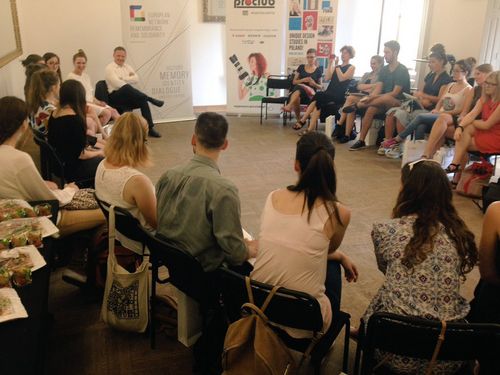
The ENRS aims to engage in dialogue with academics, memorial institutions and other partners in order to contribute to the development of a multi-perspective European culture of remembrance designed to foster mutual understanding; in doing so, it seeks to engage the younger generation in particular. The ENRS organises its own events and cooperates with numerous organisations from the fields of academia, political and cultural education, and the arts in terms of organisation, content and funding. Of particular significance is the annual European Remembrance Symposium, held at different locations across Europe each year , which brings together representatives of state and civil society institutions engaged with the history and remembrance of the 20th century to foster dialogue.
Another project format is the ‘Genealogies of Memory in Central and Eastern Europe’ workshops and conferences, which have been held annually since 2011 and provide a forum for discussing new approaches to memory studies.
Specific, ongoing event formats have been developed for the younger generation: as part of the ‘Sound in the Silence’ project, participants engage with sites of memory and remembrance (e.g. Auschwitz) and the emotions they evoke in an artistic and creative manner.
As well as supporting research projects, the ENRS also carries out its own research, for example into young people’s perceptions of totalitarian and authoritarian dictatorships in Europe.
Through its own projects
(e.g. film productions), the ENRS supports and promotes both the International Day of Commemoration in Memory of the Victims of the Holocaust on 27 January each year and the European Day of Remembrance for the Victims of Stalinism and Nazism on 23 August[2] as well as other annual commemorations and days of remembrance.
The ‘Guidelines for international discourse on history and memory’, drawn up by the ENRS, set out standards intended to contribute to the objectification and structuring of historical discourse both within and between states; individuals as well as representatives of institutions are invited to sign this voluntary commitment.
Engaging with the history of Germans in Eastern Europe is one aspect of the ENRS’s work. It is relevant, amongst other things, when examining the history of regions, national minorities and forced migrations, as well as conflicts over memory.
The ENRS cooperates in particular with the institutions commissioned by the ministries of culture of the member states (Federal Institute for Culture and History of the Germans in Eastern Europe, Oldenburg; Institute for National Memory/Ústav Pamäti Národa (Pressburg/Bratislava); Committee for National Remembrance/Nemzeti Emlékezet Bizottságának (Budapest), National Council for the Study of the Securitate Archives/Consiliul Naţional Pentru Studierea Arhivelor Securităţii (Bucharest/Bucureşti).
In addition, the ENRS collaborates with numerous institutions in Europe and worldwide. Partners in Germany include, amongst others, memorial sites commemorating the Holocaust and the injustices of the SED, as well as institutions specialising in historical research on Eastern (and Central) Europe.
3. Organisation
The founding members of the ENRS are Germany, Hungary, Poland and Slovakia; Romania joined in 2014. Austria and the Czech Republic have been observer members since the beginning,[3]Latvia since 2013 and Albania since 2015. Responsibility for the ENRS and the majority of its financing lies with the ministries responsible for cultural affairs in the member states. Additional financing is provided by the European Commission (Europe for Citizens Programme) and the International Visegrad Fund.
With the institutionalisation of the ENRS in 2010, an Office was initially established in Warsaw, affiliated with the National Centre for Culture (Narodowe Centrum Kultury), to coordinate activities; since 2015, the Office’s role has been carried out by the new ‘Institute of the European Network of Remembrance and Solidarity’.
The ENRS’s governing bodies are as follows: withinthe Steering Committee, representatives appointed by the Ministers of Culture decide on the strategy and the projects to be implemented (with Prof. Jan Rydel as Chair). The Advisory Committee, (Advisory Board; two representatives per country) is responsible for advising on the medium- and long-term development of the ENRS, as well as for its supplementary external representation. TheAcademic Council(two representatives per country) is responsible, in particular, for ensuring academic quality.
According to Aline Sierp and Jenny Wüstenberg, the ENRS is a ‘hybrid organisation’ that is influenced by both national governments and civil society, and thus exhibits characteristics of both an international intergovernmental organisation and a non-governmental network.[4]
4. History
The plan, pursued since 2000 by the Federation of Expellees (BdV), to establish a ‘Centre against Expulsions’, to commemorate the flight and expulsion of Germans at the end of and following the Second World War, led to a politically and media-driven debate within Germany and, in particular, between Germany and Poland. In 2004, an international group of academics proposed, in the ‘Bonn Declaration’, the establishment of a multilaterally conceived, decentralised ‘Network against Expulsions’[5] . In the course of political discussions, the initial focus on the topicof ‘forced migration’was broadened, and it was decided to establish the ENRS, which was intended to examine the history of the wars, totalitarian systems and dictatorships of the 20th century as a whole.[6] It was founded on 2 February 2005 through a joint ‘Declaration of Intent’ by the Ministers of Culture of Germany, Poland, Slovakia and Hungary. Following changes of government in Germany and Poland (2005), the commencement of work by the central Office was delayed (events from 2008; full-scale operations began in 2010 following the constitution of the committees and the Office).[7] The expansion of the network to include further countries, including those in Western Europe, remains an ongoing priority.
5. Challenges
The ENRS’s objective of commemorating both the communist dictatorships and National Socialism is situated within the context of a European historical discourse on the differences and similarities between these systems. The ENRS seeks to contribute to a culture of remembrance that neither negates differences nor promotes competition between victims, nor trivialises discussions.[8] Bringing together and mutually complementing different narratives, cultural patterns and historical perspectives across various countries and ethnic groups in Europe is a key challenge in this regard. The creation of a uniform, ‘standardised’ European memory is neither sought nor supported.
Bibliography
- Sebastian M. Büttner, Anna Delius: ‘World Culture in European Memory Politics? New European Memory Agents Between Epistemic Framing and Political Agenda Setting’. In: Journal of Contemporary European Studies 23, no. 3 (2015). pp. 391–404.
- Paweł Machcewicz: A Network from a Polish Perspective. In: Anja Kruke (ed.): Forced Migration and Displacement. Europe in the 20th Century. Bonn 2006. pp. 147–150.
- Stephan Raabe, Denny Schlüter (2011): In the Footsteps of the ‘European Network of Remembrance and Solidarity’. Edited by the Konrad Adenauer Foundation, 6 January 2011: www.kas.de/polen/de/publications/21555/ (accessed 27 September 2017).
- Aline Sierp, Jenny Wüstenberg: Linking the Local and the Transnational. Rethinking Memory Politics in Europe. In: Journal of Contemporary European Studies 23, no. 3 (2015). pp. 321–329.
- Stefan Troebst: ‘Towards a European Memory of Forced Migration? Processes of Institutionalisation and Musealisation in Germany and Poland’. In: Manuel Borutta, Jan C. Jansen (eds.): Displaced Persons and Pieds-Noirs in Post-war Germany and France. Comparative Perspectives. Basingstoke, New York 2016. pp. 233–251.
- Stefan Troebst (ed.): Discourse on Expulsion and European Culture of Remembrance. German–Polish Initiatives for Institutionalisation. A Documentation. Osnabrück 2006. pp. 216–218.
Periodicals and publications
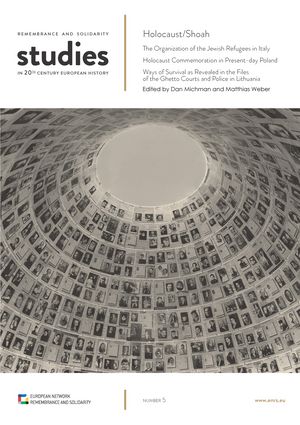
- Remembrance and Solidarity. Studies in 20th-Century European History. Warsaw 2012 onwards.
- Małgorzata Feusette-Czyżewska, Joanna Orłoś, Rafał Rogulski, Zhanna Vrublevska, Edward Assarabowski (eds.): European Remembrance. Symposium of European Institutions dealing with 20th-century History: Lectures, Discussions, Commentaries, 2012–16. Warsaw 2016.
- European Network Remembrance and Solidarity: ENRS. European Network Remembrance and Solidarity. Activities 2015/2016. Warsaw 2016.
Web links
- enrs.eu/ (ENRS website)
- www.bkge.de/Downloads/Projekte/Declaration-ENRS-2005.pdf?m=1562054245& (2005 Declaration on the Founding of the ENRS)
- www.europeanremembrance.enrs.eu/ (ENRS symposia website)
- www.bkge.de/Projekte/Europaeisches_Netzwerk_Erinnerung_und_Solidaritaet/ (Website of the Federal Institute for Culture and History of the Germans in Eastern Europe – information about the ENRS)
- www.facebook.com/enrs.eu/ (ENRS Facebook page)
- twitter.com/enrs_eu?lang=de (ENRS Twitter page)
Notes
[1] “Declaration of Intent by the Ministers of Culture of Germany, Poland, Slovakia and Hungary on the Establishment of the European Network of Remembrance and Solidarity, Warsaw, 2 February 2005”, in: Troebst: Discourse on Expulsion and European Culture of Remembrance. pp. 216–218.
[2] Cf. Büttner, Delius: *World Culture in European Memory Politics?*, p. 399.
[3] Troebst: ‘Towards a European Memory of Forced Migration?’, pp. 234, 239.
[4] Sierp, Wüstenberg: Linking the Local and the Transnational, p. 327.
[5] See ‘Remembering Displacement Across Europe – Together, Not Separately’, 2007: library.fes.de/pdf-files/historiker/04713.pdf
[6] Machcewicz: A Network from a Polish Perspective, pp. 147–150.
[7] Troebst: ‘Towards a European Memory of Forced Migration?’, pp. 239ff.
[8] Büttner, Delius: ‘World Culture in European Memory Politics?’, pp. 397ff.; European Network Remembrance and Solidarity: ENRS. Activities 2015/2016, pp. 13ff.
Citation
Vincent Regente: European Network Remembrance and Solidarity. In: Online Encyclopaedia on the Culture and History of Germans in Eastern Europe, 2017. URL: ome-lexikon.uni-oldenburg.de/p51272 (as at 2 July 2019).
Terms of use for this article
Copyright © University of Oldenburg and the Federal Institute for the Culture and History of Germans in Eastern Europe (BKGE), all rights reserved. This work was produced as part of the project ‘Online Encyclopaedia on the Culture and History of Germans in Eastern Europe’ and may be reproduced and published provided the rights holders’ consent has been obtained. Please contact:
If you have any specialist comments or additions to the text, please contact the editorial team, citing relevant literature and source references.