

Neumarkt in Silesia/Środa Śląska
Neumarkt in Silesia/Środa Śląska
Etymology
The Polish place name is derived from the day of the week ‘Wednesday’ (Polish: środa), which was market day in the town. The German name also refers to the town’s role as a trading centre.
Location
Neumarkt is situated at 51° 9' north latitude and 16° 35' east longitude, approximately 30 km west of Breslau/Wrocław.
Topography
The town lies on the Neumarkt Plateau, which stretches between the Oder (Odra), the Katzbach (Kaczawa), the Wütende Neiße (Nysa Szalona) and the Striegauer Wasser (Strzegomka). The Neumarkter Wasser (Średzka Woda), a tributary of the Oder, flows through the town.
Political and administrative affiliation
Poland. Neumarkt is situated in the Lower Silesian Voivodeship and is the capital of the Neumarkt district (Powiat Środa Śląska).
Common symbolism
The coat of arms consists of two parts: the right-hand white field depicts a vine with three shoots and four leaves, a reference to the region’s wine-growing tradition. In the left-hand field, a half Silesian eagle is depicted on a gold background. The coat of arms has been in use since the 14th century.
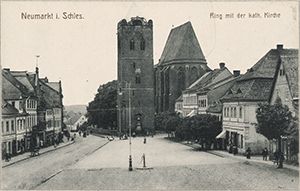
Neumarkt/Środa Śląska with the Catholic parish church of St Mary’s (
) (postcard: before 1945) [Herder Institute,
Marburg, image archive, Inv. No. 236346].
Middle Ages
Owing to its favourable location on the Hohe Straße (Via Regia), a market settlement sprang up in the 12th century on the site of what would later become Neumarkt. The town was probably founded in 1211 (first mentioned as a ‘civitas’ in 1238). The combination of earlier Flemish town charters with Magdeburg law – renewed in 1235 by Henry the Bearded, Duke of Wrocław – became a model for many Polish town foundations under the so-called Neumarkt law. There is evidence of a castellan’s castle in the town dating from 1266, serving as the seat of the ducal governor. Following the death of Duke Henry IV in 1335, Neumarkt, along with the Duchy of Breslau, passed to the Bohemian Crown, and the castle became the seat of a captain. During the Hussite invasion of 1428, the town was plundered and pillaged.
Modern times
In 1570, the town council acquired the hereditary bailiwick and thereby took over the administration of the town. During the Thirty Years’ War, the town suffered severe destruction, caused mainly by major fires in 1633–34 and 1641. In 1741, the town came under Prussian administration. Neumarkt and its population were severely affected during the Seven Years’ War in 1757–58, when an epidemic broke out in the town, and during the Napoleonic Wars. Following the Prussian administrative reform of 1816, Neumarkt became the capital of the district of Neumarkt.
Contemporary History
In February 1945, the Soviet Army captured Neumarkt; in April, it was handed over to the Polish administration. Displaced persons from the former Polish eastern territories settled there in place of the expelled German inhabitants.
Economy
During the 15th and 16th centuries, Neumarkt experienced an economic boom in trade and crafts. In the Middle Ages and the early modern period, the town was a centre for wine-growing; the wines produced here were among the finest in Silesia. Whilst still under Habsburg rule, a tobacco factory was established in 1711, marking the start of intensive tobacco and cigarette production in the 19th century. A porcelain factory was founded in 1742, followed by a silk factory in 1750. The railway line between Breslau and Liegnitz/Legnica, which opened in 1843, initially ran a few kilometres away from the town; it was not until 1926 that a narrow-gauge railway was built to connect it.
Following German reunification, several foreign companies, including those in the automotive sector and a factory belonging to the Coca-Cola Group, have established themselves in Neumarkt. For some years now, the tradition of winegrowing has been revived in the region.
Population trends
In 1621, Neumarkt had a population of 4,071.[1] As a result of the hostilities and economic decline in the 17th and 18th centuries, the population fell to 1,774 by 1749. With industrialisation and the economic upturn of the 19th century, the population rose again, reaching 3,075 by 1825 and 5,860 by 1890.[2] In 1939, following the incorporation of Flämischdorf, Probstei and Pfaffendorf, the town had a population of 6,420.[3] Today, 9,239 people live in Neumarkt (as of 2012).[4]
History of Religion and the Church
The Reformation was introduced in Neumarkt in 1523. The Franciscan church became Protestant in 1527, and the monastery was converted into a municipal almshouse. After 1654, as part of the Counter-Reformation, the parish church and the monastery church were returned to the Catholics; in 1675, the Franciscans moved back into the monastery, where they remained until secularisation in 1812. Until the Second World War, the majority of the inhabitants were of the Protestant faith (in the district: 51 per cent in 1890, 60 per cent in 1939).[5]
Documented references to Jewish life in Neumarkt date back to the 14th century. Around the middle of that century, pogroms took place in the town, followed by the expulsion of the Jewish population. It was not until 1812 that Jews settled in Neumarkt again. A Jewish community was founded in the same year, and the synagogue was built in 1862. In 1890, the community had 86 members; by 1933, the number had fallen to 62.[6]
Special cultural institutions
The City Museum opened in 1920 and has been housed in the Church of the Holy Trinity since 1935. After the Second World War, the museum resumed its work in 1964, initially as a museum of woodcraft, and today as the Regional Museum (Muzeum Regionalne), based in the Gothic Town Hall.
The most important collection is the so-called Neumarkt Treasure, discovered during building works in 1985, consisting of coins and jewellery, the oldest of which date from around 1200. The most valuable item is an eagle-adorned crown from the early 14th century, which may have belonged to Emperor Charles IV’s first wife, Blanca de Valois. Charles IV presumably pawned the objects to the Jewish merchant Muscho, who is thought to have buried them in the context of the epidemics and the anti-Jewish pogrom in Neumarkt around 1350.
Art History and Architecture
The medieval town centre is roughly square in shape, with the Ring and the town hall at its centre. The late 13th-century town walls were dismantled at the beginning of the 19th century and the five gates were demolished. In the north-western part of the town, remains of the medieval castellan’s castle – which was demolished at the beginning of the 19th century – have been preserved. It belonged to the Bohemian Crown from 1335 and was later owned by various magnates. The district court was built on the site in 1896.
The parish church of St Andrew was built from 1248 onwards as a brick basilica on the site of a previous building. The Gothic chancel was added in the 1380s. Around 1500, the church belonged to the Breslau Order of the Holy Cross with the Red Star. From 1540 to 1654, it was Protestant. Between 1670 and 1675, it was given a Baroque makeover as part of the Counter-Reformation; features that have been preserved include the high altar with sculptures by Tobias Stahlmeyster and a painting by Georg Wilhelm Neunhertz. The neo-Gothic twin-tower façade was built in 1828, whilst the free-standing, rectangular brick bell tower (watchtower) dates from the mid-14th century.
The Church of the Nativity of Mary, founded around 1234 by Henry the Bearded and his wife Hedwig, who was later canonised, was originally part of the leper hospital. Between 1349 and 1535, the church belonged to the Benedictines, P.p. the nave was built in the Gothic style during the second half of the 14th century. Converted into a municipal armoury in 1816, the building regained its religious function in 1871. Following damage in 1945, the church was not rebuilt until 1983, during which time elements of the original Romanesque structure were discovered.
The Franciscan Church of the Exaltation of the Holy Cross (formerly a monastery church, now a parish church) was built between 1378 and the mid-15th century as a three-nave brick hall church on the site of a previous building. Following secularisation in 1810, it served as a warehouse. In 1933, it was adapted for worship once more by the Protestant congregation, based on a project by Paul Klein.
The Gothic town hall was built in the decades around 1400 on the site of the former merchants’ guildhalls, parts of whose premises in the central block have been preserved. In the second half of the 16th century, the building was rebuilt in the Renaissance style. The most recent renovation work took place in 1983–84. The two-storey brick building, with a square tower to the west, extends in an ‘L’ shape around a small inner courtyard. The Gothic gable of the south façade is decorated with polychrome paintings (reconstructed in 1997); Gothic and Mannerist polychromes have also been uncovered in the interior.
Bibliography
- Beata Lejman: Środa Śląska/Neumarkt. In: Ernst Badstübner, Dietmar Popp, Andrzej Tomaszewski, Dethard von Winterfeld (eds.), Sławomir Brzezicki, Christine Nielsen (eds.): Dehio Handbook of Art Monuments in Poland. Silesia. Munich, Berlin 2005, pp. 919–924.
- Jerzy Pietrusiński: Royal jewellery from the Luxembourg treasury in the Neumarkt in Silesia gold hoard. In: King John of Luxembourg (1296–1346) and the art of his era. Prague 1998, pp. 189–200.
- Hugo Weczerka: Neumarkt. In: Ibid. (ed.): Handbook of Historical Sites. Silesia. Stuttgart 1977 (Kröners Taschenausgabe 316), pp. 342–347.
Web links
- dksrodaslaska.pl/ (House of Culture/Dom Kultury in Neumarkt in Silesia)
- www.herder-institut.de/bildkatalog/wikidata/Q387307 (Images of Neumarkt/Środa Śląska in the image archive of the Herder Institute, Marburg)
Notes
[1] See Weczerka: Neumarkt, p. 346.
[2] Figures according to Michael Rademacher: A History of German Administration from the Unification of the German Empire in 1871 to Reunification in 1990. URL: treemagic.org/rademacher/www.verwaltungsgeschichte.de/ (accessed 18 June 2013).
[3] Weczerka: Neumarkt, p. 346.
[4] As at 30 June 2012. Central Statistical Office (GUS), www.stat.gov.pl/cps/rde/xbcr/gus/l_ludnosc_stan_struktura_30062012.pdf (accessed 18 June 2013).
[5] treemagic.org/rademacher/www.verwaltungsgeschichte.de/ (note 2).
[6] Online portal on the history of the Jews in Poland: www.sztetl.org.pl/pl/city/sroda-slaska/ (accessed 18 June 2013).
Citation
Beata Lejman/Tomasz Torbus: Neumarkt/Środa Śląska. In: Online Encyclopaedia on the Culture and History of Germans in Eastern Europe, 2013. URL: ome-lexikon.uni-oldenburg.de/p32273 (as at 30 July 2021).
Terms of use for this article
Copyright © University of Oldenburg and the Federal Institute for the Culture and History of Germans in Eastern Europe (BKGE), all rights reserved. This work was produced as part of the project ‘Online Encyclopaedia on the Culture and History of Germans in Eastern Europe’ and may be reproduced and published provided the rights holders’ consent has been obtained. Please contact:
If you have any specialist comments or additions to the text, please contact the editorial team, citing relevant literature and source references.