

Schneidemühl/Piła
Schneidemühl/Piła
Political and administrative affiliation
Republic of Poland, capital of the Schneidemühl district (Powiat Piła) in the Greater Poland Voivodeship (Województwo wielkopolskie).
Common symbolism
The town’s coat of arms depicts a red stag leaping across green fields on a white (silver) background. In 1605, the heraldic animal was granted a golden crown by Queen Constance of Poland, the wife of Sigismund III; this addition was presumably a sign of the Queen’s patronage, as she supported numerous building projects in the town.[1] In 1945, the Polish administration adopted the coat of arms, which has been used in a simplified form without the crown since the 1960s. The flag consists of the colours white (silver), red and green arranged horizontally.
Middle Ages
In 1380, ‘Pyla’ was granted a charter which, amongst other things, provided for the construction of a church. Against this background, the year 1380 is also regarded as the town’s year of foundation. The name “Pyla” was first mentioned in a document dating from 1456 in connection with the name “Snydemole”. These were two different settlements: the older Polish settlement of Pyla and the younger German settlement of Snydemole. Both later merged to form a single town.
Modern times
In 1513, ‘Pyla’ was granted Magdeburg city rights by King Sigismund I of Poland. Following the First Partition of Poland in 1772, the town passed to Prussia. Two major fires in 1626 and 1834 destroyed a large part of the town’s historic buildings.
19th century
With the establishment of the Duchy of Warsaw by Napoleon I, Schneidemühl briefly came under Polish rule once again in 1807; following the Congress of Vienna in 1815, it became part of the Prussian Province of Posen, belonging to the administrative district of Bromberg and the county of Chodziesen (later Kolmar).[2] Following the opening of the Prussian Eastern Railway in 1851, the town developed into an important railway junction.
20th century
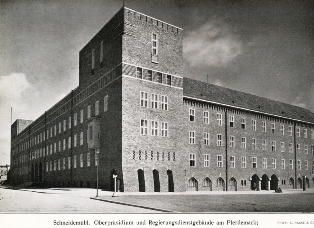
Schneidemühl, the Regional Council and Government Office building at Pferdemarkt [Photo: Images from *
* *Grenzmark*, Berlin 1931, p. 7].

In 1914, Schneidemühl seceded from the district of Kolmar and became an independent municipal district. As a result of the Treaty of Versailles, large parts of the provinces of Posen and West Prussia were ceded by the German Empire to Poland; Schneidemühl remained part of Germany, became a border town and, in 1922, the capital of the newly formed province of Grenzmark Posen-Westpreußen, comprising the northern and western parts of the province of Posen and the western part of the province of Westpreußen.[3] In 1938, the already controversial and uneconomical conglomerate that was the Province of Posen-West Prussia Border Region was annexed to the neighbouring provinces; Schneidemühl became part of the Province of Pomerania and was designated the capital of the Posen-West Prussia Border Region administrative district. During the Second World War, 72 per cent of the town – and around 90 per cent of all buildings in the centre – were destroyed. On 14 February 1945, the Red Army occupied the town. In April 1945, Schneidemühl was incorporated into the Polish Poznań Voivodeship (Województwo poznańskie). Between 1946 and 1975, it was the capital of a district, and from 1975 to 1998 it was the capital of the Piła Voivodeship (Województwo pilskie). Since 1999, Schneidemühl has once again been the capital of the district of the same name in the Greater Poland Voivodeship (Województwo wielkopolskie).
Population and Economy
In 1774, Schneidemühl had 1,322 inhabitants.[4] Under Prussian administration after 1772, and particularly following the opening of the Ostbahn railway in 1851, the town experienced a significant boom, with the population reaching 19,655 by 1900. The proportion of the Polish population fell from over 50 per cent to less than 5 per cent.[5] Thanks to the good rail links to Berlin, numerous industrial enterprises set up in the town; in 1914, a large branch of Albatros Flugzeugwerke was established here. Schneidemühl also became an important aircraft base. In 1915, the population reached 28,457.[6] When Schneidemühl was elevated to the status of provincial capital in 1922 and numerous authorities and institutions established themselves there, the population also rose due to the influx of resettlers from Poland:[7] In 1939, the town had a population of 45,791, of whom 155 were Jewish.[8] In 1940, 160 Jews were arrested in Schneidemühl; they were later deported and murdered.[9] Between 1939 and 1945, 5,262 residents lost their lives; the fate of a further 10,521 remains unknown.[10] In 1945, there was an almost complete population exchange. The German inhabitants were largely expelled.
After the town was designated the capital of the voivodeship, its population grew to 71,000 by 1990. In the 2002 national census, 121 people declared a nationality other than Polish, 47 of whom identified as German.[11]
Architecture
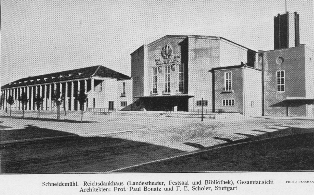
Reichsdankhaus Schneidemühl, architects: Paul
Bonatz, F. E. Scholer [Photo: Bilder aus der Grenzmark,
Berlin 1931, p. 11].

The well-preserved buildings from the interwar period are of architectural significance. One of the largest building projects was the development at Danziger Platz (formerly Pferdemarkt; pl. Plac Stanisława Staszica) in the city centre near the main railway station, designed by the German architects Paul Bonatz, German Bestelmeyer and Peter Behrens.[12] Surrounding a rectangular square were the Government Building, the Consistory, the Finance and Main Customs Office, and the ‘Reichsdankhaus’, comprising a hall and theatre complex with an adjoining library building.[13] In addition, numerous residential buildings, new schools (the Freiherr-vom-Stein Grammar School), churches (St Anthony’s Church) and other public buildings were constructed in the town. In terms of social housing, Schneidemühl surpassed all towns of a similar size in Germany during the interwar period.[14]
Culture of memory and remembrance
The displaced persons and some of their descendants are now organised within the Heimatkreis Schneidemühl e. V., based in Cuxhaven, and act as publishers of the *Schneidemühler Heimatbrief *. In 1992, the “Deutsche Sozial-Kulturelle Gesellschaft in Schneidemühl” (German Social and Cultural Society in Schneidemühl) was founded. It fosters cooperation with supporting and partner organisations abroad, as well as with the city of Cuxhaven, which has been Schneidemühl’s twin town since 1957.
Bibliography
- Pictures from the Posen-West Prussia Border Region. Berlin 1931.
- Karl Boese: History of the Town of Schneidemühl. Special issue of the Grenzmärkische Heimatblätter. Schneidemühl 1935.
- Zygmunt Boras, Zbigniew Dworecki: Piła. An Outline of History (up to 1945). Piła 1993.
- German Ostbund (ed.), Emanuel Ginschel, Franz Lüdtke (comp.): Ostmark: Mittlere Ostmark, Grenzmark, Posen-West Prussia. Berlin 1927 (German Urban Development).
- W. Hildt: Schneidemühl. Berlin et al. 1929 (The German City).
- Józef Kokot: The Plight of the Prussian Eastern Provinces. Warsaw 1958 (German Testimonies 3).
- Municipal Council (ed.), Max Reichardt (comp.): Schneidemühl. The Capital of the Province of Grenzmark Posen-West Prussia. Berlin 1930.
- Schneidemühl Local History Society (ed.): Schneidemühl: Border and Administrative Town, Then and Now. Cuxhaven 1979.
- Heimatkreis Schneidemühl e. V. (ed.): Schneidemühl: Border and Administrative Town. A Chronology of the History of the Town of Schneidemühl. Bielefeld 1998.
- Marek Fijałkowski, Tomasz Wola: Z dziejów Kościoła Ewangelickiego w Pile [From the History of the Evangelical Church in Schneidemühl]. Piła 2009.
Web links
- www.pila.pl (Official website of the town)
- https://schneidemuehl.net/ ( Heimatkreis Schneidemühl e. V.)
- www.herder-institut.de/bildkatalog/wikidata/Q556200 (Images relating to Schneidemühl/Piła from the Herder Institute’s image archive, Marburg)
Notes
[1] R. P. Becker: A Brief History of the Political Municipality. In: Magistrat (ed.), Reichardt (comp.): Schneidemühl, p. 8.
[2] Becker (as in note 1), pp. 8–23.
[3] The formation of this conglomerate was driven exclusively by political motives and was intended to demonstrate the claim for revision of the German–Polish border as laid down in the Treaty of Versailles. See Ingo Materna, Wolfgang Ribbe (eds.): History of Brandenburg. Berlin 1995, pp. 570–572.
[4] See schneidemuehl.net/geschichte-der-stadt.html (accessed 10 August 2021). From: Heimatkreis Schneidemühl: Border and Administrative Town.
[5] Becker (as in note 1), pp. 22 and 30.
[6] Becker (as in note 1), p. 22.
[7] Becker (as in note 1), p. 30.
[8] Heimatkreis Schneidemühl: Border and Administrative Town, p. 126.
[9] For further information on the deportations of Jews from Schneidemühl, see: www.geocities.ws/schneidemuehl_pila/deportations.html (accessed 22 April 2013).
[10] Commemorative plaque in Brokeswalde/Cuxhaven.
[11] Central Statistical Office.
[12] See also www.dawna.pila.pl/ (old town maps, photographs and films) and www.dawna.pila.pl/czytelnia/plac_gdanski.php (Danziger Platz) (accessed 22 April 2013).
[13] Cf. W. Hildt: ‘The architectural development of the provincial capital Schneidemühl after the World War’. In: Magistrat, Reichardt: Schneidemühl, pp. 32–36.
[14] See Becker (as in note 1), p. 30.
Citation
Joanna Lorenc: Schneidemühl/Piła. In: Online Encyclopaedia on the Culture and History of Germans in Eastern Europe, 2013. URL: ome-lexikon.uni-oldenburg.de/p32249 (as at 30 July 2021).
Terms of use for this article
Copyright © University of Oldenburg and the Federal Institute for the Culture and History of Germans in Eastern Europe (BKGE), all rights reserved. This work was produced as part of the project ‘Online Encyclopaedia on the Culture and History of Germans in Eastern Europe’ and may be reproduced and published provided the rights holders’ consent has been obtained. Please contact:
If you have any specialist comments or additions to the text, please contact the editorial team, citing relevant literature and source references.