

Sarajevo
Sarajevo
Etymology
The name ‘Sarajevo’ is derived from the Turkish word ‘saray’ (= palace) or the Ottoman Turkish expression ‘saray ovası’ (= palace plain).
Nicknames
Owing to its cultural and religious diversity, Sarajevo is also known as the ‘European Jerusalem’.
Location
Sarajevo is situated in central Bosnia at 43° 51′ north latitude and 18° 24′ east longitude.
Topography
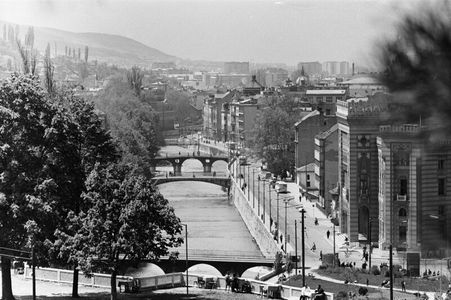
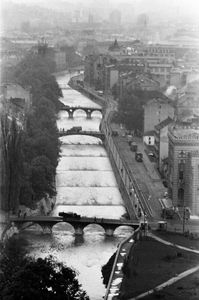
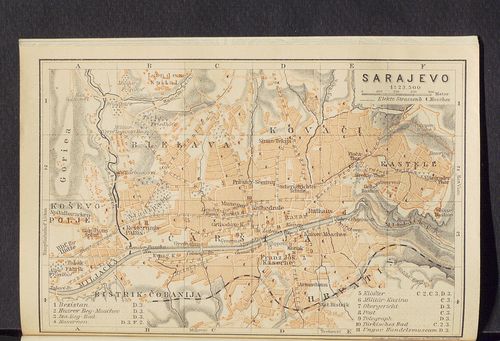
Sarajevo lies in the plain of the same name, 511 metres above sea level, and is flanked by the mountains of Bjelašnica and Igman (to the south-west) and Trebević and Jahorina (to the south-east). The Miljacka river flows through the city from east to west, whilst the Željeznica river runs around its western edge. The latter flows into the Bosna, which rises near the spa town of Ilidža, situated to the west of the city.
Political and administrative affiliation
Sarajevo is the capital and seat of government of the state of Bosnia and Herzegovina. It is also the capital of the ‘Federation of Bosnia and Herzegovina’ (FBiH), one of the two entities (Federal States) of the aforementioned state. Furthermore, the city is the administrative centre of the canton of the same name. It comprises four municipalities: Stari Grad (Old Town), Centar (Centre), Novi Grad (New Town) and Novo Sarajevo (New Sarajevo).
Common symbolism
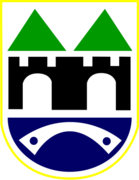
The coat of arms designed by the Imperial and Royal combined the two ‘Moor’s heads’ – the oldest symbols of Bosnia – in the background with a so-called Illyrian shield, on which a crescent moon and an eight-pointed star – the oldest Croatian heraldic motif – were depicted. The use of these heraldic elements was intended to visualise a historical link to the medieval Kingdom of Hungary. This coat of arms was retained until 1965, although the crown above the shield was removed after 1945.
The current coat of arms features, in the upper third, two green triangles on a white background, symbolising the surrounding mountains; in the centre, two black city gates; and below them, a blue river spanned by a white bridge.
Prehistory and Early History
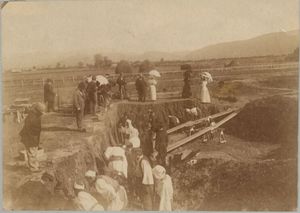
In the 1890s, Neolithic artefacts and structures were unearthed in the headwaters of the Bosna.[1] The culture named after the Butimir site, with its characteristic pottery, is one of the best-known cultures from the period 5200 to 4700 BC on the European continent. Excavations at the mineral springs around the spa town of Ilidža have brought to light the remains of Illyrian settlements as well as traces of a Roman colony.
Middle Ages
In the 7th century, the first Slavs settled in the Sarajevo area. This population was first mentioned in writing in papal documents dating from the 13th century.[2]
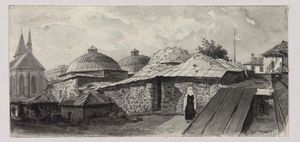
From 1463, following the Ottoman conquest of Bosnia, the city was expanded under the governor Isa-Beg Ishaković (1439–1470), a Bosnian who had converted to Islam. It became the military and administrative centre of the newly founded Sanjak of Bosnia (Turkish: Bosna Sancağı; Bosnian: Bosanski sandžak), which remained a subdivision of the Vilayet (province) of Rumelia until 1580. It also served as a base for further Ottoman expansion. Ishaković commissioned the construction of several key buildings, such as the so-called Imperial Mosque (Bosnian: Careva džamija), the bazaar, the hamam, the caravanserai and the fortress, thereby giving Sarajevo the basic structure of an Ottoman city.[3] By 1660, approximately 80,000 people lived in the city, including a community of Sephardic Jews; they had settled here following their expulsion from Spain in the mid-16th century. During this period of Ottoman prosperity, numerous mosques were built, as well as other religious buildings, including the old Orthodox church and, in 1581, the Sephardic synagogue (Kal Vježu / Stari Hram).[4] In 1697, during the so-called Great Turkish War (1683–1699), the town was extensively destroyed by the troops of Prince Eugene of Savoy (1663–1736).
After the imperial troops withdrew, the city was rebuilt. However, the crisis within the Ottoman Empire also had an impact on Sarajevo’s development. Whilst Travnik was the centre and seat of the Ottoman governor, the vizier, the Janissaries were stationed in Sarajevo.
Modern times
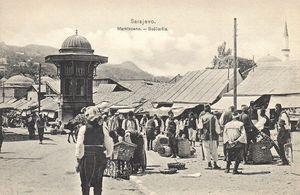
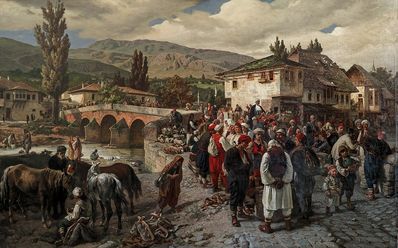
During the conflicts that shook the Balkans and the Ottoman Empire in the 19th century, the city became the administrative centre of the Sandžak of Bosnia, a part of the Vilayet of Bosnia established in 1865. Despite the reforms of the Tanzimat period (1839–1876), Sarajevo remained a city with a distinctively Oriental character. Coexistence between the Orthodox, Catholic, Muslim and Jewish inhabitants and the Ottoman administrative elite was fraught with conflict. Tensions escalated on various occasions, such as in 1872 in connection with the construction of the Greek Orthodox cathedral.[5]In 1875, uprisings by the predominantly Serbian Orthodox peasantry against the heavy tax burden in the vilayet heralded the end of the Ottoman phase of the city’s history. Serbia and Montenegro subsequently declared war on the Ottoman Empire. In the course of the negotiations to end the Balkan Crisis at the Congress of Berlin in 1878, Austria-Hungary was granted the right to occupy and administer Bosnia and Herzegovina. The Ottoman Sultan , however, retained de jure sovereignty over the province. The occupation of Bosnia-Herzegovina took place against resistance from Muslim irregulars and Serbian Orthodox volunteers. Sarajevo was captured in August 1878 following a siege.
The Austro-Hungarian occupation ushered in a new golden age. Administrative officials, teachers and doctors, as well as all manner of fortune-seekers, flocked to the new provinces from all parts of the Danube Monarchy, as well as from Poland and Russia . Civil servants were also expected to have a knowledge of a Slavic language. Consequently, there were many people from ethnically mixed families, such as Germans with a Croatian background. As a result of this immigration, the city’s population doubled between 1885 and 1910, whilst at the same time new religious groups, such as the strongly German-influenced Lutheran congregation and the Ashkenazi Jews , became established . Thus, Sarajevo developed from a multi-religious Ottoman city at the turn of the century into a multi-ethnic centre of the Austro-Hungarian Monarchy.
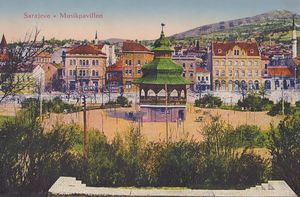
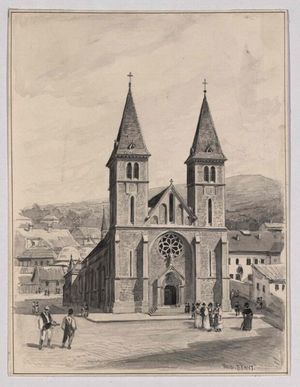
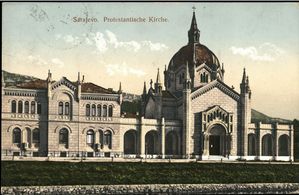
Thanks to the initiatives of Benjámin von Kállay (1839–1903), Imperial Minister of Finance and Civil Administrator of Bosnia and Herzegovina, Sarajevo became the economic, cultural and political centre of Bosnia. In 1895, Sarajevo became one of the first European cities to have an electric tramway. Furthermore, Kállay commissioned the construction of a central railway station. The establishment of new factories, including the tobacco factory which still exists today, led to an economic revival. The appearance of the new provincial capital was significantly shaped by the numerous public and religious buildings designed by Josip Vancaš (1859–1932) and Karel Pařík (1857–1942).[6] These include the provincial government headquarters (1886), the Roman Catholic Cathedral of the Sacred Heart (1889), the Protestant church (1898–1899), the community centre (1897–1898) and the Ashkenazi synagogue (1902).
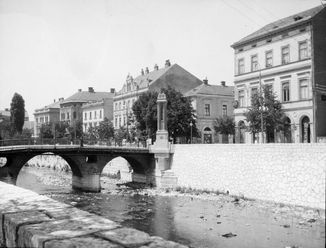
In 1883, Sarajevo was granted limited autonomy as the provincial capital. The 24 seats on the city council were allocated to the various religious denominations on a proportional basis, with twelve seats going to Muslims, six to Orthodox Christians, and three each to Catholics and Jews.[7] In order to counteract the increasing nationalisation of the Serbian Orthodox and Roman Catholic religious communities and the associated influences from neighbouring states (particularly Serbia), Kállay sought to implement the concept of a multi-denominational ‘Bosniak nation’ (“Bošnjaštvo”).[8] However, this idea failed to gain traction as the confessionally defined national movements gained influence . The annexation of Bosnia and Herzegovina on 5 October 1908 escalated the crisis between Serbia and Austria-Hungary. In Sarajevo, numerous members of the revolutionary organisation Young Bosnia (Mlada Bosna) organised protests against the annexation. Among them was Gavrilo Princip (1894–1918), who, on 28 June 1914 – Vidovdan ( St Vitus’ Day, a key Serbian commemorative day) – shot the Austro-Hungarian heir to the throne, Archduke Franz Ferdinand and his wife, Sophie Chotek, Duchess of Hohenberg, whilst they were visiting Sarajevo at the Latin Bridge (Latinska ćuprija).[9] That very evening and the following day, pogrom-like anti-Serbian riots broke out in the city.
The First World War brought about fundamental changes to people’s lives. Many men were conscripted into the Austro-Hungarian Army, whilst at the same time others volunteered to join the Serbian Army. Although the city was spared direct hostilities, a civil war-like atmosphere took hold, in which the Serbian population was subjected to repression.[10] From 1915 onwards, a commissar ruled the city, which was plagued by hunger and deprivation.
Contemporary History
Following the establishment of the Kingdom of Serbs, Croats and Slovenes, Bosnia and Herzegovina was dissolved as an autonomous unit in 1921, and Sarajevo became the administrative centre of the district of the same name. In the course of the state reorganisation in 1929, the city eventually became the capital of the newly created Banovina of Drina (Drinska banovina). However, following years of political, cultural and economic growth, development subsequently stagnated[11] – and the most pressing problems (notably a shortage of housing, a flagging economy, poor hygiene and inadequate healthcare) remained unresolved for the time being.[12]
During the Axis powers’ attack on Yugoslavia on 6 April 1941, the urban area of Sarajevo and the nearby Rajlovac airfield were also targeted.[13] Following the surrender of the Yugoslav Royal Army on 16 April 1941, Yugoslavia was partitioned between Germany, Italy and their allies Hungary and Bulgaria. Sarajevo subsequently became the second-largest city in the Independent State of Croatia ( Nezavisna Država Hrvatska, NDH), which had been established with the support of the German National Socialists , and was situated within the German occupation zone. Following the occupation, there were instances of looting, expulsions and deportations of the Serbian, Jewish and Romani-speaking populations. On 16 April 1941, the Sephardic synagogue (Il Kal Grande) was stormed and part of the building blown up. Subsequently, a mob led by local collaborators set fire to the interior of the building, thereby destroying the collections of the library, the archive and the museum.
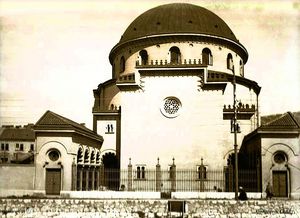
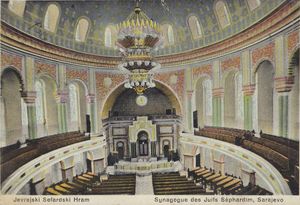
Nevertheless, many residents of Sarajevo endeavoured to protect their fellow citizens who were under threat from the terror of the Croatian Ustaše.[14] In the Sarajevo Resolution of 18 October 1941, Muslim clerics and numerous prominent citizens of the city condemned the Ustasha’s reign of terror[15] and called for equal treatment and protection.[16] Despite all the protests, the Jewish population of Sarajevo was deported between October and November 1941 to the NDH mass extermination camps at Jasenovac and Stara Gradiška. A total of 7,092 people from Sarajevo were murdered in the Shoah.[17] The Ustasha’s reign of terror continued and reached a horrific climax in early 1945 under the ‘bloody tyranny’ of Vjekoslav (Maks) Luburić (1914–1969).
On 6 April 1945, Sarajevo was captured by the Yugoslav People’s Liberation Army under Josip Broz Tito (1892–1980). In the period that followed, the historic province of Bosnia and Herzegovina was re-established as a constituent republic of Yugoslavia , and Sarajevo was designated as its capital. Under communist rule, the city experienced a third golden age, characterised by a far-reaching urban development programme that enabled significant demographic and infrastructural growth. A decisive boost to development came with its selection as the host city for the XIV Winter Olympic Games in 1984.
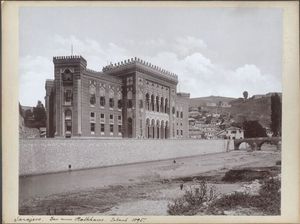
With Bosnia and Herzegovina ’s declaration of independence on 5 March 1992, Sarajevo became the capital of the now sovereign state. As early as 5 April 1992, the siege of the city began, carried out by the Bosnian Serb Army, units of the remaining Yugoslav People’s Army and paramilitary forces, and lasted a total of 1,425 days.[18] A section of the front line ran through the Grbavica district, dividing the city along the Miljacka River. The suffering of the civilian population was alleviated from June 1992 onwards by an airlift organised by the UN. During the siege, numerous buildings were damaged or destroyed, including the former Austro-Hungarian Town Hall, the Vijećnica, which housed the National Library with around two million books.
During the Bosnian War, the siege of Sarajevo sparked worldwide expressions of solidarity and protests calling for intervention by the international community. Following repeated massacres of the civilian population, NATO launched military operations P.p. with the UN against the Bosnian Serb Army in late summer 1995.
Following the signing of the Dayton Peace Agreement on 14 December 1995, Sarajevo remained the capital of the joint state, whilst territorially it remained under the control of the Federation of Bosnia and Herzegovina. As part of the process of territorial reintegration of the city’s districts, most of the Serb inhabitants left the areas that had until then been under the control of the Serb army .[19]
Population
During Ottoman rule , Sarajevo was home mainly to Muslims and Catholic or Orthodox Christians , whose proportion of the total population fluctuated. A significant Sephardic community existed from the 16th century onwards. The first census was not carried out until after the Austro-Hungarian occupation.
Population figures 1885–1910[20]
1885 | 1895 | 1910 |
|---|---|---|
26,268 | 38,083 | 51,919 |
Population by religion 1879–1910[21]
Year | Muslims | Orthodox | Catholics | Jews | Others |
|---|---|---|---|---|---|
1,885 | 15,787 | 4,431 | 3,326 | 2,618 | 106 |
1,895 | 17,158 | 5,858 | 10,672 | 4,058 | 337 |
1,910 | 18,460 | 8,450 | 17,922 | 6,397 | 690 |
In the first post-war census, the city had a population of 113,769. Of these, 40,914 were Serbs, 26,486 were Croats, 39,328 were Muslims and 1,132 belonged to other ethnic groups.[22] Only 470 people identified themselves as German in the 1991 census in Bosnia and Herzegovina.
Population of Sarajevo by ethnicity (2013)[23]
Bosniaks | Croats | Serbs | Not specified | Others | Unknown |
|---|---|---|---|---|---|
222,457 | 13,604 | 10,422 | 6,160 | 22,466 | 415 |
The German-speaking population of Sarajevo
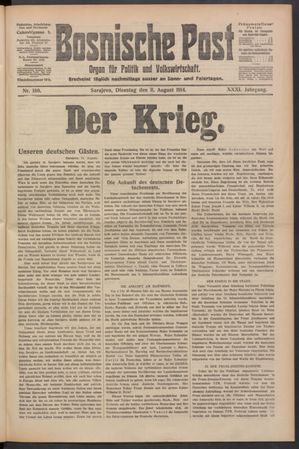
The majority of Sarajevo’s German-speaking population consisted of people who had moved to the new province following the Austro-Hungarian occupation. In 1910, there were 6,495 native German speakers living in the Sarajevo district.[24] However, this did not mean that they defined themselves as German in an ethnic sense, even though they were perceived by the locals as ‘Swabians’. German remained the official language for internal administrative use in Bosnia and Herzegovina until 1918. It was also widely used in the judiciary and in the railway system.25] Two German-language newspapers were published in the city: the *Bosnische Post* (1884–1918) and the *Sarajevoer Tagblatt* (1908–1918).[26] In 1889, Milena Mrazović Preindelsberger (1863–1927) took over ownership of the *Bosnische Post* and, until 1896, served as the province’s first female editor-in-chief, publisher and professional journalist. Through a series of German-language publications, she made an important contribution to spreading knowledge about the folk traditions of Bosnia – much like the ethnologist Jelica Belović-Bernadzikowska (1870–1946), who initially worked in Sarajevo.[27]
The associations newly founded by Sarajevo’s German-speaking residents – including women’s societies, charitable organisations and choral societies – shaped the city’s cultural and social life. A small German garrison theatre was established even before the turn of the century. Cafés and restaurants such as the Grüner Hof and the Marienhof invited orchestras from Vienna to Sarajevo and provided a venue for smaller concerts. From 1898 onwards, larger musical and theatrical performances took place in the newly built clubhouse.
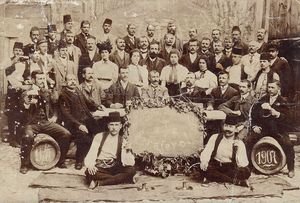
Among the politically active associations, the ‘German Stammtisch’, founded in 1902, deserves special mention. This gave rise in 1908 to the bourgeois, German-nationalist ‘Association of Germans in Bosnia and Herzegovina’. This association saw a sharp rise in membership before 1914, which points to a growing sense of national identity amongst German-speaking immigrants at that time. After the First World War, many Germans were forced to leave the city, including, in particular, military personnel and employees of state institutions. Among them was Georg Grassl (1865–1948). He was the first chairman of the ‘Deutscher Stammtisch’ and a co-founder of the Swabian-German Cultural Association in 1920, an organisation dedicated to fostering German culture and representing the German minority in Yugoslavia. From 1940 onwards, the Cultural Association was organised according to the Führer principle and, under the influence of the Berlin-based Volksdeutsche Mittelstelle, was gradually transformed into the ‘German Ethnic Group’. In 1941, the Sarajevo branch of the Cultural Association had 3,387 members.[28] Locally, Fritz Naschold, as a lecturer at the German Academy, and the German Consul Dr Hugo Gördes (1890–1965) played an important role in disseminating Nazi propaganda . During the war, both held key positions in the intelligence services.[29]
A detailed examination of the involvement of the ethnic Germans in Sarajevo in Nazi crimes has yet to be carried out. Nevertheless, it can be assumed that many of them were involved in deportations and looting due to their prominent positions within the ‘German Mannschaften’ (armed SS units) and as ‘provisional administrators’ of Jewish and Serbian property .[30]
In view of the activities of the Communist partisans and the Chetniks, which were increasingly directed against German villages and the Muslim population in Bosnia , the majority of Bosnian Germans, including those from Sarajevo, were ‘resettled’ in the summer of 1942. As part of the so-called General Plan East, they were later to be resettled near Zamość in the General Government. This plan failed, with the result that most of the evacuees were initially housed in Eastern Slavonia and Eastern Syrmia before eventually being sent to Germany .[31]
Even before the end of the war, following the resolution of the Presidential Board of the Anti-Fascist Council of National Liberation of Yugoslavia (AVNOJ) of 21 November 1944, which established the collective guilt of members of the German minority, systematic persecution of this population group began. Germans had to prove that they had supported the people’s liberation struggle in order to be spared from persecution. The remaining Germans were expropriated, expelled or interned in camps by the Yugoslav Communist authorities, including in Sarajevo.[32] This led to a significant decline in the German population in Sarajevo.
Society
As in other cities of the Ottoman Empire, Sarajevo’s population was religiously, ethnically, linguistically and culturally diverse. Alongside Turkish Muslims, there were South Slavs of both Christian denominations and groups who had converted to Islam, as well as Jews. The communities lived predominantly in their own neighbourhoods (mahale), defined by religious affiliation and social class (guilds). Occasionally, as was the case with the craftsmen, the groups lived side by side.[33] In the 18th century, a Serbian urban elite emerged which no longer relied exclusively on craftsmanship but also on trade.[³⁴] Industrialisation at the end of the 19th century led to an erosion of denominational and religious boundaries. It was in this context that the first workers’ organisations and interdenominational educational institutions emerged. During the interwar period, these rigid religious boundaries were further eroded. The ‘system of parallel societies’ [35] was finally dismantled during the socialist period.
History of Religion and the Church
Population by religion, 1921–1931[36]
Year | Muslims | Orthodox | Catholics | Jews | Protestants | Others |
|---|---|---|---|---|---|---|
1921 | 22,474 | 16,317 | 19,242 | 7,458 | 470 | 205 |
1,931 | 29,649 | 18,630 | 21,372 | not specified | 534 | 7,637 |
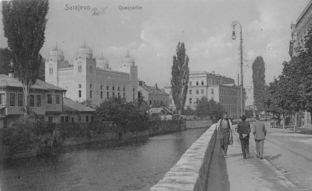
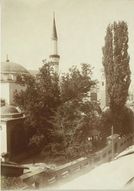
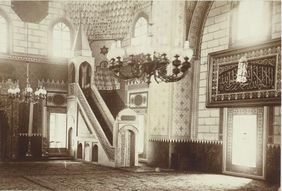
Sarajevo is the seat of the Reis-ul-Ulema, the head of the Muslim community in Bosnia and Herzegovina, Croatia, Serbia and Montenegro, as well as aSerbian Orthodox Metropolitan and a Roman Catholic Archbishop. The rabbi of the Jewish community is non-resident. In the 2013 census, almost 82 per cent of the population identified as Muslim, followed by 4.6 per cent Catholics and 3.8 per cent Orthodox Christians. 8.3 per cent of the population identified as atheists, agnostics or did not wish to declare their religion. 1.6 per cent belonged to other religious communities. Among the city’s notable religious buildings are the Gazi Husrev-Beg Mosque, built in 1531, the old SerbianOrthodox Church , first mentioned in records in 1539, as well as the Catholic Cathedral of the Sacred Heart and the Ashkenazi Synagogue, which serves as the main synagogue of Sarajevo’s Jewish community . In 2000, the King Fahd Mosque, named after the former Saudi ruler, was inaugurated, sparking numerous discussions about the process of re-Islamisation among Bosnian Muslims .
Population of Sarajevo by religious affiliation (2013)[37]
Muslims | Catholics | Serbian Orthodox | Agnostics, atheists, undeclared | Others |
|---|---|---|---|---|
225,088 | 12,608 | 10,532 | 22,871 | 4,425 |
Economy
Sarajevo is the economic centre of Bosnia and Herzegovina. Although numerous businesses were destroyed or closed down during the war and the subsequent transition period, others have managed to survive and are contributing to the country’s continued development. The best known are the pharmaceutical company Bosnalijek, the Sarajevska pivara brewery and the automotive supplier Prevent.
The industrial estates are located in the districts of Vogošća and Hadžići, as well as along the railway line to Mostar.
Special cultural institutions
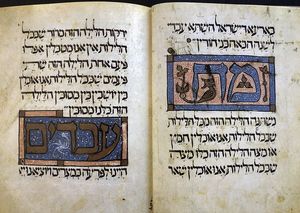
Before the war, Sarajevo was the cultural centre of Bosnia and Herzegovina. The first modern plays were staged as early as the 19th century in the home of the wealthy Despić merchant family. During the occupation, performances took place in the officers’ mess and later in the clubhouse. Following its refurbishment, the building on the banks of the Miljacka served as a venue for the National Theatre, founded in 1921, which was expanded to include opera and ballet in 1946. Following the outbreak of war in 1992, the Sarajevo War Theatre (SARTR, Sarajevski ratni teatar) was established. Among the best-known museums are the National Museum (Zemaljski muzej), which is housed in the complex of the former Provincial Museum completed in 1913, the Historical Museum (Historijski muzej) and the Art Gallery (Umjetnička galerija Bosne i Hercegovine). The National Museum houses the so-called Sarajevo Haggadah, believed to have been produced in Barcelona around 1350, which is one of the oldest surviving examples of medieval Jewish book art from Spain.[38]
Education and Science
Islamic higher education institutions were established as early as the Ottoman period . During the occupation, the Islamic School of Law (1887) and the Catholic and Orthodox higher education institutions (1892) were founded as institutions of higher education. The establishment of the university in 1949 marked a significant upswing.
In November 2000, the Goethe-Institut opened its office in Sarajevo. The institute offers language courses and cultural events with a focus on interfaith understanding.
Everyday culture
In Sarajevo, a variant of the Ijekavian Štokavian dialect is spoken, enriched by numerous Turkish and German loanwords, which have found their way into the language particularly from the fields of technology, administration and cuisine.[39] Bosnian, Croatian and Serbian are recognised as official languages. The Latin and Cyrillic alphabets are used on an equal footing.
Since 1997, the entire city has been on UNESCO’s Tentative List as a ‘unique symbol of universal multiculturalism’, and since 2018, the old Jewish cemetery has also been included. The city’s cultural and culinary offerings attract many tourists, particularly the Ottoman Old Town .
Art History
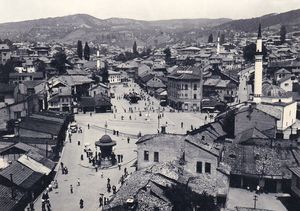
Sarajevo is characterised by a coexistence of numerous architectural styles. Traces of Ottoman influence can be found particularly in the old town of Baščaršija; notable examples include the White Fortress (Bijela tabija, 1550), the two 18th-century city gates – the Višegradska kula and the Kapi kula – and the Latin Bridge (1789) in Bistrik. Many buildings from the Austro-Hungarian period display an Orientalising architectural style, which is sometimes referred to as the so-called ‘Bosnian style’.[40] Prominent examples of this include the former town hall (the Vijećnica, 1891) and the Ashkenazi synagogue (1902). The Historical Museum (1963) is an outstanding example of modern communist architecture, as is the Parliament building (1982), which was destroyed during the siege and subsequently rebuilt.
During the interwar period, only a few significant public buildings were constructed: these include the branch of the State Mortgage Bank (1929–1932, now the Central Bank of Bosnia and Herzegovina), the new Sephardic main synagogue (Il Kal Grande, 1930), the residential and commercial building of the Vakuf of Hovadža Kemaludin (Mekteb), the city’s first modern high-rise (1939), and the Pension Fund building (1941–1943), designed by Muhamed Kadić (1906–1983), a pioneer of modern architecture in Sarajevo.
Examples of modern architecture dating from after the Second World War include the Historical Museum (1963), the UNIS Towers (1986) and the Holiday Inn Hotel (1983).
Music and Film
In the 1980s, Sarajevo emerged as a centre for Yugoslav pop and rock music. ‘Bijelo dugme’, the best-known Yugoslav band , and ‘Zabranjeno pušenje’, who were among the founders of the so-called New Primitivism (Novi primitivizam), had a lasting influence on the Yugoslav music scene. In the 19th century, Sarajevo developed into the centre of the traditional sevdalinka genre. The history of this genre, whose songs mostly deal with unrequited love, longing and melancholy, dates back to the 15th century.
In 1907, the first cinema in Sarajevo opened: Edison’s American Bioscop.[41] Following its destruction by fire in 1912, the Valić family built and opened the Apollo Cinema Theatre and produced the first domestic films. Anton Valić also filmed Franz Ferdinand’s visit and the riots that followed the assassination. During the socialist period, three film companies were founded: Bosna Film, Studio Film and Sutjeska Film. Numerous filmmakers shot their well-known films in the city, for example Emir Kusturica (born 1954) *Sjećaš li se Dolly Bell* [Do You Remember Dolly Bell?, 1981] and *Otac na službenom putu* [Dad’s on a Business Trip, 1985].
After the Bosnian War, many directors addressed the siege of Sarajevo. The city served as the setting for films by Dino Mustafić (b. 1969), *Remake* (2003), Ademir Kenović (b. 1950), *Svršeni krug* [The Perfect Circle] (1997) and Jasmila Žbanić (b. 1974), who won the Golden Bear in 2006 for *Grbavica* [Esma’s Secret].
In protest against the siege, the Sarajevo Film Festival was founded in 1995 and has since developed into a major regional event.
Bibliography
Among the best-known female writers are Umihana Čuvidina (1794–1870), who was the first poet to write in Bosnian, and Laura Papo Bohoreta (1891–1942), who published her works in Ladino, the Judeo-Spanish language.[42] Ivo Andrić (1892–1975), who later won the Nobel Prize in Literature, attended grammar school in Sarajevo and wrote his first works there. During the socialist era, numerous well-known writers lived in the city, including Meša Selimović (1910–1982), Izet Sarajlić (1930–2002), Dario Džamonja (1955–2001), Nasiha Kapidžić-Hadžić (1932–1995), Vojka Smiljanić-Đikić (1932–2016), Miodrag Žalica (1926–1992) and Abdulah Sidran (1944–2024), who have created a literary legacy for the city through their works. For the American writer of Bosnian-Herzegovinian origin, Aleksandar Hemon (born 1964), his birthplace plays a central role, particularly in reconstructing a fragile memory of life in the city before the war and exile.
Miljenko Jergović (born 1966, winner of the 2026 Leipzig Book Award for European Understanding), Alma Lazarevska (born 1957), Marko Vešović (1945–1923), Semezdin Mehmedinović (born 1960) and Dževad Karahasan (1953–2023) in their books *Marlboro Sarajevo*, ‘Death in the Museum of Modern Art’, ‘Death Is a Master from Serbia’, ‘Sarajevo Blues’ and ‘Diary of Exile’. International artists such as Susan Sontag (1933–2004) and Joe Sacco (born 1960) also addressed the siege in their works, such as ‘Regarding the Suffering of Others’ and ‘The Fixer’.
Culture of memory and remembrance
The assassination of 28 June 1914 plays a central role in Sarajevo’s culture of remembrance. The ways in which this event is commemorated have changed over time, partly depending on the political circumstances of the day: for instance, the Atonement Monument, erected in 1917 by the Austro-Hungarian authorities, was dismantled at the end of 1918 by the newly formed Kingdom of Yugoslavia . In 1930, a commemorative plaque was installed on the Lateiner Bridge in memory of the conspirators of Mlada Bosna. Nine years later, a chapel was consecrated to the ‘Vidovdan heroes’ at the Orthodox cemetery , and the remains of those involved in the assassination were reburied in its crypt. Immediately after the Wehrmacht’s invasion in 1941, the commemorative plaque on the Latin Bridge was removed by a group of Yugoslav ethnic Germans under the supervision of Wehrmacht officers and sent to Adolf Hitler as a birthday present. Following the liberation of Sarajevo by Tito’s partisans on 6 April 1945, a new commemorative plaque was erected at the site of the assassination, and the bridge was later named after Gavrilo Princip.
Another important landmark in the city’s culture of remembrance is 6 April. On this day in 1941, the Second World War began in Yugoslavia with the bombing of Belgrade and the nearby town of Rajlovac. Four years later, on 6 April 1945, troops of the People’s Liberation Army liberated Sarajevo from German occupation and the Ustaše. Furthermore, the siege of Sarajevo began one day before 6 April 1992. Since 1956, the 6 April Prize has been awarded annually by the Sarajevo City Assembly to outstanding individuals who have rendered outstanding services to the city’s development.
Bibliography
- Johann von Asbóth: Bosnia and Herzegovina. Travel Sketches and Studies, Vienna 1888.
Robert J. Donia: Sarajevo: A Biography. London 2006. - Emily Gunzburger Makaš: Sarajevo. In: Ibid., Tanja Damljanovic Conley (eds.): Capital Cities in the Aftermath of Empires: Planning in Central and South-Eastern Europe. London 2010, pp. 241–257.
- Emily Greble: Sarajevo, 1941–1945. Muslims, Christians, and Jews in Hitler’s Europe. New York 2011.
- Miljenko Jergović: The Unheard-of Story of My Family. Frankfurt am Main 2017.
- Miljenko Jergović: The Crazy Heart. Sarajevo Marlboro Remastered. Short Stories. Frankfurt am Main 2024.
- Holm Sundhaussen: Sarajevo. The History of a City. Vienna et al. 2014.
- Maximilian Hartmuth: Between Vienna and Istanbul: Imperial Legacies, Visual Identities, and ‘Popular’ and ‘High’ Layers of Architectural Discourse in/on Sarajevo, c. 1900 and 2000. In: Ibid., Tea Sindbaek (ed.): Images of Imperial Legacy. Modern Discourses on the Social and Cultural Impact of Ottoman and Habsburg Rule in South-East Europe. Berlin 2011, pp. 79–104.
- Barbara Demick: The Roses of Sarajevo: A Story of War. Munich 2012 (Original: Logavina Street: Life and Death in a Sarajevo Neighbourhood. Kansas City 1996).
- Semezdin Mehmedinović: Sarajevo Blues. San Francisco 1998.
- Mary Sparks: The Development of Austro-Hungarian Sarajevo, 1878–1918: An Urban History. London et al. 2014.
Web links
- Official website of the town: https://www.sarajevo.ba/
- Website of the War Children’s Museum: https://warchildhood.org/permanent-exhibition-sarajevo/
- Article by Ljubinka Petrović-Ziemer on the culture of remembrance in Sarajevo: https://www.cultures-of-history.uni-jena.de/debates/cultures-of-remembrance-in-sarajevo
Notes
[1] Robert Hofmann: Okolište 2 – Studies on a Late Neolithic settlement area in Central Bosnia. Bonn 2013 (University Research on Prehistoric Archaeology 234). pp. 23–24.
[2] Holm Sundhaussen: Sarajevo. The History of a City. Vienna et al. 2014, p. 21.
[3] Behija Zlatar: The Golden Age of Sarajevo. The 16th Century [Sarajevo’s Golden Age. The 16th Century]. Sarajevo 1996, p. 29.
[4] Francine Friedman: Like Salt for Bread: The Jews of Bosnia and Herzegovina. Leiden 2021, pp. 97–101.
[5] Robert J. Donia: Sarajevo: A Biography. Ann Arbor, Mich. 2006, p. 34.
[6] Sabina Ferhadbegović: Projections and Representations of Statehood. In: Włodzimierz Borodziej, Sabina Ferhadbegović, Joachim von Puttkamer (eds.): The Routledge History Handbook of Central and Eastern Europe in the Twentieth Century: Volume 2, Statehood. London 2020, p. 1.
[7] Sundhaussen: Sarajevo, p. 200.
[8] Imre Ress: An Attempt at Nation-Building at the Turn of the Century. Benjámin Kállay’s Concept of the Bosnian Nation. In: Endre Kiss, Justin Stagl (eds.): Nation and Nation-Building in Austria-Hungary 1848–1938. Principles and Methods. Vienna 2006 (Sociology: Research and Science 21), pp. 59–72.
[9] For more on the assassins, see Christopher Clark: *The Sleepwalkers: How Europe Went to War in 1914*. London 2012, pp. 49ff.
[10] Heiner Grunert: The Inner Enemy: The Habsburg State and its Serb Citizens in Herzegovina 1913–1918. In: Mark Cornwall (ed.): Sarajevo 1914. Sparking the First World War. London 2020, pp. 253–273.
[11] Donia: Sarajevo, p. 130.
[12] Sabina Ferhadbegović: Precarious Integration. The Serbian State Model and Regional Self-Government in Sarajevo and Zagreb 1918–1929. Munich 2008 (Southeast European Studies 138), p. 248.
[13] The Sephardic synagogue Il Kal Nuevu was also damaged in the air raid. See Friedman: Like Salt, p. 376.
[14] Emily Greble: Sarajevo, 1941–1945. Muslims, Christians, and Jews in Hitler’s Europe. Ithaka 2011, p. 238.
[15] On the one hand, there were demands from Sarajevo’s autonomists to put an end to the activities of the Ustaše. On the other hand, there were calls for the creation of an autonomous entity, known as the ‘Community of Bosnia’, with its seat in Sarajevo. To this end, they sought the support of the Nazi regime in Berlin. As a result, numerous Bosnian Muslims joined the various units of the Wehrmacht and the SS. Greble: Sarajevo, pp. 126–127.
[16] Cetin Onder: ‘1941 Resolutions of El-Hidaje in Bosnia and Herzegovina as a Case of Traditional Conflict Transformation’. In: European Journal of Economic and Political Studies 3 (2010), 2, pp. 73–83.
[17] Donia: Sarajevo, p. 210; Alexander Korb: In the Shadow of the World War: Mass Violence by the Ustaša against Serbs, Jews and Roma in Croatia 1941–1945. Hamburg 2013, pp. 200–202.
[18] Final report of the United Nations Commission of Experts established pursuant to Security Council Resolution 780 (1992), Annex VI – Part 1: Study of the Battle and Siege of Sarajevo. URL: web.archive.org/web/20010222115037/http://www.ess.uwe.ac.uk/comexpert/ANX/VI-01.htm (accessed 13 October 2021).
[19] Ondřej Žíla: The Flight of Serbs from Sarajevo: Not the Dayton Agreement’s First Failure, but its First Logical Consequence. In: Nationalities Papers 49 (2021) 5, pp. 967–985
[20] The Results of the Census in Bosnia and Herzegovina of 10 October 1910, Sarajevo 1912, p. XVI.
[21] The Results of the Census in Bosnia and Herzegovina of 10 October 1910. Sarajevo 1912, p. XLI.
[22] Federal Statistical Office (ed.): Population by Ethnic Nationality. Final Results of the Population Census of 15 March 1948. Volume IX. Population by Nationality: Final Results of the Population Census of 15 March 1948, Book IX [Population by Nationality: Final Results of the Population Census of 15 March 1948]. Belgrade 1954, p. 431.
[23] Federal Statistical Office (ed.): Census of Population, Households and Dwellings in Bosnia and Herzegovina 2013. / Census of Population, Households and Dwellings in Bosnia and Herzegovina 2013, cited here from www.statistika.ba (accessed 18 October 2021).
[24] The results of the census in Bosnia and Herzegovina of 10 October 1910. Sarajevo 1912, p. L. According to the census results, the relative proportion of Germans within the urban population was 10–11 per cent, which for Sarajevo would amount to approximately 5,451 people, p. LI. See also Carl Bethke: Bosnia and Herzegovina.
[25] Carl Bethke: Chapter 6 ‘The Bosnische Post: A Newspaper in Sarajevo, 1884–1903’. In: Markian Prokopovych, Carl Bethke, and Tamara Scheer (eds.), Language Diversity in the Late Habsburg Empire. Leiden 2019, pp. 87–114, here pp. 87–89. doi: doi.org/10.1163/9789004407978_007 (accessed 3 September 2024).
[26] Carl Bethke: Chapter 6 ‘The Bosnische Post: A Newspaper in Sarajevo, 1884–1903’. In: Markian Prokopovych, Carl Bethke, and Tamara Scheer (eds.), Language Diversity in the Late Habsburg Empire. Leiden 2019; doi: doi.org/10.1163/9789004407978_007 (accessed 3 September 2024).
[27] Mirjana Stančić: Buried Literature: German-language Poetry in the Territory of the Former Yugoslavia from 1800 to 1945. Vienna [et al.] 2013, pp. 124–125.
[28] Tomislav Išek: Djelatnost Kulturbunda i Folksdojčera [The Activities of the Kulturbund and the Volksdeutsche]. In: Nisim Albahari (ed.), Sarajevo u revoluciji [Sarajevo during the Revolution], vol. 2, Sarajevo 1977, p. 282.
[29] Historical studies on German actors and their involvement in the Nazi occupation of Sarajevo are virtually non-existent. In older Yugoslav studies, figures such as Gördes and Naschold are mentioned in isolated instances, often with reference to their activities for the Nazi Security Service (SD). Nedim Šarac: Conditions and Trends in the Development of the People’s Liberation Movement in Sarajevo from November 1943 to April 1945 [The Conditions and Directions of the Development of the People’s Liberation Movement in Sarajevo from November 1943 to April 1945]. In: Nisim Albahari (ed.), Sarajevo u revoluciji [Sarajevo during the Revolution], Vol. 4, Sarajevo 1981, pp. 19–20.
[30] Enver Redžić: Bosnia and Herzegovina in the Second World War. London / New York 2006, pp. 6–12.
[31] Carl Bethke: Bosnia and Herzegovina. In: Online Encyclopaedia on the Culture and History of Germans in Eastern Europe, 2015. URL: ome-lexikon.uni-oldenburg.de/p32623 (accessed 17 January 2022).
[32] Vladimir Geiger: An outline of the history of Germans and Austrians in Bosnia and Herzegovina, with particular reference to their fate during the Second World War and in the post-war period [An overview of the history of Germans and Austrians in Bosnia and Herzegovina, with a particular focus on their fate during the Second World War and in the post-war period]. In: Hercegovina, 26 (2015) 1, pp. 265–297, here pp. 281–283. doi.org/10.47960/2712-1844.2015.1.265 (accessed 18 October 2024).
[33] Florian Riedler: Segregation or communal coexistence? Dealing with diversity in the Ottoman city. In: Modern Urban History 1 (2018), pp. 39–52.
[34] Iljas Hadžibegović: The Emergence of the Working Class in Bosnia and Herzegovina and its Development up to 1914 [The Emergence of the Working Class in Bosnia and Herzegovina and its Development up to 1914]. Sarajevo 1980, pp. 42–43.
[35] Sundhaussen, Sarajevo, p. 264.
[36] Kingdom of Yugoslavia: Final results of the population census of 31 March 1931. Vol. 2. Belgrade 1938, p. 41.
[37] Final results – 2013 Census, sourced from www.statistika.ba (checked on 18 October 2021).
[38] Jakob Finci, Nenad Gavrić: The Sarajevo Haggadah. Sarajevo 2011.
[39] Nedad Memić: Borrowings from Austrian German in the urban dialect of Sarajevo. Frankfurt am Main 2006.
[40] Emily Gunzburger Makaš: Sarajevo. In: Ibid., Tanja Damljanovic Conley (eds.): Capital Cities in the Aftermath of Empires. Planning in Central and South-Eastern Europe. London 2010, pp. 251–267, here p. 252.
[41] Karl Kaser: Under the Banner of Pathé: Cinema in the Balkans in its Formative Years (1896–1912). In: Contemporary Southeastern Europe, 4 (2017) 2, pp. 25–47, here p. 33.
[42] Magdalena Koch: Lost–Regained–Revised: Laura Papo Bohoreta, Sephardic Women in Bosnia, and Transcultural Survival Strategies in Memory. In: Studia Judaica 21 (2018) 1, pp. 7–30.
Citation
Sabina Ferhadbegović: Sarajevo. In: Online Encyclopaedia on the Culture and History of Germans in Eastern Europe. 2025. URL: ome-lexikon.uni-oldenburg.de/p32242 (accessed 12 December 2025).
Terms of use for this article
Copyright © University of Oldenburg and the Federal Institute for the Culture and History of Germans in Eastern Europe (BKGE), all rights reserved. This work was produced as part of the project ‘Online Encyclopaedia on the Culture and History of Germans in Eastern Europe’ and may be reproduced and published provided the rights holders’ consent has been obtained. Please contact:
If you have any specialist comments or additions to the text, please contact the editorial team, citing relevant literature and source references.