

Stanislau/Іvano-Frankivs’k/Ivano-Frankovsk
Stanislau/Іvano-Frankivs’k/Ivano-Frankovsk
Names in other languages
Russian: Ivano-Frankivsk; Polish: Stanisławów; Ukrainian (until 1962: Stanislaviv, Russian: Stanislav)
Etymology
The name ‘Stanisławów’ derives from a 17th-century fortress named after the father (Stanisław/Stanislau) of its builder, Jędrzej Potocki. In 1962, to mark its 300th anniversary, the town was renamed in honour of the writer Ivan Franko (1856–1916).
Location
Ivano-Frankivsk is situated in the western part of Ukraine, east of the Ukrainian Carpathians, at 48° 55' north latitude and 24° 42' east longitude.
Topography
Ivano-Frankivsk lies on the River Bystryzja in the Carpathian Foothills, which form part of the historic region of Galicia. Mount Hoverla (2,061 m), situated here, is the highest peak in Ukraine.
Political and administrative affiliation
The Ukrainian city of Ivano-Frankivsk is the administrative centre of the region (oblast) of the same name, situated in the Carpathian foothills.
Common symbolism
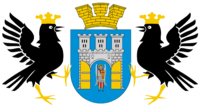
The town’s coat of arms from 1663 depicts a castle on a red shield with three towers and an open gate, behind which stands a cross against a blue background. The coat of arms used today also depicts a castle with three towers and an open gate against a blue background, with the Archangel Michael standing in the entrance. His wings are folded down; in his right hand he holds a sword, and in his left a shield. Above the coat of arms is a golden city crown with three towers, each flanked by a protective jackdaw representing Galicia.
Modern times

In 1662, the Polish hetman (captain) Jędrzej Potocki built a fortress comprising three villages named Pasichna (Pasieczna), Zabolottja (Zabłocie) and Knjahynyne (Kniahinin) in the Ruthenian Voivodeship (Województwo ruskie), which existed as an administrative unit of the Polish–Lithuanian Commonwealth from 1569 to 1772.
The town’s fortifications originally consisted of a wooden defence, later comprising stone walls, earthworks and moats.
The name ‘Stanisławów’ was first mentioned in connection with the town’s foundation from the three villages and the granting of Magdeburg town rights in 1662. In 1663, Prince Potocki confirmed the Magdeburg rights and granted the town its coat of arms.
The town’s history in the 18th century was marked by alternating occupations by Polish, Russian and Austrian armies. From the outset, the town developed into a major economic centre of Poland; in 1772, following the Partition of Poland–Lithuania, Stanisławów came under Austrian rule and was renamed ‘Stanislau’. Under Empress Maria Theresa (1717–1780) and Emperor Joseph II (1741–1790), German craftsmen and farmers were settled in Galicia to promote trade and agriculture. Stanislau – together with other towns in Eastern Galicia – formed one of the main areas of German settlement in Galicia. From 1867 to 1918, the town belonged to the Crown Land of the‘Kingdom of Galicia and Lodomeria’in the Cisleithanian part of the Habsburg Monarchy.


Contemporary History
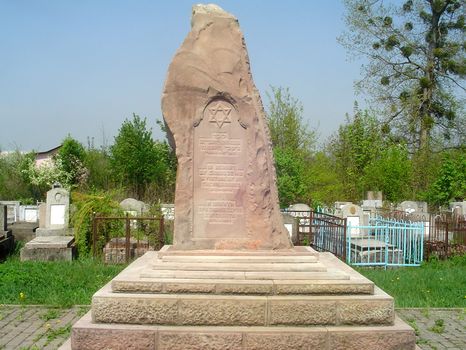
During the First World War, residents of Stanislau, as well as those of Lemberg/L’viv/Lwów, took part in fighting against the Russian occupiers on the side of the Habsburg Monarchy between 1915 and 1916. As a result, the historic part of the town was largely destroyed. After the First World War, in 1919, Stanisławów became the capital of the West Ukrainian People’s Republic for a few months; this republic existed from 1917 to 1920. From 1921, the town was once again under Polish rule and became the centre of the Stanisławów Voivodeship (Województwo Stanisławowskie). Following the incorporation of western Ukrainian territories into the Ukrainian Soviet Socialist Republic as a result of the Molotov–Ribbentrop Pact, the city came under Soviet rule from September 1939 to June 1941. This period was marked by mass reprisals against the town’s population. Following the German invasion of the Soviet Union in 1941, the Hungarian allies of the German Reich occupied the town – now known as ‘Stanislaviv’ – and handed it over to the German Wehrmacht. The town was thus under Nazi occupation for three years (1941–1944) during the Second World War. The ‘Galicia District’ was incorporated into the General Government; Stanislau served as the capital of a district administration. In Stanislau, as part of the planned ‘cleansing of the Jews’, on 12 October 1941 around 12,000 of the 30,000 Jews living there were shot in a Jewish cemetery as part of an organised mass murder. This day was later referred to as ‘Bloody Sunday’ and is regarded as the beginning of the ‘Final Solution to the Jewish Question’ in the General Government. From this point onwards, the surviving Jews were relocated to a ghetto. Here, many died as a result of disease and starvation; many were killed indiscriminately or deported to the Bełżec extermination camp. In 1941–42, a total of 70,000 Jews were shot in and around Stanislau and 12,000 were sent to extermination camps; in total, 434,329 Jews were murdered in Galicia; the number of survivors was small. In 1944, the Red Army liberated Galicia, including Stanisławów. This was followed by a policy of cultural and linguistic Russification, as a result of which the Polish population of the region was expelled. Stanislaviv initially became part of the Soviet region (oblast) of Galicia, and later the capital of its own region, Ivano-Frankivs’k. In 1962, the city was renamed ‘Ivano-Frankivsk’ in honour of Ivan Franko; it remains to this day the capital ofthe Ivano-FrankivskOblast in Ukraine.
Population and Society

At the start of the settlement under Potocki (1662), the population consisted mainly of Poles, Ruthenians, Armenians and Jews. A wave of migration to Galicia, which began at the end of the 18th century, led to a large influx of German settlers from various regions of the Habsburg Monarchy. The first Germans arrived in Stanislau in 1786 – within two years, numerous families were already living there, including craftsmen, traders, civil servants and military personnel.[2]
The city’s namesake, Ivan Franko, is still regarded today as one of the most important Ukrainian writers and historians. He was born in 1856 in Nahujevyči near Drohobyč, not far from Ivano-Frankivsk, the son of a German blacksmith, and was a member and founder of the Ukrainian socialist movement. His work can be classified as Romantic, Realist and Symbolist.[3]
Furthermore, the construction of theLviv–Czernowitz/Černivci/Cernăuți railway line in 1866 attracted further skilled workers to the town. In 1880, the city had a population of 18,626 – 2,794 Ukrainians, 5,584 Poles, 90 Armenians, 135 Germans and 10,023 Jews.[4] In 1912, around 1,000 people were employed by the railway company.[5] In 2015, the city had a population of 229,644.[6]
History of religion
The town was characterised by a diverse religious culture and the coexistence of several denominations. Alongside the Orthodox faith, there were also Greek Catholic, Roman Catholic and Jewish communities. To this day, the communities’ numerous places of worship bear witness to this diversity of faith.
![Protestant Church in Stanislau [Photograph from the appendix to: D. Theodor Zöckler. On the 100th anniversary of Father Zöckler’s birth. [BKGE Library].](/fileadmin/_processed/2/9/csm_Evangelische_Kirche_in_Stanislau__Foto_aus_dem_Band_von__Hans_Strohal_ueber_Theodor_Zoeckler__Bibliothek_des_BKGE_Signatur_10G050ZOEC1_._430774efcf.jpg "Protestant Church in Stanislau. Photograph from Hans Strohal’s book on Theodor Zoeckler, BKGE Library, call number 10G050ZOEC1.")


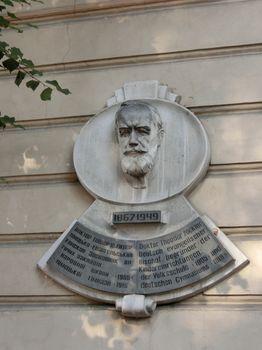
In 1891, Pastor Dr Theodor Zöckler (1867–1949), who was born in Greifswald (Pomerania), arrived in the town on behalf of the Danish Jewish Mission. He remained pastor of the Protestant German congregation (ordained in 1901) until 1939 and served as superintendent from 1924 to 1939. In 1896, he first founded a children’s home, which was followed by further charitable institutions known as the ‘Zöckler Institutions’ (a primary school, a care home for the elderly, a nursery and a hospital). Zöckler was active in literary and church political circles; he was editor of the ‘Evangelisches Gemeindeblatt für Galizien’ (Protestant Parish Gazette for Galicia), co-founder of the ‘Bund der christlichen Deutschen in Galizien’ (League of Christian Germans in Galicia) and, as chairman of the ‘Deutscher Volksrat’ (German People’s Council) (until 1924), he prevented the German Protestant Church from joining the Protestant Church in Poland. In 1946, he was one of the co-founders of the Aid Committee for the Germans of Galicia.
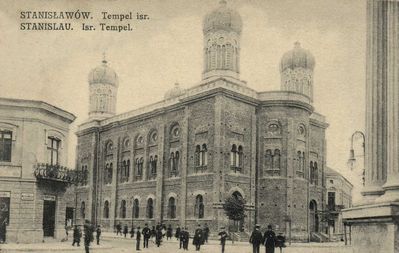
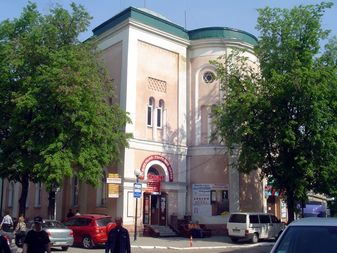
Shortly after its foundation, Stanislau also developed into the centre of a large Jewish community. Around 1900, Jewish residents accounted for just under half of the town’s population; by the 1930s, some 25,000 Jews were living there. Under the Nazis, the town’s entire Jewish community was either deported or murdered, and the town was declared ‘free of Jews’.
Architecture and Art History
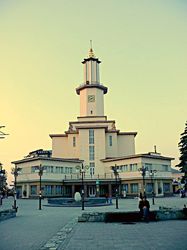
The original Stanislau Fortress was shaped like a regular hexagon, with the market square – established in 1662, the year the town was founded – at its centre. This oldest square in the town thus represents not only the historical but also the geometric centre (of the former fortress).
One of the city’s landmarks is the former town hall, the City Council building (Magistrat), designed by the architect Trel Stanislav in the 1930s. It is one of the few town halls in Ukraine to have been built in the Functionalist style. It has a gilded dome in the shape of a helmet.
Notable cultural institutions and literature
Ivano-Frankivs’k is home to universities, a college and 17 libraries. Worth mentioning is the ‘Ivan Franko Theatre’, in front of which stands a statue of its namesake. The historic townscape of Ivano-Frankivsk is also characterised by the numerous churches belonging to various religious communities. The Roman Catholic Church of the Virgin Mary is now used as a regional art museum.
Ivano-Frankivsk is now an important literary centre in Ukraine. The writers Yuriy Andruchovyč (born 1960) and Taras Prochasko (born 1968) hail from Ivano-Frankivsk. In the 1990s, Andruchovyč, Prochasko, the poet Halyna Petrosanjak (born 1969) and others the artists’ group ‘Stanislau Phenomenon’, which draws on the multi-ethnic past of Galicia.
Culture of remembrance
In Ivano-Frankivsk, streets, squares, monuments and gardens commemorate events in the city’s history. These include commemorative plaques dedicated to Pastor Theodor Zöckler, as well as the Kratter Garden (Kratterivka), which honours the mayor Franz/František Kratter (c. 1760–1838), who had the first public city garden laid out in the city centre in 1827. Furthermore, near the Jewish cemetery – where ‘Bloody Sunday’ took place on 12 October 1941 – there is now an artificial lake, which was created during the Soviet era as a memorial to the victims of Nazism.
Bibliography
- Andruchiv, P. Kam’janskyj: Social, political and religious processes in the Stanisławów region in the late 1930s to the 1950s: A historical and political analysis [Socio-political and religious processes in Stanisławów from the 1930s to the 1950s]. Ivano-Frankivsk 2005.
- Rachel Feldhay Brenner: Voices from Destruction. Two Eyewitness Testimonies from the Stanisławów Ghetto. In: Holocaust and Genocide Studies 22 (2008), No. 3, pp. 320–339.
- Elisabeth Freundlich: The Murder of a Town Called Stanislau. Nazi Extermination Policy in Poland 1939–1945. Vienna 1986.
- O. Karpenko, K. Mican: The West Ukrainian People’s Republic 1918–1923. Documents and materials. Vol. 3, Book 1: Socio-economic conditions and the struggle for liberation [The West Ukrainian People’s Republic 1918–1923: Documents and materials. Vol. 3, Book 1: Socio-economic Relations and the Struggles for Liberation]. Ivano-Frankivsk 2005.
- Caroline Milow: The Ukrainian Question 1917–1923 Amidst the Tensions of European Diplomacy. Wiesbaden 2002.
- Dieter Pohl: Hans Krüger – the ‘King of Stanislau’. In: Klaus-Michael Mallmann / Gerhard Paul (eds.): Careers of Violence. Biographies of Nazi Perpetrators (Publications of the Ludwigsburg Research Centre of the University of Stuttgart, Vol. 2). Darmstadt 2004, pp. 134–144.
- Isabel Röskau-Rydel (ed.): German History in Eastern Europe. Galicia, Bukovina, Moldavia. Munich 2002.
- Isabel Röskau-Rydel: Between Acculturation and Assimilation. Careers and Lifestyles of German-Austrian Civil Servants’ Families in Galicia (1772–1918). Munich 2015.
- Thomas Sandkühler: ‘The Final Solution’ in Galicia. The Mass Murder of Jews in Eastern Poland and Berthold Beitz’s Rescue Initiatives 1941–1944. Bonn 1996.
- Hans Strohal (ed.): D. Theodor Zöckler. On the 100th anniversary of Father Zöckler’s birth. With contributions by Emil Ladenberger, Arnold Jaki and Ernst Hobler. Stuttgart 1967.
- V. Velikočyj (ed.): Stanislaviv – Stanislav – Ivano-Frankivs’k: A monograph marking the 350th anniversary of Ivano-Frankivs’k, 1662–2012 [Stanislaviv – Stanislav – Ivano-Frankivs’k: A monograph marking the 350th anniversary of Ivano-Frankivs’k, 1662–2012]. Ivano-Frankivs’k, L’viv 2012.
- Torsten Wehrhahn: The West Ukrainian People’s Republic. On Polish–Ukrainian relations and the issue of Ukrainian statehood from 1918 to 1923. Berlin 2004.
- Alois Woldan, Olaf Terpitz (eds.): Ivan Franko and the Jewish Question. Intercultural Encounters and Dynamics in the Work of the Ukrainian Writer. Göttingen 2016.
- Erasmus Zöckler: ‘You Shall Live!’ Theodor Zöckler: Founder of what was once the largest relief organisation in Eastern Europe. Leipzig 2011.
- Lillie Zöckler: God Hears Prayer. Stuttgart 1951.
Web links
- www.jewishgen.org/Yizkor/pinkas_poland/pol2_00360.html (JewishGen Inc., article on the history of the Jews in Stanislau)
- www.galizien-deutsche.de/deutsch/was-ist-galizien/gedenkstaetten.htm (Aid Committee for the Galician Germans. Information on Galician German history)
- www.eleven.co.ilarticle/13937 (Electronic Jewish Encyclopaedia. Information on the Jewish history of Ivano-Frankivsk in Russian)
- www.ifkm.if.ua/ (Ivano-Frankivsk Regional Museum: website of the regional museum)
- www.wn.de/Muenster/2340646-Prozess-in-Muenster-Vor-50-Jahren-Kriegsverbrecher-vor-Gericht (Martin Kalitschke: Trial in Münster. 50 years ago: War criminals on trial. Westfälische Nachrichten, 23 April 2016)
- www.nachlassdatenbank.de/viewsingle.php?category=Z&person_id=54346&asset_id=59863&sid=42f0cf625398395542d1f (Zöckler estate at the Martin Opitz Library, Herne)
Notes
[1] Pohl: Hans Krüger, p. 138; Freundlich: The Assassination, pp. 135 ff.; see also www.wn.de/Muenster/2340646-Prozess-in-Muenster-Vor-50-Jahren-Kriegsverbrecher-vor-Gericht (accessed 16 December 2016).
[2] see Stanislau in Meyers Konversationslexikon, 1888: www.retrobibliothek.de/retrobib/seite.html?id=115223#Stanislau (accessed 10 August 2021).
[3] In 2012, Franko was accused of anti-Semitism by the Jewish Community of Vienna. The allegations made became the subject of an academic conference held at the University of Vienna in 2013, the proceedings of which are now available in print: Woldan/Tierpitz: Ivan Franko.
[4] І. М. Bondarev, М. І. Golovatyj, І. Z. Pančyšyn, Z. B. Fedunkiv: Ivano-Frankivs’k. In: Encyklopedija sučasnoji Ukrajiny [Encyclopaedia of Modern Ukraine]: esu.com.ua/search_articles.php?id=13412 (accessed 8 September 2016).
[5] Stanisławów. In: Słownik geograficzny Królestwa Polskiego i innych krajów słowiańskich [Geographical Dictionary of the Kingdom of Poland and Other Slavic Countries]. Volume XI, Warsaw 1890: dir.icm.edu.pl/pl/Slownik_geograficzny/Tom_XI/192 (accessed 8 September 2016).
[6] Chyselnist’ naselennya Ivano-Frankivska zbilshylos [Population of Ivano-Frankivsk has increased]: stanislavske.tv/chyselnist-naselennya-ivano-frankivska-zbilshylos/ (accessed 8 September 2016).
Citation
Victoria Soloschenko, Matthias Weber: Stanislau/Івано-Франківськ/Ivano-Frankovsk. In: Online Encyclopaedia on the Culture and History of Germans in Eastern Europe, 2017. URL: ome-lexikon.uni-oldenburg.de/p45953 (as at 29 January 2024).
Terms of use for this article
Copyright © University of Oldenburg and the Federal Institute for the Culture and History of Germans in Eastern Europe (BKGE), all rights reserved. This work was produced as part of the project ‘Online Encyclopaedia on the Culture and History of Germans in Eastern Europe’ and may be reproduced and published provided the rights holders’ consent has been obtained. Please contact:
If you have any specialist comments or additions to the text, please contact the editorial team, citing relevant literature and source references.