

General Government, Warsaw
General Government, Warsaw
2. Geography
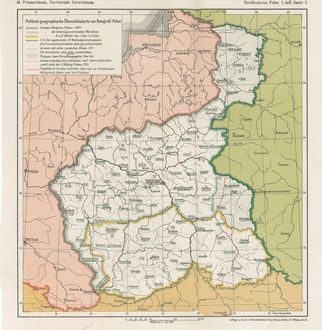
Cartographic representation of the German and Austro-Hungarian-occupied territories: the General Government of Warsaw, the Military General Government of Lublin and Ober Ost [Erich Wunderlich (ed.): Handbook of Poland (Congress Poland). Contributions to a general regional study. 2nd, expanded edition. Berlin 1918 (Publications of the Regional Studies Commission of the Imperial German General Government of Warsaw)].
Location
The General Government (GG) of Warsaw was a German-occupied territory during the First World War, covering an area of approximately 62,000 km², which comprised the former Russian governorates of Kalisz, Petrikau/Piotrków Trybunalski, Płock, Siedlce and Warsaw/Warszawa. It bordered the German Empire to the west and north; the border with the Austro-Hungarian Military General Government of Lublin was formed by the Pilica River to the south and the Vistula (Wisła) to the south-east. To the east, beyond the Bug River, lay the rear area of the German armies.
Topography
The area is largely flat and is characterised by rivers such as the Vistula, the Bzura, the Wieprz and others. Sandy soil used for agriculture alternates with forest areas, some of which are extensive.
Contemporary History
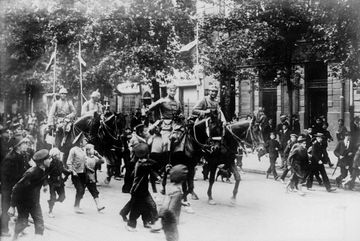
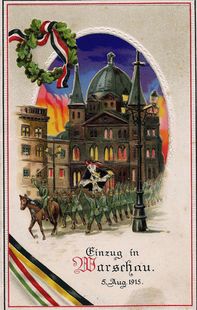
As early as the end of 1914, the Germans established a General Government in the part of Russian Poland they had occupied, centred on the industrial city of Łódź and the religious centre of Częstochowa; around one-third of the significant Dąbrowa coalfield went to Austria-Hungary. On 5 January 1915, a civil administration under the supreme command of a Governor-General assumed responsibility for these territories. Following victories in the summer of 1915, the Polish capital, Warsaw, was added; on 24 August, it became the new administrative centre and gave its name to the General Government of Warsaw.
German policy since 1914 had been aimed primarily at exploiting the country’s economic resources as fully as possible and at recruiting soldiers for its own army. Furthermore, Berlin and Vienna negotiated the ‘Polish question’, that is, they debated the country’s future in a post-war Europe, with the General Government of Warsaw and the Military General Government of Lublin, occupied by Austria-Hungary, being discussed as joint Polish territory. Opinions on how the Polish ‘pie’ should be divided were largely at odds with one another, indeed irreconcilable, and were not put into practice by the end of the war.
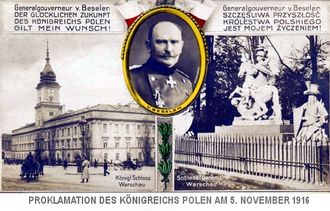
Meanwhile, politics was being conducted at a local level, with Governor-General Colonel-General Hans von Beseler (1850–1921) proving to be a key figure who repeatedly presented both his Austrian counterparts in Lublin and the Polish elites with a fait accompli. He was also responsible for the proclamation of the Kingdom of Poland on 5 November 1916. In the name of the two emperors, an independent state with a hereditary monarchy and a constitution was promised, although the specific political and geographical arrangements were not to be finalised until after the war. The main reason for the proclamation was the desire to recruit soldiers within the country, which was prohibited by the Hague Convention on Land Warfare in enemy territory. By formally separating Poland from the Russian Empire, this provision was thus complied with.
On 11 November 1918, German troops were disarmed by the Poles and governmental power was placed in the hands of Józef Piłsudski (1867–1935). The General Government was thus replaced by the Republic of Poland (Rzeczpospolita Polska), which also comprised other territories.
Administration
Governor-General of Beseler was appointed directly by the German Emperor and was answerable only to him; he was responsible for setting policy guidelines, but the practical implementation and execution were the responsibility of a civil administration headed by Wolfgang von Kries (1868–1945), which was subordinate to the imperial authorities in Berlin but otherwise independent. Beseler remained in office until the end of the war, Kries until mid-1918; he was succeeded by Maximilian von Sandt (1861–1918) and Otto von Steinmeister (1860–1937). By mid-1918, the Germans had 6,000 of their own civil servants and some 100,000 soldiers stationed in the country,[1] who were deployed across 11 governorates and 32 district commands.
From the summer of 1916, the population was granted the right to vote in local elections, but the division into electoral districts put them at a disadvantage, as they were only permitted to vote for one district. A year later, mayors were also allowed to be elected. At the same time, a Polish State Council (Tymczasowa Rada Stanu) had existed since 14 January 1917; in theory, it was intended to prepare the country for independence and subsequently exercise governmental authority, but it only gradually acquired certain powers. The body was also responsible for the Austro-Hungarian Military General Government of Lublin. The Poles regarded the German measures as primarily propaganda-driven and did not view the newly created institutions as equal partners. The self-governing body therefore faced problems of legitimacy, was dependent on the occupying powers and had to constantly navigate between Polish and German interests without being allowed to exercise any real powers.
Furthermore, on 12 September 1917, the occupying powers established the Regency Council (Rada Regencyjna), whose members included the Mayor of Warsaw, Zdzisław Lubomirski (1865–1943), the Archbishop of Warsaw, Aleksander Kakowski (1862–1938), and the politician Józef Ostrowski (1850–1922), and which can be regarded as a kind of executive body of the State Council. On 7 October 1918, it first declared Poland’s independence – which could not be realised under German occupation – and on 25 October 1918 appointed Józef Świeżyński (1868–1948) as the first Prime Minister who did not require confirmation by the occupying powers.
Population
No precise figures on the population are available. The occupying powers carried over the pre-war Russian figures from 1897, which did not take into account, for example, refugees, war dead and displaced persons. According to these figures, six million people lived in the General Government of Warsaw, of whom 603,000 were of German descent and 1,084,000 of Jewish descent – representing 10 per cent and 18 per cent of the total population respectively; the Ukrainian minority was much smaller.[2]
The Germans attempted to reduce Russian discrimination against Jews, but by 1917 at the latest they had shifted to a pro-Polish policy and did little to promote gender equality for Jews. In doing so, they sought to accommodate what they perceived as Polish anti-Semitism. Nevertheless, the formal recognition of Jews as a religious community, announced by Warsaw in November 1916, was a step towards emancipation. The German minority was granted its own schools, but otherwise received no political preferential treatment. There was no‘Germanisation’of the region. On the contrary, Beseler recommended sending ethnic Germans back to the Reich, precisely because this was a Polish state.
Economy
The two major cities, Warsaw and, in particular, Łódź, were characterised by industry; the latter, above all, by the textile industry. There were several hundred thousand workers who very soon found themselves out of work because a supply of raw materials was no longer possible and, moreover, was no longer desired by the occupying forces. In this way, on the one hand, competition for the domestic economy was eliminated; on the other, it was hoped that the unemployed could be brought into the Reich as migrant workers.
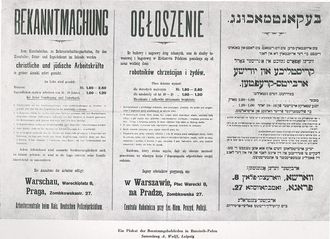
The latter was organised through a relatively effective system overseen by the German Workers’ Centre. This private-sector institution had already been responsible for placing harvest labourers in Prussia prior to 1914 and now continued its activities as a monopoly, with regional offices in German-occupied Poland. Overall, it succeeded in meeting the demand to a large extent, as in rural areas the long-standing tradition of seasonal labour was a welcome opportunity to earn good money. No coercion was used in the recruitment process, and payment was assured; however, there was no guarantee of being able to return home at will. In the summer of 1918, there were between 200,000 and 240,000 Poles in Germany, including 30,000–35,000 Jews, despite often anti-Semitic policies.[3]
As early as April 1915, the occupying forces were faced with problems in feeding the Polish urban population; the devastation caused by the fighting had severely affected harvests, stores and supply routes. To enable exports to continue nonetheless, consumption was therefore restricted through a comprehensive rationing system. In May 1917, the people of Warsaw were receiving only 131 g of bread and 205 g of potatoes per day, whereas daily consumption before the outbreak of the war had stood at 720 g of bread.[4] These quantities were insufficient for survival, leading to massive price rises and a thriving black market. The occupying powers justified the exports to Germany that nevertheless took place – for example, of potatoes – by citing the famine also prevailing there; only rarely, and for certain foodstuffs, did rations in the General Government exceed the German quotas.
Despite a wide range of coercive measures, which repeatedly alternated with periods of increased economic incentives, there was no large-scale export. At no time were the Central Powers able to fulfil the high expectations regarding potential food supplies to their home countries – partly because a deliberate policy of starvation for Poland was not their intention.
Military history
The Central Powers’ hopes of recruiting soldiers in Poland were not realised. The ‘Polish Legions’, a unit of volunteers led by Piłsudski, who was striving for independence, refused to accept the leadership of the Central Powers. When these soldiers refused to swear allegiance to the two emperors on 9 July 1917, the failure of Beseler’s strategy became abundantly clear: not even this force could be deployed as part of the German army. 15,000 legionnaires were subsequently interned, whilst, from autumn 1918 onwards, only 9,000 men served in the ‘Polish Wehrmacht’ under the command of the Polish Regency Council. Compared with the approximately 700,000 Polish soldiers from Prussia, these played no significant role in the fighting during the First World War.
Society
Under the occupation, ethnic and social conflicts amongst the population were scarcely apparent; the quest for an independent nation state united the political parties. As 2.2 million Polish soldiers were fighting in the armies of the three empires, social life was restricted and often dominated by practical concerns about survival or material provision. Furthermore, the Germans permitted a lively political life. Even left-wing parties such as the Polska Partia Socjalistyczna or the Socjaldemokracja Królestwa Polskiego i Litwy, and their respective splinter groups, were permitted to take part in the elections – even though they repeatedly criticised the occupying powers, their policies and the bodies collaborating with them in leaflets. In this sense, it was entirely possible to express dissatisfaction with the prevailing circumstances. From July 1915 onwards, there were even repeated strikes in the General Government. Their number increased as the war dragged on – between April and September 1918 alone, there were 36 wage negotiations. Compromises were the norm, particularly in the mines in the south-east, which were vital to the war effort; in 1917–18, additional food supplies were provided and co-operatives were established. In these 36 strikes, the General Government met all the demands on six occasions and parts of the demands on 19 occasions.[5]
The Central Powers secured their rule over the local population in a variety of ways. Violence was one of the methods employed, but it was neither the preferred nor a particularly frequently used means of enforcing obedience. On the contrary, the Central Powers often reacted leniently to acts of resistance. They sought to avoid corporal punishment, particularly the death penalty, wherever possible, and resorted to it mainly when they themselves were attacked, when security was at risk, or, more generally, when their authority was fundamentally challenged. This was rarely the case.
Education and Science
The University of Warsaw, the only one in the General Government, had been exclusively Russian-speaking since 1870 and had, moreover, been closed at the outbreak of the war. On 15 November 1915, the Germans celebrated its ceremonial reopening as a Polish Institute. The selection of teaching staff for the more than 1,000 students proved problematic, as there were virtually no qualified Polish-speaking academics in Germany. Beseler wished to avoid, as far as possible, recruiting such staff from Austro-Hungarian Galicia, as he feared that his ally might have a negative influence on the Germans’ efforts to present themselves as friends of the Poles. Ultimately, a list of 36 names was drawn up, which also met with the approval of the academic community.
In May 1917, serious conflicts arose when the students sought to commemorate the Polish May Constitution of 1793. The Germans arrested two of them during a rally, whereupon a general university strike was called in response, which also affected the Technical University. The occupying forces responded by closing the Technical University (Politechnika), which they had themselves reopened, whereupon the students presented a demand for full autonomy for the universities. After the students failed to comply with the final ultimatum to end their strike, the Germans also closed the university on 23 June 1917. To put an end to this debacle of symbolic politics, Beseler had the two universities handed over to the State Council in the autumn; the Council carried out the ceremonial reopening in November 1917 and now exercised sole authority.
Education policy, for its part, was intended from the outset to serve as proof that the Germans were prepared to cede genuine powers to the Poles. A key measure was the abolition of Russian as the language of instruction. German was now to be taught as a foreign language even in primary schools, but this caused considerable discontent when the occupying forces declared this language to be the medium of instruction for German and Jewish pupils. In fact, this was less an attempt to Germanise the Jews; rather, the occupiers simply did not recognise Yiddish as a language in its own right and wished to regard it merely as a German dialect; in December 1915, they were forced to correct their error.
Bibliography
- Werner Basler: Germany’s Policy of Annexation in Poland and the Baltic States, 1914–1918. Berlin (East) 1962.
- Werner Conze: The Polish Nation and German Policy during the First World War. Cologne 1958 (Eastern Central Europe in the Past and Present 4).
- Jesse Curtis Kauffman: Warsaw University under German occupation. State-building and nation-building in Poland during the Great War. In: First World War Studies 4 (2013), pp. 65–79.
- Stephan Lehnstaedt: Two Kinds of Occupation? German and Austro-Hungarian Economic Policy in Congress Poland, 1915–1918. In: Joachim Bürgschwentner, Matthias Egger, Gunda Barth-Scalmani (eds.): Other fronts, other wars? First World War Studies on the Eve of the Centennial. Leiden, Boston 2014 (History of warfare 100), pp. 197–217.
- Stephan Lehnstaedt: Imperial Orders Instead of Germanisation. The Central Powers in Congress Poland, 1915–1918. In: Osteuropa 64 (2014), Nos. 2–4, pp. 221–232.
- Piotr Mikietyński: Germany’s Path to Central Europe. The Policy of the German Reich towards the Kingdom of Poland (1914–1916). Kraków 2009.
- Marta Polsakiewicz: Specific Features of German Occupation Policy in Warsaw 1914–1916. In: Journal of East Central European Research 58 (2009), pp. 501–537.
- Robert Michael Spät: Towards a Shared German–Polish Future? Hans Hartwig von Beseler as Governor-General in Poland 1915–1918. In: Journal of East Central European Research 58 (2009), pp. 469–500.
- Włodzimierz Suleja: Tymczasowa Rada Stanu [The Provisional Council of State]. Warsaw 1998.
- Christian Westerhoff: Forced Labour in the First World War. German Labour Policy in Occupied Poland and Lithuania 1914–1918. Paderborn, Munich 2012 (Studies in Historical Migration Research 25).
Notes
[1] Central Archives of Historical Records, Warsaw, 314-2 / 15. Governor-General to the Head of Administration at the GGW, 1 July 1918.
[2] Political Archive of the Federal Foreign Office, Berlin, R 21577, pp. 233 ff.: Eugen Lewizky: The Eastern Theatre of War and the Peoples of Eastern Europe, Vol. III. Pamphlet dated 15 July 1916 (containing figures from *Statystyka Polski* 1913, pp. 46–49, which in turn are based on the 1897 census).
[3] Westerhoff: Forced Labour in the First World War, pp. 259 ff.
[4] Polsakiewicz: Specific Features of German Occupation Policy, p. 531.
[5] Westerhoff: Forced Labour in the First World War, pp. 278 ff.
Citation
Stephan Lehnstaedt: General Government of Warsaw. In: Online Encyclopaedia on the Culture and History of Germans in Eastern Europe, 2015. URL: ome-lexikon.uni-oldenburg.de/p42286 (accessed 15 September 2015).
Terms of use for this article
Copyright © University of Oldenburg and the Federal Institute for the Culture and History of Germans in Eastern Europe (BKGE), all rights reserved. This work was produced as part of the project ‘Online Encyclopaedia on the Culture and History of Germans in Eastern Europe’ and may be reproduced and published provided the rights holders’ consent has been obtained. Please contact:
If you have any specialist comments or additions to the text, please contact the editorial team, citing relevant literature and source references.