

Lublin Military General Government
Lublin Military General Government
German name
Lublin Military General Government, often also referred to as the Military General Government in Poland
Names in other languages
Polish: General Government of Lublin or General Military Government in Poland
Etymology
The term ‘General Government’ refers to the Russian administrative units of the same name in Poland prior to 1914, but also has its roots in the Austro-Hungarian army’s administration of occupied territories.
2. Geography
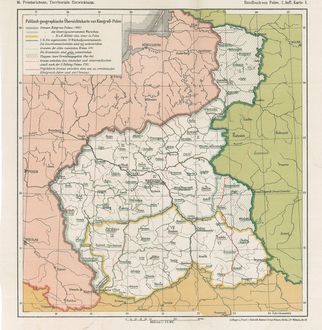
Cartographic representation of the Austro-Hungarian and German-occupied territories: the Lublin Military General Government, the Warsaw General Government and Ober Ost [Erich Wunderlich (ed.): Handbook of Poland (Congress Poland). Contributions to a general regional study. 2nd, expanded edition. Berlin 1918 (Publications of the Regional Studies Commission at the Imperial German General Government of Warsaw)].
Location
The Lublin Military General Government (MGG) was an Austro-Hungarian-occupied territory during the First World War, covering an area of approximately 48,000 km² and comprising the former Russian governorates of Kielce, Radom and Lublin. It bordered the Austro-Hungarian Crown Land of Galicia to the south. The border with the German General Government of Warsaw was formed by the Pilica River to the north and the Vistula (Polish: Wisła) to the north-west; in Częstochowa, the Pauline monastery of Jasna Góra formed an enclave there. To the east, beyond the Bug River, lay the rear area of the German armies.
Topography
The territory of the MGG Lublin is gently undulating to the east of the Vistula; to the west, it is partly flat and partly characterised by small mountain ranges south of Radom, each with some woodland. The population lived overwhelmingly in rural areas; there was no sign of urbanisation; there were no towns with more than one hundred thousand inhabitants.
Contemporary History
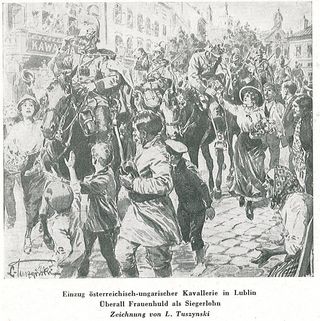
Following the Battle of Tarnów-Gorlice, won by the Central Powers in early summer 1915, the allied armies swiftly conquered the former ‘Vistula Governorates’ of the Russian Empire. On 25 August 1915, Austria-Hungary initially established the Military General Government of Kielce, which from 1 October operated under the name Military General Government of Lublin, named after the largest and most important occupied city, where the occupation administration also had its headquarters.
Plans to annex Russian Poland were drawn up in Vienna almost immediately after the outbreak of war. One particular problem was that this would have meant there were more Poles than people of German descent living in the Dual Monarchy. Even more so, the shared rule with Germany made political solutions impossible. The two partners were unable to reach an agreement until the end of the war, with the result that the Military General Government and the General Government of Warsaw continued to exist in parallel. In view of this, key decisions were not taken in Vienna or Berlin, but in Lublin and Warsaw/Warszawa. The Governor-General of Warsaw, Hans von Beseler (1850–1921), proved to be the more decisive figure in this regard, as his position was far stronger than that of his Austro-Hungarian counterparts, for whom a lack of continuity posed a problem. The four generals who held office in succession were Erich Baron Diller (1859–1926), Karl Kuk (1853–1935), Stanisław Count Szeptycki (1867–1950) and Anton (Ante) Lipošćak (1863–1924) held office in succession.
On 5 November 1916, Germany and Austria-Hungary proclaimed the Kingdom of Poland in Warsaw, comprising the Lublin Military District and the Warsaw General Government. On behalf of the two emperors, they promised an independent state with a hereditary monarchy and a constitution, without specifying the details. The main reason for the proclamation was the desire to recruit soldiers within the country, which was prohibited by the Hague Convention on Land Warfare in enemy territory. By formally separating Poland from the Russian Empire, this provision was circumvented. However, efforts to recruit local people proved largely fruitless. In particular, the planned cession of the districts of Chełm and Hrubieszów, situated in the MGG, to Ukraine – following the negotiation of a peace treaty with Ukraine in February 1918 – led to widespread protests and acts of resistance throughout the country. With this move, however, Austria-Hungary sought to continue the nationality policy practised in Galicia, which granted substantial privileges to the ethnically dominant group.
On 6 November 1918 , Ignacy Daszyński (1866–1936) proclaimed a ‘Provisional People’s Government of the Polish Republic’ (Polish: Tymczasowy Rząd Ludowy Republiki Polskiej) in Lublin, but was unable to establish political authority. It proved more significant that, in the German General Government of Warsaw, governmental authority passed to Józef Piłsudski (1867–1935) on 11 November and that the accompanying disarmament of the occupying forces brought the occupation to an end in Lublin as well. This date marks the founding of the Republic of Poland (Rzeczpospolita Polska), which also included other territories.
Administration
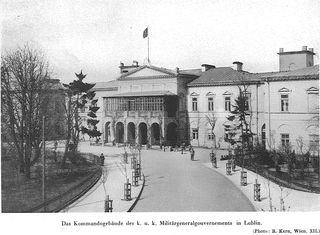
The governors in Lublin were subordinate to the Imperial and Royal Army High Command in Teschen/Cieszyn/Český Těšín, which meant they were rarely able to take decisions on their own authority or without a cumbersome authorisation process. Legislative measures, regulations of a fundamental nature and amendments to the population’s existing fundamental rights were the sole preserve of the Supreme Army Command, meaning that local politics were subject to strict regulation. In keeping with this military dominance, the so-called Civil Provincial Commissariat exercised only subordinate functions. Furthermore, all senior posts in the provincial government and the district commands – the two intermediate levels of administration – were filled by officers and military officials. Industrial enterprises and, above all, agricultural production in the occupied territory remained under military control at all times. Including troops, between 170,000 and 200,000 occupying forces were stationed in the Military General Government.
Initially, Austria-Hungary proved more restrictive than Germany when it came to Polish participation in the administration. It was only when a curia-based electoral system was introduced in the General Government in Warsaw in the summer of 1916 that the Dual Monarchy was also compelled to offer its subjects opportunities for participation; on the other hand, from early 1917 onwards, mayors were also allowed to be elected directly, thereby sending a clear signal regarding the inclusion of Poles.
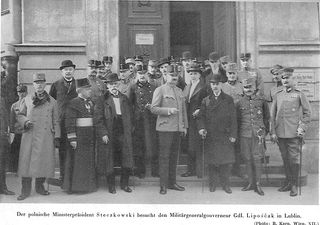
At the same time, from 14 January 1917, a Polish State Council (Tymczasowa Rada Stanu) existed, which was intended, at least in theory, to prepare the country for independence and to exercise governmental authority, but which only gradually acquired certain powers. The body was also responsible for the German-occupied territory. On 12 September 1917, the Regency Council (Rada Regencyjna) was also established, whose members included the Mayor of Warsaw, Zdzisław Lubomirski (1865–1943), the Archbishop of Warsaw, Aleksander Kakowski (1862–1938), and the politician Józef Ostrowski (1850–1922), and which can be regarded as a kind of executive body of the State Council. On 7 October 1918, it first declared Poland’s independence – which could not be realised whilst the country was under occupation – and on 25 October 1918 appointed Józef Świeżyński (1868–1948) as the first Prime Minister who did not require confirmation by the occupying powers.
Population
Unlike the German administration in the General Government of Warsaw, the Dual Monarchy carried out a census in Lublin. The results were available in early 1917; they included data on languages and occupations and revealed an illiteracy rate of over 50 per cent. Out of a population of 1,662,634 men and 1,844,333 women – totalling 3,506,967 people – around 1.6 million of those aged over six were unable to read. The Jewish population accounted for just over 13 per cent, whilst the German population remained below one per cent.
Results of the 1916 census in the Lublin Military General Government:[1]
| Occupations (including family members) | Male | female | Total |
| Agriculture | 1,141,061 | 1,251,276 | 2,392,337 |
| Trade and industry | 292,631 | 316,558 | 609,189 |
| Retail and trade | 116,201 | 130,375 | 246,576 |
| liberal professions | 14,403 | 15,544 | 29,947 |
| Public sector | 20,169 | 22,198 | 42,367 |
| Pensioners | 12,158 | 17,114 | 29,272 |
| Unemployed | 66,011 | 91,268 | 157,279 |
| Total | 1,662,634 | 1,944,333 | 3,506,967 |
Economy
The Military General Government was predominantly agricultural in character and had hardly any industrial enterprises of any significance. Consequently, agriculture there played a central role, particularly as the food supply situation in the Dual Monarchy was not favourable. Vienna hoped that Polish agricultural produce would enable it to meet part of its own food requirements. In 1915, the Austro-Hungarian occupying forces therefore began a complete confiscation of the harvest, took control of seed distribution and also introduced food rationing in the few towns within their territory. Residents were allotted 300 g of flour per day, which led to severe malnutrition there during the war.
As many farmers no longer saw any economic incentive to increase their harvests in the face of compulsory deliveries, some were forced to work in the fields. In cases of sabotage, such as fires set to haystacks, the Austrians prevented further disruption by taking the most respected members of the respective communities hostage.
Nevertheless, the high expectations regarding exports were not met. In 1915 and 1916 combined, the amount sent back to the homeland and consumed by the units on the ground equalled what had originally been earmarked for export in 1916 alone. Consequently, the focus shifted to greater economic incentives and partial cooperation with the local population. With the establishment of the Harvest Utilisation Centre, an independent organisation – which, admittedly, remained under military control – began to oversee and coordinate the distribution of the most important agricultural produce in Lublin from autumn 1916 onwards. To allay the vocal criticism of the externally dictated policy, the Germans and Austrians established a Polish Agricultural Council in May 1917, which formally took over the organisation of the harvest in July. However, this council was not truly autonomous, as it was supervised by a government commissioner, and its sole task was the purchase of grain. In April 1918, Lublin once again took over the Polish harvest organisation and its granaries. The Poles put up strong resistance in some cases to this setback on the path to independent self-government, with the result that armed force was not infrequently used to enforce the measures.
Significant industry existed only in the Dąbrowa coalfield, one-third of which belonged to the MGG Lublin and two-thirds to the German-occupied territory. The coal mines there covered five per cent of the Dual Monarchy’s coal requirements in 1915 and 4.5 per cent in 1916. In December 1916 alone, 110,000 tonnes of coal were extracted on the Austro-Hungarian side.
Military history
Immediately after the outbreak of war, Józef Piłsudski had begun, on Galician territory and with the approval of the Vienna Army High Command, to form a volunteer unit comprising Poles from the territory under Russian occupation, as he wished to fight for the independence of his homeland in this way. However, the military value of this force was limited – not only because of the relatively small number of soldiers. In July 1916, Piłsudski resigned from command of the Legions out of dissatisfaction with what he considered to be the Central Powers’ insufficient concessions. This led to Stanisław Szeptycki, who had until then been commander of the 3rd Brigade, being appointed Commander-in-Chief in September.
Four days after the proclamation of the Kingdom of Poland, a call for recruits was issued for what was now known as the ‘Polish Wehrmacht’, which represented a deliberate distinction from the legions. The aim was to recruit up to 100,000 men into the MGG. However, these efforts were largely unsuccessful, and when the soldiers refused to take the required oath of allegiance to the two emperors on 9 July 1917, the Central Powers interned 15,000 of them. From autumn 1918 onwards, only 9,000 men served under the command of the Polish Regency Council.
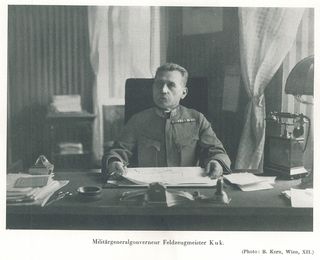
Military Governor-General Karl Kuk tried unsuccessfully to recruit more Polish soldiers following the proclamation of the Kingdom of Poland. On 23 April 1917, he was relieved of his post [Photo: Hausner: The Central Powers’ Policy towards Poland].
Society
Following its conquest of the Lublin region,Austria-Hungary had hoped to be welcomed by the population as liberators from the Russian yoke, not least because it could point to its pro-Polish policies in Galicia. Yet the local population met the new rulers with great scepticism. Whilst the aristocratic elites were reluctant to break with the Tsarist Empire, not least for material reasons, the Polish middle classes saw the First World War as an opportunity to establish a nation state, to be achieved at the expense of Austria-Hungary, which was regarded as much weaker than Germany. The vast majority of the rural population had no interest in politics and were primarily preoccupied with the numerous economic hardships they faced.
Austria relied on the Polish majority population and, to their advantage, was prepared to discriminate against the Ukrainian and Jewish minorities. It confined itself to stalling negotiations with Jewish leaders and to declaring official tolerance. With the Treaty of Brest-Litovsk, the tide turned in favour of the Ukrainians, and Vienna even sought to cede Polish territory to Ukraine. This led to open unrest amongst the Poles and exacerbated ethnic tensions within the population.
History of Religion and the Church
The Catholic Habsburgs saw themselves as rulers over all Catholics, the vast majority of whom were Poles. They presented themselves as a religious counterweight to the Orthodox Romanovs on the one hand and the Protestant Hohenzollerns on the other. In this context, whilst the town of Częstochowa came under German administration in 1915, Jasna Góra – the famous pilgrimage site there, home to the Pauline Monastery and the Polish national shrine of the Black Madonna – came under Austro-Hungarian supervision. In the years that followed, Lublin consistently sought to maintain good relations with the Catholic Church and courted it in order to secure its goodwill and, indirectly, its influence over the population. However, attempts to win over the clergy and thereby influence Polish public opinion were once again thwarted by the circumstances of the war: the armaments industry required metal, and this could be obtained from church bells. And whilst back home one could still count on the solidarity of the clergy in this regard, this was by no means the case in occupied Poland.
Bibliography
- Jerzy Gaul: The Office of the Military Governor-General in Lublin. 1915–1918. Warsaw 1998.
- Arthur Hausner: The Central Powers’ Policy towards Poland and the Austro-Hungarian Military Administration in Poland during the World War. Vienna 1935.
- Stephan Lehnstaedt: The Military General Government of Lublin. The ‘Exploitation’ of Poland by Austria-Hungary during the First World War. In: Journal of East Central European Research 61 (2012), pp. 1–26.
- Stephan Lehnstaedt: The colonial gaze? Poland and Jews as perceived by the Central Powers. In: Bernhard Bachinger, Wolfram Dornik (eds.): Beyond the Trenches. The First World War in the East: Experience – Perception – Context. Innsbruck 2013 (Publications of the Ludwig Boltzmann Institute for Research on the Consequences of War, Graz, Vienna, Klagenfurt; Special Volume 14), pp. 391–410.
- Jan Lewandowski: Królestwo Polskie pod okupacją austriacką, 1914–1918 [The Kingdom of Poland under Austrian Occupation, 1914–1918]. Warsaw 1980.
- Jan Lewandowski: The Kingdom of Poland and Austria-Hungary, 1914–1918. Warsaw et al. 1986.
- Rudolf Mitzka: The Imperial and Royal Military Administration in Russian Poland. In: Hugo Kerchnawe (ed.): The Military Administration in the Territories Occupied by Austro-Hungarian Troops. Vienna 1928 (Economic and Social History of the World War. Austrian and Hungarian Series), pp. 8–52.
- Tamara Scheer: Austria-Hungary’s Occupying Power in Russian Poland during the First World War (1914–1918). In: Journal of East Central European Research 58 (2009), pp. 538–571.
- Włodzimierz Suleja: Tymczasowa Rada Stanu [The Provisional Council of State]. Warsaw 1998.
- Damian Szymczak: Between the Habsburgs and the Hohenzollerns. German–Austro-Hungarian rivalry during the First World War and the reconstruction of the Polish state [Between the Habsburgs and the Hohenzollerns. German-Austro-Hungarian rivalry during the First World War and the establishment of the Polish state]. Kraków 2009.
Notes
[1] Central Archives of Historical Records, Warsaw (AGAD), 312 / 244 and 1918. Population figures in the MGGL, 10 July 1917 (= 1916 census).
Citation
Stephan Lehnstaedt: The Military General Government of Lublin. In: Online Encyclopaedia on the Culture and History of Germans in Eastern Europe, 2015. URL: ome-lexikon.uni-oldenburg.de/p42284 (accessed 21 February 2022).
Terms of use for this article
Copyright © University of Oldenburg and the Federal Institute for the Culture and History of Germans in Eastern Europe (BKGE), all rights reserved. This work was produced as part of the project ‘Online Encyclopaedia on the Culture and History of Germans in Eastern Europe’ and may be reproduced and published provided the rights holders’ consent has been obtained. Please contact:
If you have any specialist comments or additions to the text, please contact the editorial team, citing relevant literature and source references.