

Carniola
Carniola
Etymology
The name derives from the pre-Indo-European term *Kar(n) *, meaning ‘stone’ or ‘rock’. This is the origin of the name of the Principality of Carantania (Latin: Carantanum) in what is now Carinthia during the 7th and 8th centuries, and of the Margraviate of Carniola, the ‘little Carnia’, situated to the south of the Duchy of Carinthia. This border region was known in the vernacular as ‘Creina marcha ’. For the Slavic-speaking population already living there, ‘creina’ and ‘krajina ’ meant ‘countryside’ and ‘borderland’.
Location

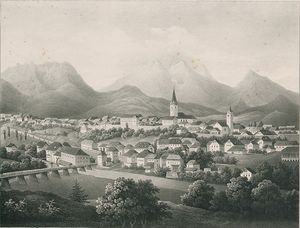
For centuries, Carniola, comprising the cities of Ljubljana and Kranj, formed the heart of the Slovenian-speaking region. To the north, it is bounded by the Karawanken and the Steiner Alps; to the south, by theSlovenian-Croatian border (running along the River Kulpa [Kolpa]), which cuts through the Hochwald forest rising to the south of Ljubljana. To the west of Triglav (Slovenia’s highest peak at 2,864 m), Carniola gives way to a forested karst region that forms part of the Slovenian coastal region (Primorska); in the north-east, the boundary between Carniola and Slovenian Styria (Lower Styria, Štajerska) runs from the Steiner Alps, following the course of the River Save (Sava) to theSlovenian-Croatian border along a line from north-west to south-east.
Topography
From a topographical point of view, Carniola can be usefully divided into three regions. Firstly: Upper Carniola (Gorenjska) in the north, including Ljubljana, is characterised by the mountainous landscape of the Julian Alps. The Triglav National Park has been in existence here since 1981. In the immediate vicinity, around Jesenice, the effects of industrialisation during the second half of the 19th century are unmistakable (iron and coal mining). Secondly: Inner Carniola (Notranjska) in the south-west has no urban centre. In the west of Notranjska, people tend to look to the Venetian-influenced town of Koper (Slovene)/Capodistria (Italian), whilst in the east they tend to look to Ljubljana. Logatec, Postojna and Cerknica can be regarded as secondary centres in this region. Geomorphologically, Notranjska is characterised by karst, that is, a rugged landscape of rocks and caves, which is said to comprise some 15,000 caves (a good 6,000 of which are considered to have been explored). The porous soils of Inner Carniola are not particularly fertile for agriculture. Thirdly: South of Ljubljana, between Inner Carniola and Lower Styria (Štajerska), lies Lower Carniola (Dolenjska), a hilly, densely forested region characterised predominantly by agriculture. Numerous castles, palaces and fortified churches bear witness to its former role as a border region (for defence against attacks from the Ottoman Empire). Within Lower Carniola, the Gottschee and White Carniola (Bela Krajina) regions have distinctive characteristics. The Gottschee region, a remote, densely wooded area with the urban centre of Gottschee/Kočevje, was characterised for over six centuries (until the expulsion of its inhabitants on the orders of Adolf Hitler [1889–1945] at the end of 1941). In the south-eastern border region, where hardly any Gottschee Germans lived, with the centres of Möttling/Merling/Metlika and Tschernembl/Črnomelj, the region is known as White Carniola, or Bela Krajina, where sparse birch forests and what is arguably Slovenia’s warmest and most stable continental climate prevail.
Symbolism
Originally a red eagle, which became blue under the Habsburgs from 1335 onwards; facing left, with a golden crown, a red beak and a red tongue, and a breast bar chequered in red, gold and yellow, usually depicted on a golden-yellow background; the national colours are blue and gold.
Prehistory and Early History
Archaeological finds show that Carniola has been inhabited intermittently since the Palaeolithic period, although these cultures constituted peripheral areas of more extensive settlement centres in the Danube and Adriatic regions. The revolutionary shift from hunting and gathering to agriculture and livestock farming, associated with the Neolithic period, is also evidenced by traces of settlement at Cilli/Celje, Igg/Ig and Ljubljana. By the Early Iron Age, the extent of settlement had probably already reached levels comparable to those at the beginning of the Middle Ages. From the 4th century BC onwards, the Celtic La Tène culture exerted its influence on the region. The Noric Celts established the Regnum Noricum and had their silver coins minted at Celeia, later known as Cilli. From the 2nd century BC onwards, the Noric-Celtic kingdom maintained trade links with the Roman Empire. The Roman Empire became increasingly dominant in theAdriatic region politically, militarily, economically and culturally, before incorporating the kingdom of the Noric Celts without a fight in 10 BC. The subsequent four hundred years of Romanisation led to an enormous surge in development in Carniola. Legionary settlements sprang up, veterans settled there, the population density rose, and numerous villages and roads were built; the Via Gemina emerged as an important trade route from Aquileia towards the east; Emona, on the site of present-day Ljubljana, Celeia and Poetovium (from which Pettau/Ptuj developed) formed the most important urban centres and, following the Christianisation of Rome and Aquileia respectively, served as bishoprics. The ecclesiastical organisation of the dioceses was modelled on the Roman provincial administration.
From the end of the 4th century, the Roman defence system could no longer hold. The power vacuum left by the collapse of the Western Roman Empire was temporarily filled in Carniola by the Visigoths, Ostrogoths, Huns, Lombards and Avars.
Middle Ages
Alongside the Avars, a Turkic-speaking nomadic people, Slavic-speaking ‘warrior-farmers’ – who sought a settled way of life and lived in small social groups – also reached the region. Their settlement initially took place from the north via the Eastern Alps, and subsequently, particularly in the 6th century, also from the south-east. The settlement of the land took place gradually, in an uncoordinated manner and without central control. However, the ‘Slavisation of the lowlands’ (Edgar Hösch) led to a massive population shift and, as a result, to a reshaping of linguistic and cultural conditions. The Slavs did not assimilate, but retained their dialects and way of life; their settlement proved to be permanent.
In the 7th century, the Carniolan Slavs were subjects of the Principality of Carantania, which, as a result of Avar pressure in the 8th century, was reduced to a client principality dependent on the Franks or Bavarians. Before an independent power structure emerged in Carniola, this region too was incorporated as a borderland to secure and organise the Holy Roman Empire (German Nation) emerging under the Carolingians and Ottonians. This is evidenced by the Christianisation of the Slavs from Salzburg (as far as the Drau [Drava]) and from Aquileia (south of the Drau River)—which met with, in some cases, massive resistance from the population—and the grants of imperial property to secular and ecclesiastical vassals of the crown. In particular, Bavarian bishoprics acquired extensive landholdings in Carniola. In the Frankish Imperial Annals of the year 820, the Carniolenses are described as the inhabitants of the border region of Carniola. This incorporation gave rise to a social structure that persisted into the 19th century and became problematic with the emergence of the ideas of nationalism and democracy: The upper classes were predominantly German-speaking, whilst the lower classes were predominantly Slavic- or Slovenian-speaking (see also ‘Population, Society and Religion’).
The Magyar raids in the first half of the 10th century disrupted this restructuring and called it into question for several decades. Thereafter – from west to east – the Margraviate of Verona, the Margraviate of Istria, the Margraviate of Carniola, the Margraviate on the Sann, the Margraviate on the Drava and the Carantanian Margraviate secured the south-eastern border of the Holy Roman Empire. Internally, the margraves had to stabilise manorial rule and the feudal system. Carniola became so attractive, both economically and strategically, that the ambitious Bohemian King Otokar Přemysl II (c. 1232–1278) temporarily occupied it in the 1270s. The rising Habsburgs, who brought an end to the Přemyslids’ heyday, took control of Ljubljana in 1278 and the region of Carniola in 1335. Carniola remained under Habsburg rule for the next 580 years or so. In 1364, the Habsburgs elevated it to the status of a duchy.
Modern times
The people of Carinthia suffered as a result of the military conflicts between the Habsburgs and the Princes of Cilli, whose line died out in 1456. By the end of the 15th century, they felt they were not being adequately protected against the numerous attacks from the Ottoman Empire. The estates of Carniola lodged complaints and demanded greater support against the ‘Turkish threat’. The Hungarian mercenary armies of Matthias Corvinus (1443–1490), who had conquered Vienna in 1485, also ravaged Carniola. Only the sudden death of this King of Hungary saved the Habsburgs. They stabilised the south-east of their domain by uniting the provinces of Styria, Carinthia, Carniola, Gorizia and Istria into Inner Austria, which they governed from 1564 onwards with the aid of the Inner Austrian central administration.
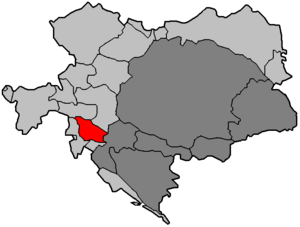
In the second half of the 18th century, Maria Theresa (1717–1780) ordered an administrative reform. The central administration within Austria was dissolved, and the provinces of Carinthia, Styria and Carniola were merged into a single governorate, governed from Graz. Following Austria’s defeat in the Fifth Coalition War in 1809, Napoleon (1769–1821) established the so-called Illyrian Provinces, stretching from the northern Adriatic to the Bay of Cattaro, to which Carniola was also assigned. Following the withdrawal of the French, Ljubljana became the administrative centre of Carinthia and Carniola, which were henceforth merged into a single governorate. During the Vormärz period, a small Slovenian national movement developed here, which presented an ethnically based national programme in 1848.
Following the suppression of the 1848–1849 revolution, the representatives of the Slovenian national movement quickly came to terms with the monarchist and counter-revolutionary forces, as well as with the neo-absolutism of the 1850s. (see also ‘Population, Society and Religion’)
Contemporary History

Following the establishment of the first Yugoslav state after the First World War, the region of Carniola became part of the Kingdom of Serbs, Croats and Slovenes. Until the destruction of Yugoslavia byNazi Germany in April 1941, the region was shaped by a process of Slovenian nation-building in which the geographical concept of Carniola was abolished. Consequently, the cession to Italy – agreed in Rapallo on 12 November 1920 – of not only the coastal region but also the western parts of Upper Carniola and Inner Carniola was portrayed as a loss of ‘Slovenian territory’ (after the Second World War, Slovenia regained these territories).
With the break-up of Yugoslavia, the German-Italian occupation divided Carniola once again. Hitler ordered that the territories occupied by Germany – Lower Styria and the north of Upper Carniola – be ‘made German again’, whilst he left Ljubljana and the rest of Carniola to Italy. The Gottschee region also lay within the Italian occupation zone. Consequently, the slogan ‘Home to the Reich’ meant resettlement and the end of the world for the Gottschee Germans. The decentralised, over-federalised Second Yugoslavia of the second half of the 20th century allowed scope for increasing Slovenian autonomy, which led to the declaration of independence of the Republic of Slovenia in 1991. Carniola ceased to be an administrative unit; it remained a historical concept, overshadowed by Slovenian national discourse.
Population, Society and Religion
In the wake of post-Carolingian colonisation, German-speaking peasants and craftsmen also came to Carniola. The most notable achievement of this colonisation was the development of the Gottschee region from the beginning of the 14th century.
The numerous peasant uprisings in the 15th and 16th centuries, all of which were brutally suppressed, show that the largely Slavic- or Slovenian-speaking rural population was dissatisfied with conditions under Inner-Austrian administration. However, most of the peasant uprisings – and the largest ones – originated in the Gottschee region; the uprisings were therefore essentially not national in nature (Slovenians versus Germans), but socially motivated (peasants versus landlords).
The resonance that the Reformation found in Carniola from the 1520s onwards suggests that many representatives of the Catholic Church, as well as the secular and ecclesiastical nobility, also wished to weaken the Habsburgs or shake them off entirely. The provincial governor and the estates supported the establishment of a Protestant school in Ljubljana. The provincial church joined the Reformation. The preacher Primus Truber (1508–1586) was enthusiastic about the idea of conveying the Holy Scriptures in the languages of the people. His translations were the first books to be printed in the ‘Windish’ or Old Slovenian language in 1550 and 1555. The head of the Protestant school, Adam Bohoritsch (c. 1520–1598), wrote the first grammar of Slavic languages in Latin, taking the ‘Windish’ language into account; it was published in 1584. In the same year, the complete Bible translation by Georg Dalmatin (c. 1547–1589), Truber’s successor as preacher, was printed in the ‘Windish’ language; this Bible continued to serve as a guide for philologists of the 18th and 19th centuries in the codification of the Slovenian written language.
In the long term, the Habsburgs were unwilling to tolerate Protestantism. From around 1580 to 1630, they had the region recatholicised. Around 750 nobles left Inner Austria, 104 of whom were from Carniola. The recatholisation commissions had thousands of Protestant books burnt. The Counter-Reformation halted the further development of the Slovenian written language for almost two hundred years.
The Josephine church and education policies of the second half of the 18th century inevitably drew attention to the linguistic situation in the country and the need to cultivate the ‘Windish’ or ‘Carniolan’ language. For example, in the 1780s, the Bishop of Ljubljana, Karl von Herberstein (1719–1787), insisted on ordaining only those priests who could preach fluently in the language of the Slavic faithful. Although the authorities in Graz and Vienna maintained that German was generally the language of instruction, in the village Sunday and elementary schools the children initially had to be taught in their vernacular. As part of a new form of ‘patriotism’ (Josef Matl), scholars, clergy and writers produced dictionaries, grammars, primers, schoolbooks and the first newspapers, which served to consolidate and further develop the Slovenian written language. This was also encouraged in the Illyrian Provinces: for just under four years, the people of Carniola experienced the Civil Code, a standardised tax system, freedom of trade and universal conscription. French became the language of administration, but lessons were taught in ‘Slovene’.
After 1813, the development of Carniola was characterised by economic stagnation, political oppression and a vigorous cultivation of the Slovenian language. By the mid-19th century, this had led, on the one hand, to the codification of the Slovenian language (distinct from the Croatian language) and, on the other, to the transformation and expansion of Carniolan regional patriotism into a Slovenian national consciousness. The journal *Carniolia*, which appeared from 1838 to 1844 as a patriotic journal and entertainment magazine for art, literature, theatre and social life in Ljubljana, reflects an attempt to foster a supranational, patriotic loyalty to Carniola. The editors and publishers – Leopold Kordesch (1808–1879), Franz Hermann von Hermannsthal (1799–1875) and Josef Blasnik (1800–1872) failed in this endeavour; however, *Carniolia* bears witness to German–Slovenian coexistence and German–Slovenian interactions prior to national confrontation. This was first expressed nationwide during the 1848 Revolution in the petition movement for a ‘United Slovenia’, which aimed to unite the Slovenes in their own kingdom (within the Habsburg Monarchy) with its own provincial assembly and Slovenian as the language of administration and instruction.
The relaxation of mark and restrictions on the right of association following the end of neo-absolutism in 1859, as well as the liberalisation from 1867 onwards, accelerated national differentiation, with the Sloveniannationalist forces remained conservative and Catholic in orientation until the end of the 1860s, whilst the German nationalist forces were predominantly liberal in orientation. Following the example of the Czech national movement, the so-called ‘Young Slovenes’ – who presented themselves as more radical and liberal than the ‘Old Slovenes’ – organised open-air national political gatherings (tabori) from 1868 to 1871. This marked the beginning of the political differentiation within the Slovenian national movement, which had dominated the Ljubljana City Council since 1882 and the Carniola Provincial Assembly since 1883. More so than in neighbouring countries, the Slovenian national movement in Carniola succeeded in bringing about a kind of ‘Slovenisation’ of public life. In 1895, a severe earthquake shook the provincial capital. Mayor Ivan Hribar (1851–1941) incorporated national elements into the necessary reconstruction efforts in order to transform Ljubljana from ‘Laibach ’. However, all three political factions of the Slovenian national movement present in Carniola – conservative-clerical, liberal and social-democratic forces – remained loyal to the Habsburg dynasty until towards the end of the First World War.
According to statistics on languages spoken, which exacerbated national tensions, the number of Germans in Carniola fell from 29,392 to 27,915 between 1880 and 1910 (from 6.2 per cent to 5.4 per cent of the population). In Ljubljana, the proportion of the population identified as ‘German’ fell from 21 per cent to 14 per cent over the same period (these figures should not be overinterpreted; the declaration of one’s everyday language determined one’s national affiliation; heads of households were only permitted to declare one language per person, which did not do justice to the widespread multilingualism in Carniola and the Habsburg Monarchy as a whole.[1]
According to the 1921 and 1931 censuses, the number of native German speakers in the Slovenian part of Yugoslavia fell from 41,514 to 28,998 due to emigration and assimilation. Furthermore, in 1941, Hitler ordered an end to the settlement of Gottschede Germans; just under 12,000 Gottschede Germans moved to the Ranner Triangle north of the River Gurk (Krka), whilst fewer than 100 remained behind. After the Second World War, in the 1948 census in the Slovenian part of the second Yugoslav state, only 2,406 people identified themselves as native German speakers (1,824 Germans and 582 Austrians); this figure fell to below 800 in the following decades (1953: 1,907; 1961: 986; 1971: 700; 1981: 546; 1991: 745.[2]
Economy
The development of the Margraviate of Carniola was facilitated by trade along the Amber Road from Aquileia to Pettau (and onwards towards Croatia and Bosnia). The ‘Lords of Carniola’, as the margraves from the Babenberg and Spanheim dynasties called themselves, promoted the reclamation and development of Carniola from the 11th century onwards: they secured the borders and ensured the consolidation of their rule and administration; they drove forward the construction of roads as well as the development of markets and towns. On the site of the Roman settlement of Emona, the city of Ljubljana was founded in the 12th/13th centuries and became the political and economic centre of the region.
The decline of the Republic of Venice in the early 17th century dealt an economic blow to Carniola; interregional trade declined significantly. The relocation of the seat of government from Graz to Vienna in 1619 is an outward sign of the socio-economic marginalisation of Carniola and its neighbouring regions. The absolutist state responded to the impoverishment of ever-larger sections of the population with disciplinary measures and mercantilist economic policies. Mercantilism provided some impetus for the economic development of Inner Austria, although a north-south divide persisted. In Idria/Idrija in Carniola, where mercury had been mined since 1493, the world’s largest supplier of mercury emerged from the 1740s onwards. In Ljubljana, the number of wealthy merchants, publishers and freight forwarders rose significantly. The drainage of the Ljubljana Marshes, which began after 1750, was also indicative of a certain economic revival, though this remained less pronounced than in the neighbouring countries to the north.
The Josephine reforms of the second half of the 18th century brought some relief to the rural population: the practice of ‘Bauernlegen’ was banned, corvée labour was restricted, serfdom was abolished, and freedom of movement was extended. Attempts were made to modernise agriculture with the help of ‘economic societies’. The transformation from an agrarian to an industrial society took place in Carniola during the ‘nation-building’ process mentioned above, between the two world wars. Even in the Second Yugoslavia, Carniola ranked among the most highly developed and best-structured regions of the entire state.
Culture of memory and remembrance
As early as the mid-19th century, the Slovenian national movement had replaced ‘Carniolan’ with ‘Slovenian’. After 1918, historiography based on the regional history of Carniola redefined this concept. It focused on the Germanisation of ‘Slovenian territories’ in the past, wrote Slovenian national history and, in doing so, also rejected the project of a Yugoslav history.[3] It appears that, in the second Yugoslav state, the historical community integrated itself more closely into Yugoslav historiography than it had before 1941. However, an awareness of Slovenian distinctiveness was preserved. From 1991 onwards, the historical community legitimised Slovenian statehood as the fulfilment of the national demands of 1848 without any major friction.[4] There was, and remains, little scope for the memory of Carniola. Nevertheless, the interested public is familiar with the journal *Kronika* (Chronicle), which has been publishing articles on regional history since 1952, including those on figures, events and developments from the history of the province of Carniola.
For a long time, the terms ‘Krain’ and ‘Oberkrain’ were probably popularised most strongly through the music of the ‘Original Oberkrainer’. However, the region’s traditional folk music has little in common with this musical style, which was created in the early 1950s.
Bibliography
- Mitja Ferenc, Joachim Hösler (eds.): In Search of Traces in the Gottschee. German-speaking Settlers in Slovenia. Potsdam 2011 (Potsdam Library on Eastern Europe – History).
- Harald Heppner (ed.): Slovenes and Germans in a Shared Space. New Research on a Complex Topic. Munich 2002 (Book Series of the South-East German Historical Commission 38).
- Edgar Hösch: History of the Balkan Countries. From Early Times to the Present Day. Munich 1995.
- Joachim Hösler: Slovenia. From the Beginnings to the Present Day. Regensburg 2006 (Eastern and South-Eastern Europe – History of Countries and Peoples).
- Joachim Hösler: From Carniola to Slovenia. The Beginnings of the Processes of National Differentiation in Carniola and Lower Styria from the Enlightenment to the Revolution, 1768 to 1848. Munich 2006 (South-Eastern European Studies 126).
- Jože Korinšek (ed.): Discover Slovenia! Translated from Slovenian by Wolfgang Zitta. Ljubljana 1995.
- Marco Kranjc: Culture Shock Slovenia. Bielefeld 2009.
- Josef Matl: South Slavic Studies. Munich 1965.
- Mira Miladinović-Zalaznik: German–Slovenian Literary Interactions. Ljubljana 2002.
- Dušan Nećak (ed.): The ‘Germans’ in Slovenia (1918–1955). A Brief Outline. Ljubljana 1998.
- Klaus Detlef Olof, Miloš Okuka (eds.): Dream Journeys and Border Surveys. Travellers from Five Centuries on Slovenia. Klagenfurt 1995.
- Petra Rehder: Slovenia. Munich 1999 (Beck’s Countries Series).
- Peter Štih, Vasko Simoniti, Peter Vodopivec: Slovenian History. Society – Politics – Culture. Translated from the Slovenian by Michael Kulnik. Graz 2008.
- Johann Weichard, Baron von Valvasor: The Glory of the Duchy of Carniola. Volumes I and II. Ljubljana and Nuremberg 1689; 2nd, unaltered edition. Edited by Janez Krajec, Vincenz Novak and Josef Pfeifer. Rudolfswerth 1877–1879.
- Krista Zach, Mira Miladinović Zalaznik (eds.): Cross-Sections. ‘… Who knowingly passes off novels as history …’. German–Slovenian culture and history in a shared space. Munich 2001.
Web links
- kronika.zrc-sazu.si (Website of the Slovenian-language journal *Kronika* for Slovenian regional and local history)
- www.slovenia.info/de (Official German-language portal of the Slovenian Tourist Board)
Notes
[1] Hösler: From Carniola to Slovenia, p. 67 ff.
[2] Nećak: The ‘Germans’ in Slovenia, p. 102.
[3] See, for example, Dragotin Lončar: Politično življenje Slovencev [The Political Life of the Slovenes]. Ljubljana 1921; Josip Mal: Zgodovina slovenskega naroda [The History of the Slovenian Nation]. Celje 1928/29; Fran Zwitter: *Prebivalstvo na Slovenskem od XVIII. stoletja do današnih dni* [The Population of Slovenia from the 18th Century to the Present Day]. Ljubljana 1936; Francè Škerl: Ljubljana v prvem desetletju ustavne dobe 1860–1869 [Ljubljana in the First Decade of the Constitutional Era, 1860–1869]. Ljubljana 1938.
[4] See, for example, Janko Prunk: The Slovenian National Revival. National Politics (1768–1992). Ljubljana 1992; Ibid.: Slovenia. An Outline of its History. Ljubljana 1996 [numerous editions and translations]; cf. also Štih/Simoniti/Vodopivec: Slovenian History.
Citation
Joachim Hösler: Krain. In: Online Encyclopaedia on the Culture and History of Germans in Eastern Europe, 2015. URL: ome-lexikon.uni-oldenburg.de/p32564 (accessed 14 October 2021).
Terms of use for this article
Copyright © University of Oldenburg and the Federal Institute for the Culture and History of Germans in Eastern Europe (BKGE), all rights reserved. This work was produced as part of the project ‘Online Encyclopaedia on the Culture and History of Germans in Eastern Europe’ and may be reproduced and published provided the rights holders’ consent has been obtained. Please contact:
If you have any specialist comments or additions to the text, please contact the editorial team, citing relevant literature and source references.