

Rügen (Principality)
Rügen (Principality)
1. Toponymy
The term ‘Principality of Rügen’, referring to a territory that existed between 1168 and 1325, derives from the Baltic Sea island of Rügen, whose name is derived from the designation of the tribes that settled there in the first millennium AD. The Romans were already familiar with a Germanic tribe settled on the southern Baltic coast, to the west of the Goths, whose name, ‘Rugii’, is recorded in Tacitus’s *Germania*. Whether there was a long-standing connection between the tribe and the island remains uncertain. During the Migration Period, the ‘Rugier’ appeared on the borders of the Roman Empire north of Passau and Vienna respectively; unlike in other areas, however, a remnant population apparently remained on the island of Rügen, which was assimilated by the Slavs who had been migrating into this region since the 7th century. It is likely that these Rügen Slavs are referred to as ‘Rugini’ in the Anglo-Saxon church history by the monk Bede the Venerable (672/673–735), by Helmold of Bosau (c. 1120–1177) as ‘Rani’ and by Saxo Grammaticus (c. 1140–1220) as ‘Rugiani’.
Whilst the rulers of this tribe were still occasionally referred to as kings in the sources mentioned above, the term ‘Principality of Rügen’ became established for the High Medieval territory with the establishment of Danish feudal rule in 1168. Particularly in the early days of the principality, titles of sovereignty continued to be found that referred not to the territory but to the tribe, such as ‘Prince of the Slavs’ or‘princeps Ruyanorum’.
Location
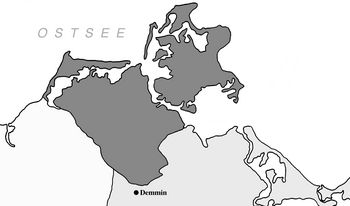
The Principality of Rügen consisted of two parts, which have varied in significance over the course of history: the island of Rügen and mainland Rügen. The island from which it takes its name lies off the West Pomeranian Baltic coast, separated by the Strelasund, and covers an area of 926 km². The mainland boundaries of the Principality of Rügen were formed in the west by an isthmus on the Fischland peninsula south of Ahrenshoop, in the south-west, the River Recknitz from Damgarten to Tribsees; south of Loitz, the River Peene; and, from 1250, the River Ryck north of Greifswald. To the east, the Principality extended as far as the outskirts of Wolgast until the first half of the 13th century, at the time of its greatest extent.
Shortly before its transfer to the Duchy of Pomerania in the first quarter of the 14th century, the principality covered a land area of approximately 3,000 km². The present-day district of Vorpommern-Rügen, which had a population of more than 220,000 in 2013, roughly corresponds to this territory.
Historical Geography
Following the conquest of the temple fortress of Arkona on Rügen, the settlement area of the Rügen Slavs became part of the Danish confederation in 1168 as the Principality of Rügen. The island of Rügen consisted of nine bailiwicks (Garz, Streu, Jasmund, Wittow, Schaprode, Patzig, Gingst, Bergen and Rambin), the structure of which can be traced back to Slavic times and remained significant right up to modern times. During the 12th and 13th centuries, the Princes of Rügen succeeded in consolidating their territory on the mainland, which henceforth comprised the lands of Barth, Damgarten, Grimmen, Loitz, Pütte, Saal, Sund and Tribsees, as well as the dominions of Brandshagen and Gristow. As early as 1215, the County of Gützkow and, in 1250, the territory of Wusterhusen passed definitively to Pomerania.
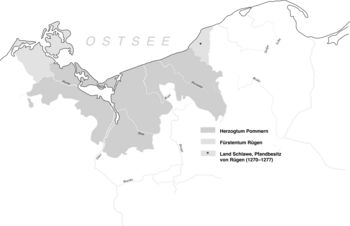
The towns of Stralsund, Garz, Barth, Damgarten, Grimmen and Tribsees were founded by the Princes of Rügen under Lübeck law. The town of Richtenberg came under the sovereignty of Neuenkamp Abbey. The towns of Rugendal (near Garz on Rügen) and Schadegard (near Stralsund), founded by the local rulers, did not endure. The granting of Lübeck town rights to the town of Rügenwalde/Darłowo in Hinterpommern can be traced back to Prince Wizlaw II of Rügen (c. 1240–1302). This is an indication of his ambitions in this region during the 1270s.
In the wake of the Wars of Succession between Pomerania and Mecklenburg after 1325, the Principality of Rügen was dissolved as a separate domain and integrated into the Duchy of Pomerania. From then on, the Dukes of Pomerania bore the title ‘Prince of Rügen’. The actual feudal relationship between the Principality of Rügen and the Kingdom of Denmark lasted until 1438. Whilst it can be assumed that mainland Rügen had been part of the Holy Roman Empire since at least 1283, the island of Rügen also attained this status from the first half of the 15th century. Along with the western part of Pomerania, the Principality of Rügen also came under Swedish rule in 1648. Until 1815, the Swedish kings held, by personal union, the titles of Dukes of Pomerania and Princes of Rügen and, as such, were Princes of the Holy Roman Empire of the German Nation. From 1815 to 1918, the Prussian kings bore the title and coat of arms of a Prince of Rügen. The abdication of Wilhelm II (1859–1941) as German Emperor also formally marked the end of the history of the Principality of Rügen.
Common symbolism
On a seal belonging to Wizlaw I, Prince of Rügen (c. 1180–1250), dating from 1224, a crowned lion with its tail raised can be seen for the first time in the upper part of a divided shield, emerging from gables in the lower part. This coat of arms was adopted by the Dukes of Pomerania following the succession of the Pomeranian throne. The Principality of Rügen, and subsequently the district of Rügen, bore in a shield divided into gold and blue a black lion—crowned in red, with a forked tail and armed—emerging from an open red gable.
Prehistory
Reindeer hunters from the Ice Age (c. 10,000 BC) were already living in the area that would later become the principality. During the Stone, Bronze and Iron Ages, the island in particular repeatedly served as a settlement area.
Settlement by the Rügen Slavs in the early Middle Ages
Although the Rügen Slavs (Ranen) were one of the smallest West Slavic tribes in terms of the extent of their settlements, they nevertheless managed to maintain a pre-eminent position in the western Baltic region for centuries – in economic, political and, not least, religious terms – right up until their Christianisation. The economic foundations were laid by herring fishing in the waters around Rügen, extensive long-distance trade, and raids in the territories of the neighbouring Obotrites and Pomeranians and along the Danish coast.
The incorporation of the Principality of Rügen into the Danish realm from 1168 onwards
At the northern tip of the island of Rügen stood the temple-fortress of Arkona, where the four-headed god Svantevit was worshipped; this was one of the most important religious centres of the Western Slavs. According to 12th-century accounts, the priesthood in Arkona also held political power in the region of the Ranen. There was, admittedly, a nobility and also a king or prince. But it was not until around the time of the destruction of the Arkona temple fortress by a Danish army in 1168 that – beginning with Tezlaw (mentioned in the sources from 1164 to 1170) – that an independent dynasty of the Princes of Rügen became evident, which ruled the territory until its extinction in 1325.
Whilst the island of Rügen was characterised by a high population density throughout the entire late Slavic period (approximately the 10th to the 13th century), the numerous armed conflicts with neighbouring tribes on the mainland opposite led to a far sparser settlement pattern. With the settlement under German law, the economic and political centre of the principality shifted there. The town of Stralsund, situated on the Strelasund opposite the island of Rügen, grew to become one of the most important Hanseatic towns in the Baltic Sea region. However, from the mid-13th century onwards, the Princes of Rügen resided primarily in Barth, situated to the west of Stralsund.
Over the course of the 13th century, Low German gradually began to replace the Slavic vernacular, a process that accelerated in the towns and amongst the upper classes, until Low German became established as the written language in the princely chancellery and in the towns during the 14th century.
With their integration into the Danish state, the princes of Rügen and the collateral branches of the house – foremost among them the Lords of Putbus – ranked among the great lords of the Danish realm. Extensive enfeoffments and pledges of property throughout Denmark and Norway, as well as numerous kinship ties to the Danish royal house and to the other high-ranking noble families of the realm, ensured close links across the Baltic Sea. The extinction of the dynasty of the Princes of Rügen upon the death of Wizlaw III (1265/1286–1325) led to two wars of succession (1325–1328 and 1351–1354) between Pomerania and Mecklenburg, as a result of which the territory of the Principality of Rügen finally passed to the Duchy of Pomerania.
(see also‘Pomerania’)
The Principality of Rügen’s special status in terms of church administration
As the Church spread throughout the region, a long-standing dichotomy arose between mainland Rügen and the island of Rügen. Whilst the conquest of Arkona brought the island of Rügen under the jurisdiction of the Diocese of Roskilde, almost the whole of mainland Rügen was incorporated into the Diocese of Schwerin. The parishes in the Loitz region, acquired for Rügen at a late stage (1273), were not subject to the authority of Schwerin, but to that of the Bishop of Cammin. The same applied to the region of Wusterhusen and the County of Gützkow, which were at times under Rügen’s sovereignty until the first half of the 13th century.
The Cistercian nunnery in Bergen (founded in 1193) on the island of Rügen, the Cistercian monastery in Neuenkamp (founded in 1231) on the mainland and, finally, its daughter foundation, St Nicholas on the island of Hiddensee (founded in 1296). The princes of Rügen were also involved, alongside the Dukes of Pomerania, in the founding of the Cistercian monastery at Eldena in 1199 at the mouth of the River Ryck.
Owing to the high concentration of mendicant monasteries and the town estates of ecclesiastical dignitaries, Stralsund developed into a spiritual centre for the entire territory by the end of the Middle Ages.
Rügen’s special status in terms of ecclesiastical administration was evident right up to the post-Reformation period through the claims of the Dukes of Mecklenburg – as successors to the Bishops of Schwerin – to the Archdeaconry of Tribsee, as well as those of the Danish kings – as successors to the Bishops of Roskilde – to the island of Rügen. With the Reformation, separate superintendencies were established in Stralsund and on Rügen, which for some time served as a reminder that these areas had not belonged to the Pomeranian diocese of Cammin.
The culture of remembrance after 1945
The princely castle in Putbus, whose walls dated back to the Middle Ages, was a key site in the history of the von Putbus family and the Principality of Rügen, owing to its furnishings and its archive. The archive was largely destroyed during the land reform after 1945, and the castle was demolished in 1960.
Today, the archive of the Hanseatic City of Stralsund – alongside the Greifswald Regional Archive and the Szczecin State Archive – is the most important repository for source documentation relating to the region. The Cultural History Museum of the Hanseatic City of Stralsund, founded in 1858 as the Provincial Museum for New Vorpommern and Rügen, is of outstanding importance for the documentation and presentation of artefacts from the history of the Principality of Rügen. In addition, there are significant collections relating to the history of Rügen in the museums in Bergen auf Rügen, Barth and Grimmen.
4. Bibliographical references
- Dirk Alvermann (ed.): The Early Archives of the Bergen Superintendency (1616–1922). Greifswald 2011 (Publications of the Chair of Nordic History 13).
- Bengt Büttner: The Parishes of the Island of Rügen. From Christianisation to the Reformation. Cologne, Weimar, Vienna 2007 (Publications of the Historical Commission for Pomerania, Series V: Research on Pomeranian History 42).
- Bengt Büttner, Haik Thomas Porada: Nordic Nobles and Their Estates on the Island of Rügen during the Middle Ages. In: Medeltida storgårdar – 15 uppsatser om ett tvärvetenskapligt forskningsproblem [Medieval Noble Estates – 15 Essays on an Interdisciplinary Research Problem]. Uppsala 2014 (Acta Academiae Regiae Gustavi Adolphi 131), pp. 269–295.
- Norbert Buske, Joachim Krüger, Ralf-Gunnar Werlich (eds.): The Dukes of Pomerania – Evidence of the Reign of the House of the Griffin. Cologne, Weimar, Vienna 2012 (Publications of the Historical Commission for Pomerania, Series V: Research on Pomeranian History 45).
- Renate Herrmann-Winter: Linguistic Atlas of Rügen and the Vorpommern Coast. Cartography by Martin Hansen. Rostock 2013.
- Karl Lenz: The Deserted Villages of the Island of Rügen. Remagen 1958 (Research in German Regional History 113).
- Fritz Petrick (ed.): The History of Rügen from its Beginnings to the Present Day in Five Volumes. Putbus 2008–2013.
- Heike Reimann, Fred Ruchhöft, Cornelia Willich†: Rügen in the Middle Ages. An interdisciplinary study of medieval settlement on Rügen. Stuttgart 2011 (Research on the History and Culture of Eastern Central Europe 36).
- Martin Schoebel: The Codex Rugianus and the Chancellery of the Princes of Rügen. In: Roderich Schmidt (ed.): A Thousand Years of Pomeranian History. Cologne, Weimar, Vienna 1999, pp. 165–193 (Publications of the Historical Commission for Pomerania, Series V: Research in Pomeranian History 31).
- Joachim Wächter: The Principality of Rügen. An Overview. In: Contributions to the History of Western Pomerania. The Demmin Colloquia 1985–1994. P.p. The Western Pomerania Department of the Society for Pomeranian History, Archaeology and Art e. V., edited by Haik Thomas Porada. Schwerin 1997, pp. 299–313.
Citation
Haik Thomas Porada: Rügen (Principality). In: Online Encyclopaedia on the Culture and History of Germans in Eastern Europe, 2015. URL: ome-lexikon.uni-oldenburg.de/p32544 (accessed 18 March 2015).
Terms of use for this article
Copyright © University of Oldenburg and the Federal Institute for the Culture and History of Germans in Eastern Europe (BKGE), all rights reserved. This work was produced as part of the project ‘Online Encyclopaedia on the Culture and History of Germans in Eastern Europe’ and may be reproduced and published provided the rights holders’ consent has been obtained. Please contact:
If you have any specialist comments or additions to the text, please contact the editorial team, citing relevant literature and source references.