

Support for culture and science under Section 96 of the Federal Budget Act (BVFG)
Support for culture and science under Section 96 of the Federal Budget Act (BVFG)
1. Brief description
Section 96 of the Federal Act on Displaced Persons and Refugees (BVFG) obliges the Federal Government and the Länder to support the preservation and study of the culture and history of those regions in Eastern Europe where Germans used to live or still live today. It forms the legal basis for numerous funding initiatives, particularly those of a cross-border nature.
2. Context, wording and content
The “Act on Matters Relating to Displaced Persons and Refugees” (BVFG), which came into force in 1953, established the framework for the integration of displaced persons, refugees and resettlers into society in the Federal Republic of Germany. Section 96 of the BVFG, also known as the ‘Culture Clause’, forms the basis for funding measures by the Federal Government and the Länder in the fields of culture and science. Funding is provided in accordance with the principle of subsidiarity. The original version of 19 May 1953 was replaced by an expanded revised version which came into force on 27 July 1957; this version included foreign countries as a further beneficiary and extended the scope of support to additional areas. In this version, which remains in force today, Section 96 reads as follows (additions in italics):[1]
Section 96 Preservation of the cultural heritage of displaced persons and refugees and promotion of academic research
“The Federal Government and the Länder shall, in accordance with their powers under the Basic Law, preserve the cultural heritage of the areas from which people were displaced, raising awareness amongst displaced persons and refugees, the entire German people and abroad; they shall safeguard, supplement and evaluate archives, museums and libraries, and to ensure and promote institutions for artistic creation and education. They shall promote scholarship and research in fulfilling the tasks arising from the expulsion and the integration of displaced persons and refugees, as well as the further development of the cultural achievements of displaced persons and refugees. The Federal Government shall report annually to the Bundestag on the measures it has taken.”
Under the term ‘areas of expulsion’ – a phrase characterised by the specific diction of the 1950s – the Act groups together those regions of Eastern, Central-Eastern and South-Eastern Europe in which Germans lived before 1945 or still live today: the historic Prussian eastern provinces such as East Prussia, Pomerania and Silesia in the present-day states of Lithuania, Poland and Russia, as well as the areas settled by Germans in the present-day states of Estonia, Kyrgyzstan, Kazakhstan, Croatia, Latvia, Moldova, Poland, Serbia, Slovakia, Slovenia, the Czech Republic, Turkmenistan, Hungary, Ukraine, Romania, Russia, Belarus and others.

In terms of subject matter, this section covers the history and culture of the German people in the regions mentioned and their interactions with the culture and history of other ethnic groups, as well as with the historical and cultural characteristics of the respective region. It also covers contemporary historical developments such as resettlements, flight and expulsions of Germans in the context of forced migration during and after the Second World War, the resettlements and late resettlements since the 1950s, which intensified in the 1990s; the integration of resettlers, displaced persons and refugees, as well as resettlers and late resettlers, into German society; and their contribution to the establishment and development of the Federal Republic of Germany.
In addition to institutional funding for relevant museums, research institutes and other organisations, project funding is provided in the areas of science, outreach, cultural outreach and cultural education, the preservation of archival material, the restoration of historic monuments, and other areas. The Federal Government’s reports to the Bundestag provide detailed information on the implementation of the provisions of Section 96 of the Federal Cultural Promotion Act (BVFG).[2] The Federal Institute for Culture and History of the Germans in Eastern Europe in Oldenburg (BKGE) is tasked with advising and supporting the Federal Government on all matters relating to the implementation of Section 96 of the BVFG.
3. Discourses/Controversies
Funding for culture and science under Section 96 of the Federal Education and Training Act (BVFG) has, from the outset, been caught between political and scientific or specialist developments and interests. For this reason, in the context of the political and social changes that have taken place since the Act came into force, it has been assessed differently within academic and wider society. On the one hand, the focus of its content solely on Germans has been criticised; on the other hand, there have been calls for greater consideration to be given to the interactions with other ethnic groups and cultures. Conversely, certain interest groups have asserted that this legal framework should be used primarily to support the institutions and cultural policy concerns of displaced persons and refugees.
4. Development of funding under Section 96 of the Federal Vocational Training Act (BVFG)
Funding under Section 96 of the BVFG was initially provided by the Federal Ministry for Displaced Persons, Refugees and War Victims (BMVt), until it was dissolved in 1969 and its responsibilities transferred to the Federal Ministry of the Interior (BMI). In 1998, responsibility for funding was largely transferred to the Federal Government Commissioner for Culture and the Media (BKM).
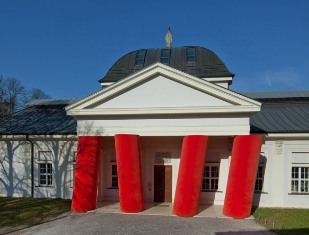
Kunstforum Ostdeutsche Galerie, Regensburg,
Façade with column installation by Magdalena Jetelová,
Venceremos/Sale, 2006 [Photo: W. Schmidt].

In the early days of the Federal Republic of Germany, the focus of funding was on resuming or continuing support for culture and research relating to the historical eastern territories (“East Germany”). It centred on the newly established cultural institutions, initiatives and associations of displaced persons and refugees (regional associations, the Federation of Displaced Persons, cultural societies) as well as the newly constituted academic institutions (such as the Herder Institute in Marburg, founded in 1950). With the eight-volume documentation of the expulsion of Germans from Eastern Central Europe (1953–1961) and the three-volume publication *Die Vertriebenen in Westdeutschland* (1959), two seminal works were supported, the – not uncontroversial — continues to be felt to this day. The new Ostpolitik and the Warsaw Treaty (1970) also had an impact on funding under Section 96 of the Federal Refugee Act (BVFG). From then on, greater consideration was given to the general German public and also to other countries. Finally, following the political transition of 1989–1990, funding was adapted to the new international framework.[3] Today, the focus is on the safeguarding, museum conservation and presentation of cultural heritage in relevant state museums, academic research based on international co-operation, cultural education and fostering understanding with Germany’s eastern neighbours. The end of the Cold War, the reunification of Germany and the eastward enlargement of the EU have also had a lasting impact on the concept of cultural funding under Section 96 of the BVFG: The term‘East Germany’, which was in use until 1989, is now applied in official contexts solely to the new German Federal States; the scope of funding has been redefined as ‘Culture and History of the Germans in Eastern Europe’; and a shift has been made from the former ‘ethnic heritage’ paradigm to a ‘relationship’ paradigm. The topic has gained increased relevance due to the expanded opportunities for international academic cooperation arising from European integration and, in particular, the interest shown by the current inhabitants of these regions in their regional history and culture. Since the accession of Eastern and Central European states to the European Union (2004, 2007), the cultural heritage of Germans in Eastern Europe has been understood as part of national culture and, increasingly, as a European cultural heritage to be jointly preserved and researched. Accordingly, the funding framework under Section 96 of the Federal Cultural Promotion Act (BVFG) is designed to reach as wide an audience as possible, both in Germany and abroad.
Cultural education, outreach work
- Adalbert Stifter Society, Munich
- German Cultural Forum for Eastern Europe, Potsdam
- Gerhart Hauptmann House, Düsseldorf
- Haus der Heimat of the State of Baden-Württemberg, Stuttgart
- Haus der Heimat e. V., Nuremberg
- House of the German East, Munich
Museums
See also Regional Museums
- Danube Swabian Central Museum, Ulm
- Kunstforum Ostdeutsche Galerie, Regensburg
- Museum Haus Schlesien, Königswinter
- Upper Silesian State Museum, Ratingen
- East Prussian Cultural Centre, Ellingen
- East Prussian Regional Museum, Lüneburg
- Pomeranian State Museum, Greifswald
- Silesian Museum, Görlitz
- Transylvanian Museum, Gundelsheim
- Foundation for Flight, Expulsion and Reconciliation, Berlin
- West Prussian State Museum, Münster
Science
- Herder Institute for Historical Research on East Central Europe – a Leibniz Association institute, Marburg
- Institute for German Culture and History in South-Eastern Europe (e. V.), Munich
- Institute of Danube Swabian History and Regional Studies, Tübingen
- Institute for the Culture and History of Germans in North-Eastern Europe (e. V.), Lüneburg
- Institute for the Folklore of Germans in Eastern Europe (IVDE), Freiburg (until 31 July 2013: Johannes Künzig Institute for East German Folklore)
Support for early-career researchers
- Immanuel Kant Scholarship
- Immanuel Kant Research Prize
- Georg Dehio Prize
Bibliography
- Gerhard Robbers: Cultural Promotion and Competence. Federal Competences in Cultural Promotion under the Law on Displaced Persons and Refugees. In: Deutsches Verwaltungsblatt 3 (2011), pp. 140–149.
- Beate Störtkuhl: ‘Culture and History of the Germans in Eastern Europe – a Subject of Current Art-Historical Inquiry?’ In: www.kunsttexte.de/ ‘Ostblick’ 1/2010. URL: www.kunsttexte.de/index.php.
- Christoph Bergner, Matthias Weber (eds.): Resettlement and Minority Policy in Germany. Assessment and Prospects. Munich 2009 (Publications of the Federal Institute for the Culture and History of Germans in Eastern Europe 38).
Web links
- www.gesetze-im-internet.de/bvfg/BJNR002010953.html (text of the BVFG)
- www.bundesregierung.de/breg-de/bundesregierung/bundeskanzleramt/staatsministerin-fuer-kultur-und-medien/staatsministerin-und-ihr-amt (website of the Minister of State for Culture and Media)
- www.bkge.de/5843.html (website of the Federal Institute for Culture and History of the Germans in Eastern Europe)
Notes
[1] Federal Law Gazette, Part I, No. 47, p. 1236.
[2] See the Federal Government’s latest report covering the years 2009/2010; BT-Drucks 17/9401, dated 19 April 2012.
[3] See most recently: BT-Drucks. 14/4586 of 26 October 2000.
Citation
Matthias Weber: Support for culture and science under the Federal Displaced Persons Act (Section 96 BVFG). In: Online Encyclopaedia on the Culture and History of Germans in Eastern Europe, 2012. URL: ome-lexikon.uni-oldenburg.de/p32877 (as at 21 February 2022).
Terms of use for this article
Copyright © University of Oldenburg and the Federal Institute for the Culture and History of Germans in Eastern Europe (BKGE), all rights reserved. This work was produced as part of the project ‘Online Encyclopaedia on the Culture and History of Germans in Eastern Europe’ and may be reproduced and published provided the rights holders’ consent has been obtained. Please contact:
If you have any specialist comments or additions to the text, please contact the editorial team, citing relevant literature and source references.