

Schwenckfelders
Schwenckfelders
1. Definition
‘Schwenckfelders’ is the term used to describe the followers of the mystical spiritualist and reformer Kaspar Schwenckfeld von Ossig (1489–1561).
2. Support, use
From the second third of the 16th century onwards, Schwenckfeld communities (known in English as Schwenkfelders) were found not only in numerous territories of the Holy Roman Empire of the German Nation, but particularly in Silesia and the County of Glatz. Originally, ‘Schwenckfelder’ was primarily a pejorative or heretical term used by others. From the turn of the 17th century onwards, they adopted the term as a self-designation to distinguish themselves from other religious communities. In more recent historiography, the term is generally used in a neutral sense.
3. Teaching and structures
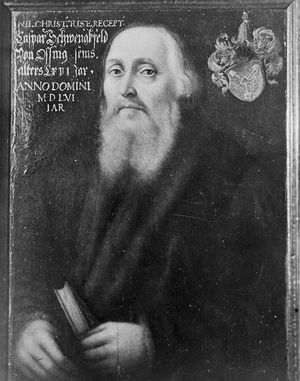
Kaspar Schwenckfeld von Ossig was originally a follower of Martin Luther’s (1483–1546) Reformation. However, as his spiritualism grew stronger, disputes broke out from 1525 onwards with Luther and his associates over the understanding of the sacraments. A rift developed between them and the Upper German and Swiss Reformers when Schwenckfeld and his followers (among them Valentin Krautwald, d. 1545) gradually began to develop deviant Christological ideas and, from 1538 onwards, held the view that the ‘man Jesus Christ’ had never been a ‘creature’ (not even in his state of humiliation, i.e. during his earthly ministry), but a ‘new man’. At their rebirth, human beings are incorporated into this ‘glorified’ Christ and, in a lifelong process, share in his glory. Owing to their spiritualist theology and their otherworldly piety, the Schwenckfelders levelled severe criticism at the doctrine and state of the Lutheran Church, to which they generally belonged legally by virtue of their baptism.
Unlike the Schwenckfelders in the southern and western German territories, those in Silesia formed larger, enduring communities. Such communities had existed here since the mid-16th century, primarily in villages on the south-western periphery of the Duchy of Liegnitz and the adjoining border region of the Hereditary Principalityof Schweidnitz-Jauer.
4. Origins and historical overview
Centred on the nobleman Kaspar Schwenckfeld von Ossig, who had been a court councillor to Duke Frederick II of Liegnitz since 1519, Brieg and Wohlau, had been gathering since the early 1520s to help the Reformation, which had originated in Wittenberg, gain a foothold in Silesia. Even after Schwenckfeld voluntarily left his homeland in the spring of 1529 following theological differences with Frederick II of Liegnitz and continued his work in southern and western German territories until his death, his following in Silesia continued to grow. Furthermore, his followers in the County of Glatz had gained considerable influence from the late 1530s onwards, though this came to a halt with the forcible recatholisation of the county (from 1622). Owing to their theological deviations and criticism of the Church, secular authorities – often urged on by local Lutheran parish priests – took disciplinary and punitive measures against them (coercive detention, penal servitude, forced labour, galley sentences). In 1719, as part of the Counter-Reformation carried out with great severity in Silesia, a Jesuit mission was established among them on the orders of Emperor Charles VI, with the aim of persuading them to convert to Catholicism. As the mission’s measures (compulsory gatherings, fines, bans on marriage) became increasingly severe, and after their petitions for tolerance or legal emigration had been rejected, several hundred of them secretly left their homeland from early 1726 onwards. They made their way to the nearby Lutheran region of Upper Lusatia, which had belonged to the Electorate of Saxony since the Peace of Prague in 1635. Here they were given temporary accommodation in Görlitz and, above all, in Herrnhut and Oberberthelsdorf, estates belonging to the Pietist Imperial Count Nikolaus Ludwig von Zinzendorf (1700–1760). In 1733, Frederick Augustus II of Saxony (1696–1763) – following an intervention by Emperor Charles VI – ordered them to leave the Electorate in small groups within a year. After a fruitless search for a new refuge in Europe, they decided to emigrate to America. The Schwenckfelders who remained in Silesia continued to be subjected to the arbitrary measures of the Jesuit mission (forced baptisms). However, when King Frederick II of Prussia marched into Silesia two months after the death of Emperor Charles VI (20 October 1740) and took possession of it – relying on disputed legal claims (the Liegnitz Fraternal Alliance of 1537) – he immediately guaranteed them individual freedom of religion and conscience
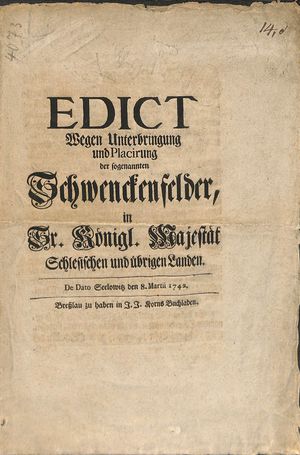
They were thus legally reintegrated into the Lutheran Church, meaning that sacramental services had to be performed by the respective local vicar; however, there was no obligation to participate in church life. They were free to hold domestic devotions and private edification meetings. Despite these favourable conditions, the Silesian Schwenckfeld movement steadily declined. The Schwenckfelders, whose numbers were dwindling, met for devotional gatherings only sporadically at best, and in their everyday way of life and dress they no longer differed from those around them. The reasons for the decline of the Silesian Schwenckfeld movement and its eventual extinction in the early 19th century were the migration of its most committed followers to America and its demographic trends.
The 204 Schwenckfelders, most of whom were related to one another, who emigrated to America via Holland in six waves (1731–1737), were unable, despite intensive efforts, to acquire a contiguous tract of land in Pennsylvania on which to settle together. Eventually, they settled within a 50-mile radius north-west of Philadelphia. Although there was complete freedom of religion in this English colony (William Penn’s ‘holy experiment’), their religious community life initially went through a serious crisis, caused primarily by their relatively scattered settlement pattern and the need to establish new livelihoods. It was revitalised following the first General Conference of all Schwenkfelders in October 1762 through the intensification of religious instruction for young people and the creation of catechetical literature and spiritual hymns. Spiritual gatherings now took place on a regular basis and were more structured. In 1782, the ‘Society of Schwenkfelders’ was established. With its ‘Basic Rules’ (‘Constitution’) – strongly focused on the religious and moral shaping of individual and communal life – the Schwenckfelders adopted a binding set of rules for the first time. Everything was to be determined exclusively by love, the ‘archetype’ Jesus Christ; love is the ‘virtue that unites God and humankind’. Significantly, this ‘Constitution’ no longer included key characteristics of Schwenckfeld’s theology, such as his Christology, as these had become largely marginal or irrelevant since the second generation of immigrants. In 1909, the Congregationalist ‘Schwenkfelder Church’ was founded. In addition to the core tasks of the congregation, its autonomous parishes focus in particular on education and upbringing, charitable and social work, and the preservation of literature and tradition.
5. Significance
Kaspar Schwenckfeld was a leading figure of the Radical Reformation. Owing to their spiritualism, his followers made a significant contribution, above all, to the development of the idea of tolerance. They also influenced various pietist movements of the 17th and 18th centuries. The Schwenckfelders who emigrated to Pennsylvania contributed to America’s cultural and religious pluralism through their dedicated preservation of the Schwenckfeld tradition and Silesian culture. Through their wide-ranging contacts with other denominations, they fostered mutual understanding and promoted practical Christianity (e.g. by supporting Germans in need through Relief Work after the Second World War).
Bibliography
- Corpus Schwenckfeldianorum. Edited by Chester D. Hartranft, Elmer E. S. Johnson and Selina Gerhard Schultz. 19 vols., Leipzig, Pennsburg, PA 1907–1961.
- Peter C. Erb (ed.): Schwenkfelders in America. Pennsburg, PA 1987.
- Caroline Gritschke: ‘Via Media’. Spiritualist Lifestyles and Confessionalisation. The Schwenckfeld Movement in Southern Germany in the 16th and 17th Centuries. Berlin 2006 (Colloquia Augustana 22).
- Howard Wiegner Kriebel: The Schwenkfelders in Pennsylvania. A historical sketch. Lancaster, PA 1904.
- R. Emmet McLaughlin: Caspar Schwenckfeld, Reluctant Radical. His Life to 1540. New Haven, CT, London 1986.
- R. Emmet McLaughlin: Schwenckfeld and the Schwenkfelders of South Germany. In: Peter C. Erb (ed.): Schwenckfeld and Early Schwenkfeldianism. Pennsburg, PA 1986, pp. 145–180.
- Selina Gerhard Schultz: Caspar Schwenckfeld von Ossig (1489–1561). Spiritual interpreter of Christianity, apostle of the middle way, pioneer in modern religious thought. Norristown, PA ⁴1977.
- Horst Weigelt: Spiritualist Tradition in Protestantism. The History of Schwenckfeldism in Silesia. Berlin, New York 1973 (Studies in Church History 43).
- Horst Weigelt: Migration and Faith. The Migrations of the Schwenkfelders from Germany to America – Risks and Opportunities. Göttingen 2017 (Research in Church and Dogmatic History 110).
Web links
- www.schwenkfelder.com/ (Schwenkfelder Library & Heritage Centre)
- www.centralschwenkfelder.com/ (Central Schwenkfelder Church, Worcester, Pennsylvania)
Notes
[1] Caspar von Schwenckfeld: On the Incarnation of Christ. In: Corpus Schwenckfeldianorum, VI, 235.
[2] The Silesian writer Fedor Sommer (1864–1930) paints a vivid picture of the lives of the Schwenckfelders during the Jesuit mission in his novel *Die Schwenckfelder. A Novel from the Time of the Counter-Reformation’ (Halle 1911); English: ‘The Iron Collar’ (Pennsburg, PA 1956).
Citation
Horst Weigelt: Schwenckfelder. In: Online Encyclopaedia on the Culture and History of Germans in Eastern Europe, 2018. URL: ome-lexikon.uni-oldenburg.de/p32776 (as at 7 September 2020).
Terms of use for this article
Copyright © University of Oldenburg and the Federal Institute for the Culture and History of Germans in Eastern Europe (BKGE), all rights reserved. This work was produced as part of the project ‘Online Encyclopaedia on the Culture and History of Germans in Eastern Europe’ and may be reproduced and published provided the rights holders’ consent has been obtained. Please contact:
If you have any specialist comments or additions to the text, please contact the editorial team, citing relevant literature and source references.