

Kolberg/Kołobrzeg
Kolberg/Kołobrzeg
Etymology
A compound word formed from the Old Slavic words ‘Kol’ – ‘stake’ – and ‘berg’ – ‘bank’ or ‘hill’.
Location

Political and administrative affiliation
Republic of Poland; West Pomeranian Voivodeship (Województwo zachodniopomorskie).
Common symbolism
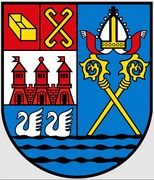
The current coat of arms features a shield divided into two parts. On the heraldic left-hand side is a silver bishop’s mitre with white and red ribbons on a blue background, beneath which are two crossed bishop’s croziers. The heraldic right-hand side is divided into three sections: the upper red field shows two golden crossed hooks on the left and a golden pan on the right, with a red defensive wall featuring three gates on a silver background between them, and beneath this, two silver swans on a blue background. The lower part consists of black ocean waves on a blue background.
The coat of arms in this form has been in use since the 17th century. The oldest known depictions of the coat of arms, dating from the 14th century, showed only the crossed bishop’s croziers and the mitre above the ocean waves, a reference to episcopal rule – until 1534. The symbolism in use since the 17th century refers to the tradition of salt-making (hook and pan), the harbour and the fortress (defensive wall), and the merchant and seafaring tradition (swans)[1].
Middle Ages
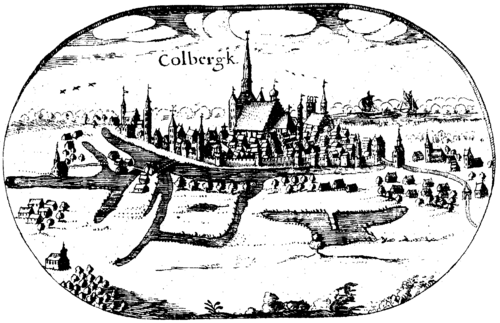
The first settlement (approximately two kilometres south-east of the present-day town, now known as Budzistowo, meaning ‘Old Town’) is thought to have existed as early as the 8th century AD. From the mid-9th century onwards, there was a fortified complex comprising a castle[2]. In the mid-10th century, the settlement, like the whole of Pomerania , came under the rule of the Piasts. It was first mentioned in historical sources as ‘Salsa Cholbergiensis’ (Latin for ‘salt works’) in the Chronicle of Thietmar of Merseburg (early 11th century), it served as the seat of the missionary diocese founded by Bolesław the Brave, headed by Reinbern, the first Bishop of Pomerania (until the bishop’s expulsion by the pagan Pomeranians in 1010)[3]. In 1107–1108, ‘Cholberg’ was reconquered by Duke Bolesław III Schiefmund and incorporated into the Polish Piast state; in 1135, he was forced to recognise the feudal suzerainty of the Holy Roman Empire over the greater part of Pomerania. Following the prince’s death and the fragmentation of Poland into individual principalities in 1138, the Pomeranian princes recognised the emperor’s feudal suzerainty in 1181. Between 1168 and 1186, Denmark conquered Vorpommern and Hinterpommern and held them until 1227.
In 1248, the Pomeranian Duke Barnim I exchanged the territory of Kolberg with the Bishopric of Cammin for the territory of Stargard. In 1255, a new town was founded approximately two kilometres north of the old settlement; it was granted Lübeck law by Duke Wartislaw of Pomerania and the Bishop of Cammin. In 1277, the town became part of the Cammin chapter. In 1442, a conflict arose between the town and the bishop over the bishop’s claims to the revenue from the salt works and the harbour, which had previously been due to the town. Kolberg was subsequently placed under ecclesiastical excommunication and unsuccessfully besieged; the dispute was not settled until 1468.
Modern times
Following the introduction of the Reformation in Pomerania , conflicts arose between the town council and the now Protestant diocese, as the town wished to seize the opportunity to free itself from dependence on the sovereign. The disputes were settled in the late 1540s through the mediation of the Imperial Chamber Court.
During the Thirty Years’ War, the town was occupied by imperial troops in 1627, leading to the expansion of its fortifications. In 1630, part of the population fell victim to a plague epidemic; in 1631, Kolberg was conquered by the Swedes. Following the Peace of Westphalia in 1648, Kolberg, along with the whole of Hinterpommern, became part of Brandenburg-Prussia. Kolberg became the seat of the provincial authorities: the Pomeranian Government, the Chamber, the Court of Appeal and the Pomeranian and Camminschen Ecclesiastical Consistory, which was relocated to Stargard/Stargard Szczeciński in 1688.
During the Seven Years’ War, the fortress of Kolberg was besieged by Russian troops in 1758 and 1760, captured in 1761, and then rebuilt and refortified under Prussian administration in 1762.
19th/20th century
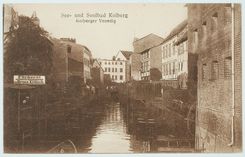


In 1806–07, during the Napoleonic Wars, Kolberg was unsuccessfully besieged by French troops.
As part of the Prussian administrative reform of 1816, Kolberg became part of the Fürstenthum Cammin district in the Köslin administrative region; from 1872 onwards, it was an independent district town. In the same year, the fortifications were demolished; the town remained the seat of a garrison, which was expanded following the National Socialists’ seizure of power to include further barracks, an air base and a torpedo school.
In 1944, Kolberg was declared a fortress and was captured by Soviet and Polish troops on 18 March 1945. In 1945, the town came under Polish administration. From 1946 to 1950, it belonged to the Szczecin Voivodeship, and thereafter to the Koszalin Voivodeship. Following the administrative reform of 1999, the town became part of the West Pomerania (Hinterpommern) Voivodeship.
Economy

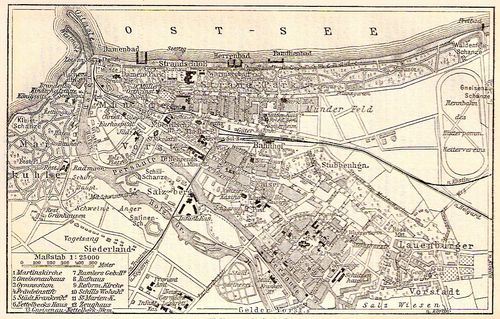
The first Pomeranian settlement was known for its salt springs; even in the Middle Ages, salt production and trade, alongside fishing, were the town’s main sources of income. From 1361 to 1610, Kolberg was a member of the Hanseatic League. After 1800, the town experienced an economic boom with the development of spa facilities and, later, seaside tourism. In 1859, Kolberg was connected to the railway network. Following the demolition of the fortifications in 1873, the town was expanded, and parks, health resorts and hospitals were built a . In the 19th century, Kolberg developed into a major cargo port; in the 20th century, it also became important for passenger shipping and as a marina. Following the Second World War and the town’s reconstruction, spa operations were resumed and further expanded after 1990. Today, Kolberg is one of the region’s leading tourist destinations, whilst the commercial port is now of only regional significance.
History of Religion and the Church


Between 1000 and 1010, the first settlement of Kolberg (Budzistowo, Old Town) was the seat of the missionary diocese founded by Bolesław the Brave. As early as 1125, Bishop Otto of Bamberg visited the settlement and consecrated St Mary’s Church. In 1276–77, the town came under the jurisdiction of the Diocese of Cammin and became the seat of the cathedral chapter, with St Mary’s Church serving as the collegiate church and a cathedral school. In 1531, the first sermon based on Luther’s teachings was delivered in St Mary’s Church; in 1534, the Reformation was officially introduced in the town, the cathedral chapter became Protestant, and secularisation took place in 1811. A Roman Catholic parish was not re-established in Kolberg until 1895 (St Martin’s, on what is now ul. Zwycięzców). With the reconstruction of St Mary’s Church, the Kolberg Cathedral Chapter was reactivated in 1979, and St Mary’s Church was elevated to the status of a co-cathedral.
Jews in Kolberg
The earliest documentary references to a Jewish community in Kolberg date from 1261. Around 1510, all Jews were expelled from the town. Following the introduction of the Prussian Jewish Edict of 1812, Jewish families began moving back into the town. In 1816, the community acquired its own cemetery; in 1844, the first synagogue was built, which was replaced by a new building in 1900. Jewish doctors such as Aaron Simon, Moritz Behrend and Hermann Hirschfeld played a key role in the development of the spa infrastructure. In 1874, the Jewish Spa Hospital, with 100 beds, was opened. From the beginning of the 20th century, the number of Jewish residents declined, particularly after 1933 due to the professional bans imposed by the Nazis on Jewish doctors and the prohibitions on the Jewish population using the spa facilities. During Kristallnacht, the synagogue was vandalised and subsequently converted into a warehouse. The last Jewish residents were deported to ghettos in the General Government in early 1940 and later murdered. A lapidarium comprising old gravestones, erected in 2000 on the site of the so-called old Jewish cemetery (Stary cmentarz żydowski w Kołobrzegu, on the corner of ul. Zdrojowa and Mickiewicza); a memorial stone to the victims of the Holocaust has also stood there ever since.
Population
Before the Thirty Years’ War, the town had a population of around 6,000. Following the Russian siege of 1758–61, the figure fell to 3,940. After 1820, an economic boom led to a rapid rise in the population.
1820: 5,554 (of whom 43 were Catholics and 48 were Jews), 1862: 10,082 (92 Catholics, 202 Jews), 1900: 20,200 (786 Catholics, 349 Jews), 1939: 33,580 (85 Jews).
In the second half of the 19th century, a Polish minority lived in the town, accounting for approximately 1.5 per cent of the population by 1900.[4] In 1945, the population fell to 2,816 as a result of the flight and expulsion of the Germans. Poles settled in the town, including displaced persons from the former Polish eastern territories. By 1960, the population had risen to around 17,000; in 2006 it stood at around 44,000, and in 2021 at 45,930.[5] /
Art History and Architecture

In the area of the first settlement (Budzistowo, Old Town), the remains of a fortified, two-part complex have been preserved on a hill on the right bank of the Persante. From the first half of the 12th century, two churches were built in the Old Town: St Mary’s Church (consecrated in 1125, handed over to the Order of St Benedict following the relocation of the town, and demolished in 1727), and St John’s Church, built after 1222. The Gothic, single-nave building was endowed by the Pomeranian Duchess Miroslawa and donated to the Benedictine monastery in Mogilno. Damaged following the introduction of the Reformation and during the Seven Years’ War, it was renovated in 1776 and 1827.
In Kolberg’s old town, only a few buildings have survived. In 1945, over 90 per cent of the houses lay in ruins. In the 1950s and 1960s, a number of town houses were rebuilt (including the 15th-century Gothic Schlieffen House, now home to the Polish Arms Museum; the Braunschweig House, named after the von Braunschweig family of councillors, built in the mid-17th century for the Plüddemann family of merchants and shipowners, rebuilt in 1808, and now the Museum of Local History). The Old Town was developed from 1985 onwards according to a design by Michał Witwicki, featuring understated postmodern forms. This makes Kolberg the first town in the second phase of the reconstruction of Polish towns. Unlike in Elbing/Elbląg, the best-known example of this so-called ‘retroversion’, Kolberg chose not to adapt its architecture to match the historical façades.
The city’s most imposing building is the five-aisled St Mary’s Church, built between 1301 and 1321 and extended on both sides by one aisle each after 1350, and covered with a widely projecting gable roof. The west façade, with its unfinished towers, stands like a mighty transverse bar in front of the naves. The church is the only five-aisled basilica in present-day Poland.
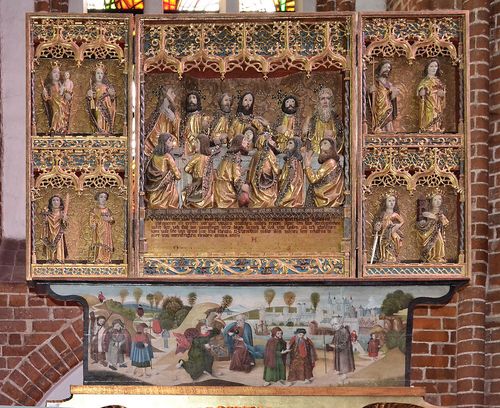
Remnants of the rich Gothic frescoes have survived. The interior furnishings (high altar, pulpit, organ) date largely from the post-war period. Three of the original 22 late-Gothic side altars have survived, as have the councillors’ pews from the early 15th century and the choir stalls of the collegiate chapter (c. 1340).
Other valuable elements of the original interior include the bronze baptismal font by Master Johann Alart (1335) depicting scenes from the life of Christ, the nave chandelier (1523), named the ‘Schlieffen Crown’ after its donor; a Marian candlestick (from the Holken family, c. 1420); two Gothic crucifixes and votive paintings (including the one commissioned by Siewert Granzin, ‘Poor Souls Rush to the Aid of a Knight Fleeing from Pursuers’, 1442). The seven-armed floor candlestick from a Lübeck workshop (1327) belongs to a small group of similar objects in Braunschweig, Paderborn, Essen and Milan.
Close to St Mary’s Cathedral stands the Town Hall, redesigned in 1826 by Karl Friedrich Schinkel (1781–1841) over Gothic cellar vaults; the construction was carried out between 1829 and 1832 by his pupil Ernst Friedrich Zwirner (1802–1861).6] The unplastered neo-Gothic brick building was constructed as a three-winged complex with an attic and a central square tower, reminiscent of a medieval castle.
A relic of the medieval town fortifications dating from the 15th century is the so-called Luntenturm (Powder Tower; Baszta Lontowa or Prochowa) in the north of the former old town, a rectangular building in the Brick Gothic style.
The modern fortifications of Kolberg Fortress were demolished in 1887; fragments from the 18th and early 19th centuries are visible, amongst other places, in the harbour area – such as Fort Münde beneath the lighthouse, which was effectively rebuilt in 1947 on the foundation walls dating from 1770.
Education
From the second half of the 13th century, there was a Latin school at Kolberg Cathedral, which later became the Ratslyzeum and was converted into the State Cathedral and Realgymnasium in the mid-19th century. From the mid-17th century, Kolberg was home to military training establishments. In 1655, Elector Frederick William of Brandenburg founded a knights’ academy, which was closed in 1716 and merged into the Royal Knights’ Academy in Berlin.
Culture of remembrance

The defence of the town under the overall command of August Graf von Gneisenau in 1806–07 became the subject of the Nazi propaganda film *Kolberg*, directed by Veit Harlan, in 1944.
Bibliography
- Tadeusz Gasztold, Hieronim Kroczyński, Hieronim Rybicki: Kołobrzeg: An Outline of its History. Poznań 1979.
- Ernst Bahr, Roderich Schmidt: The Old Town of Kolberg. In: Helge bei der Wieden, Roderich Schmidt (eds.): Mecklenburg-Pomerania. Handbook of Historic Sites in Germany. Stuttgart 1995.
- Hieronym Kroczyński: Dawny Kołobrzeg. Old Kolberg. Kołobrzeg 1999.
- Kolberg (Hinterpommern), in: Klaus-Dieter Alicke: Encyclopaedia of Jewish Communities in the German-speaking World, Vol. 2, Großbock – Ochtendung. Gütersloh 2008, p. 2259.
- Jerzy Patan: The History of the Former Seaside Resort of Kołobrzeg 1872–1945. Kołobrzeg 2010, p. 291.
- Hugo Riemann: History of the Town of Colberg. Based on primary sources. With documents, plans of the siege and a view of Colberg. Colberg 1873 [Reprint urn:nbn:de:gbv:9-g-5272255].
- Hieronim Rybicki: Kołobrzeg. An outline of its history. Poznań 1979.
- Tomasz Torbus: Poland. Journeys between the Baltic Sea and the Carpathians, the Oder and the Bug. Ostfildern 2011.
- Dirk Schleinert: The Town and the Salt. Sources on the Kołobrzeg Salt Works in the State Archives of Saxony-Anhalt. In: Pomerania. Journal of Culture and History. Vol. 43 (2005), No. 4, pp. 11–21.
Web links
- citypopulation.de/de/poland/zachodniopomorskie/admin/powiat_kołobrzeski/3208011__kołobrzeg/
- kolberg-koerlin.de/ortsforschung/kolberg/
- miastokolobrzeg.pl/historia/49-historia-kapituly-kolegiackiej-w-kolobrzegu.html
- https://www.sztetl.org.pl/de/node/137491
- www.herder-institut.de/bildkatalog/wikidata/Q110011 (Images relating to Kolberg from the Herder Institute’s image archive, Marburg)
Notes
[1] Marian Gumowski: Coats of Arms of Polish Towns. Warsaw 1960, p. 202.
[2] Tadeusz Gasztold, Hieronim Kroczyński, Hieronim Rybicki: Kołobrzeg: An Outline of its History, Poznań 1979; Ernst Bahr, Roderich Schmidt: The Old Town of Kolberg. In: Helge bei der Wieden, Roderich Schmidt (eds.): Mecklenburg-Pomerania. Handbook of Historic Sites in Germany. Stuttgart 1995, pp. 151ff.
[3] Bahr/Schmidt 1995.
[4] Hieronym Kroczyński: *Dawny Kołobrzeg*. Old Kolberg. Kołobrzeg 1999, p. 52.
[5]https://pl.wikipedia.org/wiki/Ko%C5%82obrzeg; see also https://citypopulation.de/de/poland/zachodniopomorskie/admin/powiat_kołobrzeski/3208011__kołobrzeg/
[6] Ewa Gwiazdowska: Schinkel, his pupils and the forms of their architecture in present-day Western Pomerania. In: Melanie Ehler (ed.): Schinkel and his pupils: in the footsteps of great architects in Mecklenburg and Pomerania. Schwerin 2004, pp. 97–112.
Citation
Tomasz Torbus: Kolberg/Kołobrzeg. In: Online Encyclopaedia on the Culture and History of Germans in Eastern Europe, 2024. URL: ome-lexikon.uni-oldenburg.de/p32295 (as at 24 April 2024).
Terms of use for this article
Copyright © University of Oldenburg and the Federal Institute for the Culture and History of Germans in Eastern Europe (BKGE), all rights reserved. This work was produced as part of the project ‘Online Encyclopaedia on the Culture and History of Germans in Eastern Europe’ and may be reproduced and published provided the rights holders’ consent has been obtained. Please contact:
If you have any specialist comments or additions to the text, please contact the editorial team, citing relevant literature and source references.