

Reichenberg/Liberec
Reichenberg/Liberec
Etymology
The origin of the name has not been conclusively established. As the settlement was not particularly wealthy, it is thought that German settlers brought the name ‘Reichenberg’ with them, or that it derives from rich mineral deposits.
Historical terms
Among others, the following German names have been handed down: Reychinberch, Reychmberg, Reichmberg, Richemberg. In Czech, the name evolved from Rychberg via Lychberg, Libercum and Liberk to the modern name Liberec , as a result of the sound shift from r to l at the beginning of a syllable.
Location
Reichenberg is situated in the north of the Czech Republic, south-east of the tri-border area where Germany, Poland and the Czech Republic meet, at 50° 46′ north latitude and 15° 3′ east longitude, 374 m above sea level (town centre), approximately 90 km north-east of Prague/Praha.
Topography
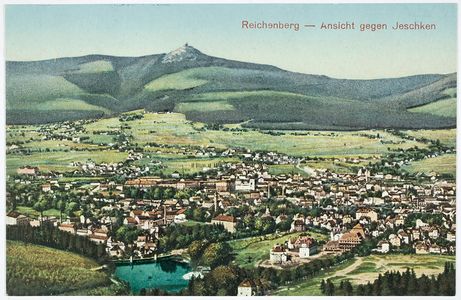
The town lies on the Lusatian Neisse (Lužická Nisa) (also known in German as the Görlitz Neisse) between the Ještěd Ridge (Ještědský hřbet) and the Jizera Mountains (Jizerské hory) in the Liberec Basin (Liberecká kotlina). The town’s local mountain is the 1,012-metre-highJeštěd.
Liberec is known for its harsh climate, which is why the Czech poet Jan Neruda wrote in 1863 that it was an uninviting town (with neglected houses). Nevertheless, Liberec is regarded as one of the towns with the highest quality of life in the Czech Republic.
Political and administrative affiliation
Czech Republic (Česká republika), Liberec Region (Liberecký kraj)
Common symbolism
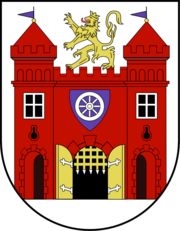
The coat of arms of the town of Liberec is largely identical to that of Reichenberg. It features two towers and a single-tailed golden lion, as well as a wheel from the coat of arms of the von Redern noble family.
Common or historical nicknames
Second-largest city in the state, capital of German Bohemia (1918), city of cloth-makers, textile city, city of banks, city of architecture, Vienna of the North, Bohemian Manchester.
Middle Ages
The settlement was founded in 1278 and was first mentioned in a document as the town of Reychinberch in 1352. This comparatively late date is attributable to its geographical location. It lay off the main trade route from Prague via Jungbunzlau/Mladá Boleslav to Zittau and Görlitz/Zgorzelec, which turned northwards as early as the neighbouring Deutsch Gabel/Jablonné v Podještědí. The town’s name suggests that it was founded by Germans. As in other parts of Lusatia and Silesia, Reichenberg and its surrounding villages were governed by Magdeburg Law with Frankish influences. The town was under the jurisdiction of the Oberhof of Leitmeritz/Litoměřice. The oldest surviving town register of Reichenberg covers the years 1542–1564. The oldest surviving register of residents (1560) contains exclusively German surnames.
The first owners of the village of Reichenberg within the Friedland domain belonged to the Biberstein family, who originated from Meissen; the town remained in their possession as a hereditary fief of the Bohemian Crown until the death of Christoph von Biberstein in 1551.
Modern times
In 1552, King Ferdinand confiscated the Friedland estate, comprising Reichenberg and Seidenberg, on the grounds that it was a neglected crown fief. Reichenberg remained in his direct possession until 1558 and was administered by a captain appointed by the king.
In 1558, Ferdinand sold the Friedland domain for 40,000 talers to the Lutheran Friedrich, Baron von Rödern (Redern, d. 1564). The town’s subsequent rise is particularly associated with the name of Joachim Ulrich von Rosenfeldt (1525–1591), who administered the town on behalf of the von Rödern family, who resided in Breslau/Wrocław, and ‘became a true father to Reichenberg’[1]. The town’s growing importance led to it being granted town privileges in 1577 by Emperor Rudolf II (1552–1612), including a coat of arms and the right to hold an annual fair. It was under the von Rödern family that Reichenberg began its development as a cloth-making town. Following the Battle of White Mountain in 1620, the Rödern family’s estates were confiscated and, after a brief interlude as a forfeited crown fief in the possession of Emperor Ferdinand II (1578–1637), it was bequeathed in 1622 to Albrecht von Wallenstein (Waldstein, 1583–1634) for the sum of 150,000 Rhenish guilders. It is thanks to Wallenstein that the town was spared during the Thirty Years’ War (1618–1648), whilst the rest of Bohemia was repeatedly subjected to devastating plundering. Following Wallenstein’s assassination, Reichenberg passed to Count Matthias Gallas (1588–1647). When his family died out with Philipp Josef Gallas in 1757, the town passed to his nephew Christian Philipp von Clam-Gallas (1748–1805). The transition from a craft-based town to an industrial town then took place under his son, Christian Christoph von Clam-Gallas (1771–1838). Together with Prague, Reichenberg became the first so-called ‘statutory town’ in Bohemia in 1850 and was granted a municipal charter in the same year.
Contemporary History
As early as the beginning of the 20th century, calls for an independent German Bohemia were being heard in Reichenberg. On 29 October 1918, Reichenberg was declared the capital of the short-lived province of German Bohemia. However, the Czechoslovak military put an end to these independence efforts. During the interwar period, the town became the centre of the nationalist Sudeten German movement[2] led by the Prague professor Erich Gierach (1881–1943). With the German annexation of the Czechoslovak border regions in October 1938, Reichenberg was incorporated into the German Reich and became the administrative centre ofthenew‘Reichsgau Sudetenland’. Due to the ‘enormous scale of political and social Gleichschaltung’, this region was also referred to as a ‘model Gau’[3] . With the aim of providing scientific legitimisation for the ‘struggle for national identity’, the Sudeten German Institute for Regional and Ethnic Research (SALV) was founded in October 1940.
The town was captured by Soviet and Czech troops in May 1945. Subsequently, the town once again became part of Czechoslovakia (and, since 1993, the Czech Republic). Following the Second World War, the German majority population was forcibly resettled.
Population
As a result of the Thirty Years’ War, the exodus of Protestants during the Counter-Reformation under Wallenstein’s initially harsh rule, and the plague of 1680, the population of the burgeoning cloth-making town declined sharply. It was not until the 18th century that this loss was offset. By 1850, Reichenberg had finally become the second most populous town in the Bohemian lands after Prague, and the economic and cultural centre of Northern Bohemia.
The final abolition of serfdom (hereditary servitude) in Austria in 1848 led to an increase in internal migration. The textile industry in Northern Bohemia, in particular, attracted a large workforce, resulting in the emergence of a relatively sizeable Czech minority in Reichenberg.[4] One of the leading political representatives of the German-speaking Czechs in the first half of the 19th century was the Reichenberg entrepreneur Karl Herzig (1803–1849). Between 1880 and 1890, despite a growing population, the proportion of Czechs in Reichenberg’s population initially fell from 9.1 per cent to 5.4 per cent, only to rise again by 1900.[5] During this period, internal migration within Bohemia signalled a shift in the ratio between Germans and Czechs in favour of the Czech population. Czechs were numerous amongst unskilled labourers and domestic servants, but above all amongst civil servants, as the latter were primarily posted to German-speaking areas and had an advantage over German candidates due to their bilingualism. These successes of the Czechs met with resistance from the German Bohemians and contributed to their radicalisation. Emperor Franz Joseph I’s (1830–1916) visit to Reichenberg in 1891 was overshadowed by clashes between the two sides. Among the German-Bohemian towns, Reichenberg staked a claim to leadership, which was underlined by the German-Bohemian Exhibition of 1906.[6] In 1935, around 30,000 Germans were still living in Reichenberg.[7] Following the expulsion of the German population, numerous new settlers from other parts of Czechoslovakia moved into the town. However, the 1930 population figure was not reached again until 1980.
An overview of population trends since 1648; from 1869 onwards, taking into account all 32 of today’s city districts:[8]
| Year | Population |
| 1648 | 1,600 |
| 1730 | 3,000 |
| 1789 | 6,594 |
| 1801 | 7,763 |
| 1827 | 10,367 |
| 1869 | 50,252 |
| 1880 | 60,198 |
| 1890 | 68,135 |
| 1900 | 79,470 |
| 1910 | 89,312 |
| 1921 | 84,845 |
| 1930 | 95,623 |
| 1950 | 69,663 |
| 1961 | 78,193 |
| 1970 | 84,046 |
| 1980 | 95,924 |
| 1991 | 101,162 |
| 2001 | 99,102 |
| 2014 | 102,301 |
Economy
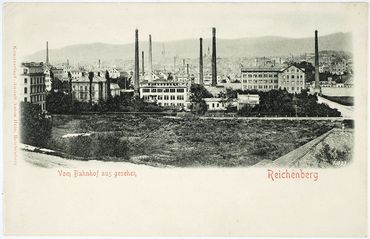
Until the 18th century, the town was characterised by mining. Iron ore, silver, copper, lead and tin were mined. However, the deposits were soon exhausted, and weaving and cloth-making in particular experienced a rapid boom, with Reichenberg rising to become Bohemia’s most important cloth-making town.
The town gained particular importance for the Habsburgs following the loss of Silesia (1742). As a result of the customs measures introduced as part of the Josephine Reforms, Reichenberg ‘achieved an unprecedented status as an industrial and commercial centre around 1800’[9].
Mechanised production replaced traditional cottage industries (the first steam engine in 1835, followed shortly afterwards by the first mechanised weaving mill), which initially led to high unemployment. Consequently, Northern Bohemia, with the Reichenberg region at its heart, became a centre of the labour movement within the Habsburg Monarchy. From 1877, the Central Committee of the Austrian Social Democratic Party had its headquarters here for several years. In 1828, the Liebieg brothers laid the foundations for the Liebieg & Comp. family empire with the ‘manufacture of half-woollen waistcoat and trouser fabrics’, which was to become one of the largest textile companies in Europe. By 1850, Reichenberg was a leading industrial centre of the Monarchy. In Reichenberg’s cotton industry, the number of weaving mills rose from 26 to 93 between 1866 and 1878, and the number of employees from 4,360 to 24,681, with the result that, by the turn of the century, the town occupied a ‘dominant position’[10] in Bohemia’s textile industry. 63 per cent of all spindles in the Bohemian lands were located in the Reichenberg Chamber District. The town’s importance to this industry was reflected in the founding in 1920 of the ‘Allgemeiner Deutscher Textilverband’ (General German Textile Association), the largest German trade association in Czechoslovakia. The Reichenberg Automobile Factory operated from 1907 until around the time of the First World War. Other important industrial sectors included metalworking and the production of food and luxury foods.
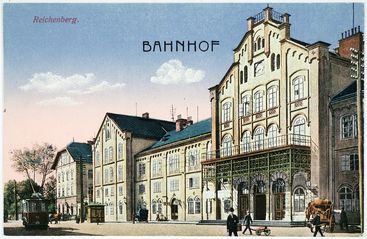
In 1859, Reichenberg was connected to the railway network (lines to Turnau/Turnov and Zittau). A year later, the line to Pardubitz/Pardubice followed, then to Görlitz in 1875, to Gablonz an der Neiße/Jablonec nad Nisou in 1888, and finally to Böhmisch-Leipa/Česká Lípa in 1903. To this day, the town remains a regional railway hub with good connections to Germany (Zittau and Dresden) and Poland (Hirschberg/Jelenia Góra). The first tram line began operating in 1897 between the railway station and the Volksgarten.
History of Religion and the Church
The first wooden church was built in 1360, destroyed during the Hussite Wars in 1449, and subsequently rebuilt. It was not until 1587 that the first stone church, the town church (Archdeaconry Church of St Anthony, Kostel svatého Antonína Velikého), was completed on Neustadt Square.
Protestantism spread throughout the Reichenberg region under Joachim von Biberstein (1521–1544). By the time the Biberstein family died out in 1551, the population was predominantly Protestant. [11] The Counter-Reformation took full hold following the withdrawal of the Swedes in 1649. Numerous families fled to Lusatia, whereupon their property was confiscated.
Traces of Jewish life in Reichenberg can be traced back to the 16th century, when, in 1582, around 50 Jewish families arrived in the town, having fled the plague in Prague. Due to its heterogeneity (assimilation, changes of religion), it is difficult to estimate the size of the Jewish community in Reichenberg.
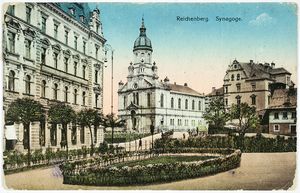
In 1799, the first manorial ban on Jews was imposed on the town, which was renewed in 1810. It was not until the 1860s that Jews in Bohemia were granted the right to choose their place of residence freely and to practise their professions freely. Until then, they were not permitted to take up permanent residence in the town. Consequently, numerous Jewish families settled in Reichenberg, leading to the establishment of the Israelite Cultural Community and various Jewish associations, such as the Chewra Kadisha (burial society) in 1864. A Jewish cemetery had existed since 1865. After several years of construction, the Reichenberg Synagogue – a domed building in the Neo-Renaissance style designed by the Viennese architect Karl König (1841–1915) – was inaugurated in 1889; it was burnt down in November 1938. In proportion to the size of their community, Jews played a disproportionately large role in the town’s economic life.[12]
Between 1886 and 1938, around 5,800 Jews lived in Reichenberg, at least temporarily.[13] However, other sources put this figure for the same period at around 1,400 people (3.6 per cent of the total population), which is considerably lower.[14]
Following Germany’s annexation of the Czechoslovak border regions in 1938, most of the Jews fled Reichenberg. For the majority of them, however, this flight did not mean salvation. The deportations of the few remaining Jews began in 1942. One of the main beneficiaries of the ‘Aryanisation’ of Jewish property was the Reich Governor and future Gauleiter Konrad Henlein (1898–1945), who moved into the villa of the Jewish cloth merchant Julius Hersch (1875–1948) shortly after the German invasion.
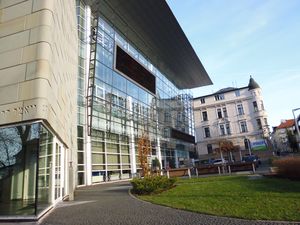
After the Second World War, Jews from Carpatho-Ukraine – which had belonged to Czechoslovakia during the interwar period – settled in the town, leading to a revival of Jewish life there. By 1948, the Jewish community once again numbered over 1,000 people.[15] Today, the Jewish community in Reichenberg comprises around 120 people.[16] On 9 November 2000, the ‘Building of Reconciliation’ – comprising a library and a synagogue – was opened on the site of the destroyed synagogue. The synagogue was built in the shape of half a Star of David. Today, a memorial in the Taharahausat the Jewish cemetery commemorates the Holocaust victims from Reichenberg.
Special cultural institutions
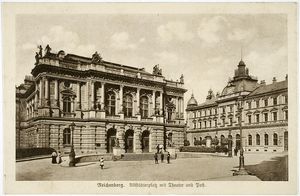
Reichenberg is the cultural centre of Northern Bohemia. The town boasts numerous museums and several permanent theatres. First and foremost among these is the former municipal theatre, built to plans by the Viennese architects Ferdinand Fellner (1847–1916) and Hermann Helmer (1849–1919), now known as the Divadlo Františka Xavera Šaldy, named after the art historian and writer František Xaver Šalda (1867–1937), which opened in 1883 with a performance of Schiller’s *Wilhelm Tell *. Its predecessor, the Guild Theatre, built in 1820 by the Clothmakers’ Guild, was destroyed by fire in 1879.
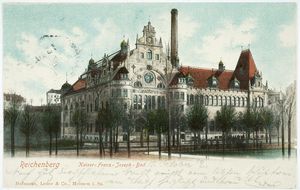
The Liberec Regional Gallery (Oblastní galerie v Liberci) is one of the most renowned institutions of its kind in the Czech Republic and has been housed since 2014 in the Franz Joseph Municipal Baths (Městské lázně Františka Josefa I.), which were specially converted for this purpose. The permanent exhibition features 20th-century Czech art as well as Dutch, French, German and Austrian paintings from the 16th to the 18th centuries. Many of the exhibits come from the collection of the Reichenberg industrialist and art patron Heinrich Liebieg (1839–1904).
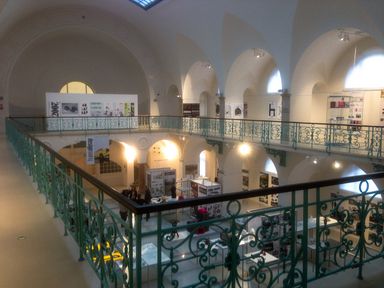
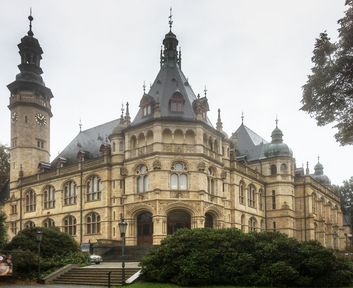
The North Bohemian Museum (Severočeské muzeum) was founded in 1873 as a museum of decorative arts at the instigation of local entrepreneurs and has been located in the town’s villa district since the late 19th century (architects: Friedrich Ohmann, 1858–1927), Hans Griesebach, 1848–1904). The tower of this historicist building was modelled on that of the old town hall (1603–1893). The textile collections document the development of this craft in Northern Bohemia.
The municipal cinema, built in 1922–1923 in the Art Deco style, is currently undergoing extensive restoration; it houses a cinema and a cultural café for readings, concerts and theatre performances (Kino Varšava).
Education and Science
The Technical University of Liberec (Technická univerzita v Liberci) was established in 1995 as a successor to the Liberec University of Mechanical Engineering (Vysoká škola strojní v Liberci), which was founded in 1953. It comprises six Schools and maintains contacts with around 200 academic institutions worldwide. Together withZittau/Görlitz University of Applied Sciences and the Wroclaw University of Technology, it forms part of Neisse University. The English-language degree programme includes study periods at all three campuses.
History of the press from 1848 onwards
Among the various German newspapers published in Reichenberg in the mid-19th century, the *Reichenberger Zeitung* (published by Gebrüder Stiepel), which had been appearing as a daily newspaper since 1859, is particularly worthy of mention. This newspaper “occupied a position on a par with the Prague newspapers; it is German-progressive and widely read in Bohemia.”[17] In 1938, the newspaper was shut down at the instigation of the Nazis and was absorbed into *Die Zeit*, the main organ of the NSDAP in the Reichsgau Sudetenland, which had previously served as the party organ of the Sudeten German Party (SdP). From 1885 onwards, the daily newspaper of the German People’s Party in Bohemia, the *Deutsche Volkszeitung* (published by Gerzabel), was also published in Reichenberg. Newspapers influenced by social democracy included the central organ of the Social Democratic Workers’ Party of Austria, *Der Freigeist*. The organ of the German Social Democratic Workers’ Party for Northern Bohemia, *Der Volksfreund*, *Der Radikale * and*Arbeiterpresse/Neue Arbeiterpresse*. In addition, numerous other German-language newspapers were published, each aimed at a specific specialist readership, such as the Mitteilungen des nordböhmischen Gewerbemuseums, the Allgemeine Österreichische Industriezeitung, the Deutsche Apothekerzeitung and the Allgemeine Sportblatt: Illustrierte Wochenschrift für alle Sportzweige.
At the beginning of the 20th century, and increasingly during the interwar period, further German-language publications emerged, often with a clear political orientation: *Gewerkschaftliche Rundschau*. Journal of the Central Trade Union Commission of the German Trade Union Federation in Czechoslovakia; *Kämpfer*. *Kommunistisches Tagblatt* for Western and Southern Bohemia; *Vorwärts*. *Kommunistisches Tagblatt* for Northern and Eastern Bohemia; *Der Guide*. Featuring news from the Sudeten German Party, as well as *Der Kamerad*. News bulletin for District 4.
Everyday culture
Reichenberg is an attractive resort and holiday destination and boasts a long tradition of winter sports. For instance, the first European Luge Championships were held in 1914 on the wooden luge run at Jeschken, which had been built in 1909–1910 by the German Alpine Club for the Jeschken and Iser Mountains (only the remains of which are visible today) in 1914, which were won by local man Rudolf Kauschka (1883–1960), competing for Bohemia. Fritz Preißler (1908–1948), also from Reichenberg, was the winner at the last European Championships held on this track in 1939. Following the recent annexation of the outlying regions of Czechoslovakia, the championships – originally awarded to Czechoslovakia – were held in the German Reich, with luge athletes from the annexed territories, such as the runner-up in the women’s event, Waltraud Grassl, competed for Czechoslovakia in order to maintain the appearance of an international championship. Czechs and Slovaks did not take part in the competitions.
In 2009, the city hosted the 47th Nordic World Ski Championships. The Isergebirgslauf has been held in Friedrichswald/Bedřichov, ten kilometres away, since 1968. In 2015, over 4,000 participants took part in the main 50-kilometre race. The local football and ice hockey teams, FC Slovan Liberec and Bílí Tygři Liberec respectively, are among the best in the country and regularly feature in European competitions.
Architecture and urban development
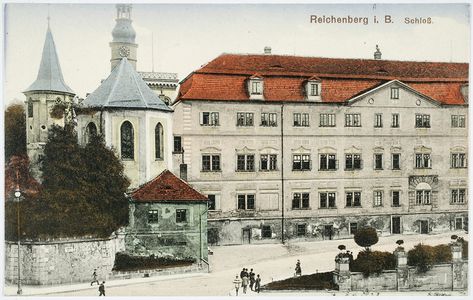
The Gothic architectural features of the three-nave town church (Archdeaconry Church of St Anthony, Kostel svatého Antonína Velikého) are already blending with Renaissance elements. Following several fires, extensive renovation work was carried out. The church acquired its present appearance during the neo-Gothic restoration carried out under Ludwig Tischler (1840–1906) between 1879 and 1883. The Church of the Holy Cross (Kostel Nalezení svatého Kříže) was built between 1753 and 1761 in the Baroque style on the site of the small burial church next to the plague cemetery in the New Town, based on plans by Marek Antonín Canevalle (1652–1711).
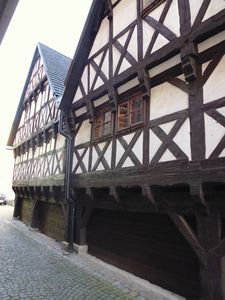
Among the oldest architectural monuments in Reichenberg are the three so-called Wallenstein Houses, which were built between 1678 and 1681 using the half-timbered construction method typical of the region. The name is historically inaccurate, as Wallenstein had already been assassinated decades before the houses were built.
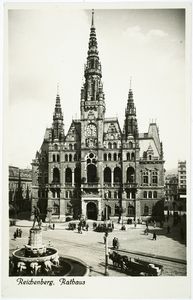
The town’s architectural landmark is the Neo-Renaissance Town Hall on Old Town Square (nám. Dr. E. Beneše), which was completed in 1893 after five years of construction, modelled on the Viennese example. The New Reichenberg Castle (Nový zámek) was built between 1772 and 1776 and combines elements of the Baroque and Classicist styles. During a historicist renovation in the mid-19th century, Neo-Renaissance elements were added.[18]
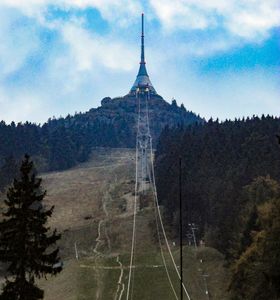
After the Neue Jeschkenhaus, which had opened in 1907, was completely destroyed by fire in 1963, the hotel of the same name (including the television tower) was built on the Jeschken in 1973; it is now a landmark of modern architecture in Liberec. In 1969, architect Karel Hubáček (1924–2011) was awarded the prestigious Auguste Perret Prize for his futuristic project.
Bibliography
The plot of the Liberec-set novel *Grandhotel* (2006; German edition: *Grandhotel*, 2008) by Jaroslav Rudiš (born 1972), which was adapted for the screen by David Ondříček (born 1969) in the same year it was published. The novel also explores, through literature, the city’s German history and the expulsion of the German population. These are also the themes in Isa Engelmann’s (b. 1936) novel *Blauer Flieder*. *Wiedersehen in Nordböhmen* (1999), in which the author describes the often painful search for her own roots in a country that is now foreign to her. Otfried Preußler (20 October 1923–18 February 2013), who was born in Reichenberg, became famous as a children’s author.
Culture of Memory and Remembrance/Controversies
Isa Engelmann’s book was also published in Czech translation under the title *Návrat pod zelenou střechu* to mark the Czech Republic’s accession to the EU in 2004. However, the database of Czech books<LINK typo3/#_ftn1>[19]</LINK> expressly states that the book’s content may provoke strong reactions and must be understood as a purely personal account relating to the author’s childhood memories. This refers not only to the historical accounts of the immediate post-war period but also, in particular, to the author’s numerous negative comments on urban development after 1945, in which she alleges, amongst other things, that the new residents – such as the architect of the modern hotel on the Jeschken – had “no connection to this land and its traditions” (p. 145) and had “raped it, just as the women were raped, to show who the new masters were” (p. 145).
On the part of the Sudeten German associations, the history of the period between 1938 and 1945 was largely glossed over after 1945, and with it the role of Reichenberg as the centre of the Sudeten German völkisch movement, as well as that of the German National Party and, finally, from 1933 onwards, the SudetenGerman Party. The eight points of the SdP’s 1938 Karlovy Vary Programme, for instance, despite being disguised as a demand for autonomy, ‘would, if implemented, have amounted in practice to a union with Germany. <link typo3/#_ftn2>[20]</link> The Detmold Declaration of the Sudeten German Association of 1950 does indeed refer to ‘terrible experiences since 1945’, but makes no mention of such experiences prior to 1945.
In 2015, the amended constitution of the Landsmannschaft, which no longer refers to ‘recovery’ or the ‘right to a homeland’, met with fierce criticism from some district associations. In 2016, Culture Minister Daniel Herman became the first member of the Czech Government to speak at the Sudeten German Day, a move that met with a mixed reception in the Czech Republic. [21] At the intergovernmental level, the two neighbours and EU partners, Germany and the Czech Republic, are endeavouring to engage in constructive dialogue on contentious issues. Initiatives such as the ‘Liberec-Reichenberg’ architectural project demonstrate the residents’ current interest in the town’s German heritage as well.
Bibliography
- Karl M. Brousek: Large-scale Industry in Bohemia 1848–1918. Munich 1987 (Publications of the Collegium Carolinum 50).
- Karl Joseph Czoernig: A Topographical, Historical and Statistical Description of Reichenberg. Vienna 1829.
- Winfried Eberhard: Handbook of Historical Sites: Bohemia and Moravia. Stuttgart 1998. Hermann Hallwich: Reichenberg and its Surroundings. A Local History with Special Reference to Industrial Development. Reichenberg 1872.
- Emil Hofmann: History of the Jews in Reichenberg. In: Hugo Gold (ed.): The Jews and Jewish Communities of Bohemia in the Past and Present I. Brno, Prague 1934, pp. 529–569. Roman Karpaš: Kniha o Liberci [A Book about Reichenberg]. Liberec 2004.
- Karl Kerl: The Urban Development of Reichenberg. In: Karl Kerl: Reichenberg. Berlin-Friedenau 1929, pp. 58–67.
- Emanuel Rádl: The Struggle between Czechs and Germans. Reichenberg 1928. Translated into German by Richard Brandeis (original title: Válka Čechů s Němci).
Web links
- www.liberec.cz/cz/ (Official town portal. Information in Czech, Polish, German and English)
- www.muzeumlb.cz/ (North Bohemian Museum. Information in Czech, German and English)
- www.ogl.cz/ (Liberec Regional Gallery. Information in Czech and English)
- www.kvkli.cz/ (Liberec Library: information in Czech, German and English)
- www.dkliberec.cz/ (Liberec Cultural Centre: information in Czech)
- www.kehila-liberec.cz/ (Liberec Jewish Community: information in Czech, German and English)
- www.tul.cz/ (Technical University of Liberec: information in Czech and English)
- www.kinovarsava.cz/ (Cinema and Cultural Café: information in Czech and English)
- liberec-reichenberg.net/ (Architecture in Northern Bohemia: information in Czech)
- www.neisse-nisa-nysa.org/ (Neisse-Nisa-Nysa Euroregion: information in German, Czech and Polish)
- www.reichenberg.de/ (Sudeten German Association. Reichenberg Town Home District. Information in German and Czech)
- www.herder-institut.de/bildkatalog/wikidata/Q146351 (Images of Reichenberg/Liberec in the image archive of the Herder Institute, Marburg)
Notes
[1] Joseph G. Herrmann: History of the Town of Reichenberg. Vol. 1. Reichenberg 1863, p. 205.
[2] On the term ‘Sudeten German’, see: Tobias Weger: ‘An Endless Struggle for the People’: Sudeten German Organisations, 1945–1950. Frankfurt am Main et al.: 2008, pp. 30–51.
[3] Lukáš Novotný: Discourses on the Past between Germans and Czechs. Baden-Baden 2009, p. 84.
[4] Friedrich Prinz: ‘The Liberal Era (1860–1880): The Constitutional Question and the National Question’. In: Friedrich Prinz (ed.) German History in Eastern Europe. Bohemia and Moravia. Berlin 1993, pp. 334–302, here p. 347.
[5] Karl Kurth: The Sudetenland. Kitzingen/Main 1954, p. 137.
[6] Tomáš Okurka: The German-Bohemian Exhibition in Reichenberg in 1906. In: Kristina Kaiserová, Miroslav Kunštát (eds.): The Search for a Centre: Academic Institutes and Educational Institutions of the Germans in Bohemia (1800–1945). Münster, New York 2014 (Publication series of the Commission for German and East European Folklore within the German Society for Folklore e. V. 96), pp. 371–391, here p. 371.
[7] Kurth: Sudetenland (note 5), p. 137.
[8] Lug: History of the Town of Reichenberg. In: Kerl: Reichenberg, pp. 31–43, here p. 40; Eberhard Holtz: Reichenberg (Liberec). In: Joachim Bahlke; Winfried Eberhard: Handbook of Historical Sites: Bohemia and Moravia. Stuttgart 1998, pp. 514–516, here p. 515; Jiřina Růžková; Josef Škrabal: Historical Encyclopaedia of Municipalities of the Czech Republic 1869–2005. Volume 1 [Historical Encyclopaedia of Municipalities of the Czech Republic, 1869–2005. Part 1.] Prague 2006, pp. 440ff.: www.czso.cz/documents/10180/20538302/13n106cd1.pdf/cf538eaa-7f70-49f6-8e76-dc88932650ef?version=1.0 (accessed 15 August 2016); Population figures for municipalities in the Czech Republic as at 1 January 2014 [Czech Statistical Office]: www.czso.cz/documents/10180/20556283/1300721403.pdf, p. 57 (accessed 15 August 2016).
[9] Holtz: Reichenberg, p. 515.
[10] Brousek: Large-scale Industry, p. 113.
[11] Lug: History (note 8), p. 31.
[12] Hofmann: History of the Jews, p. 542.
[13] Engelmann: Reichenberg and its Jewish Citizens, p. 14.
[14] Jörg Osterloh: Nazi Persecution of the Jews in the Reichsgau Sudetenland 1938–1945. Munich 2006 (Publications of the Collegium Carolinum 105), p. 55; Klaus-Dieter Alicke: Encyclopaedia of Jewish Communities in the German-Speaking World. Vol. 3. Gütersloh 2008, col. 3467.
[15] Tina Walzer: Reichenberg: Vienna of the North, Bohemian Manchester – today Liberec in the Czech Republic. In: David – Jewish Cultural Journal, Issue 98, 09/2013.
[16] Alicke: Encyclopaedia of Jewish Communities (note 14), col. 3467.
[17] A[ladar] G[uido] Przedak: History of German Periodicals in Bohemia. Heidelberg 1904, p. 221. In the Austrian context, ‘German-progressive’ did not mean ‘liberal’, but rather German-nationalist, anti-Semitic and anti-Czech.
[18] Liberec Project: Reichenberg: Nový (zahradní) zámek (The New Reichenberg Castle): liberec-reichenberg.net/stavby/karta/nazev/131-novy-zahradni-zamek (accessed 15 August 2016).
[19] Návrat pod zelenou střechu:www.databazeknih.cz/knihy/navrat-pod-zelenou-strechu-108948 (accessed 21 September 2016).
[20] Schmelser, Roland M.: The Sudeten Problem and the Third Reich 1933–1938. Munich, Vienna: 1980, p. 198.
[21] Historic visit: Czech minister attends Sudeten German Day. FAZ, 15 May 2016 www.faz.net/aktuell/politik/inland/tschechischer-minister-besucht-sudetendeutschen-tag-14235175.html (accessed 27 September 2016).
Citation
Kai Witzlack-Makarevich: Reichenberg/Liberec. In: Online Encyclopaedia on the Culture and History of Germans in Eastern Europe, 2016. URL: ome-lexikon.uni-oldenburg.de/p32231 (accessed 15 February 2022).
Terms of use for this article
Copyright © University of Oldenburg and the Federal Institute for the Culture and History of Germans in Eastern Europe (BKGE), all rights reserved. This work was produced as part of the project ‘Online Encyclopaedia on the Culture and History of Germans in Eastern Europe’ and may be reproduced and published provided the rights holders’ consent has been obtained. Please contact:
If you have any specialist comments or additions to the text, please contact the editorial team, citing relevant literature and source references.