

Reichsgau Sudetenland
Reichsgau Sudetenland
The ‘Reichsgau Sudetenland’ was established by the ‘Law on the Organisation of the Sudeten German Territories’ of 25 March 1939. Its existence came to an end with the defeat of the German Reich in the Second World War and the restoration of the Czechoslovak Republic in 1945.
Location of the region
The ‘Reichsgau Sudetenland’ bordered Bavaria to the west, Saxony and Silesia to the north, and the ‘Protectorate’ of Bohemia and Moravia to the south. The Aussig administrative district comprised the northern parts of Bohemia, the Eger administrative district comprised areas in north-western and western Bohemia, and the Troppau administrative district comprised areas in northern Moravia and Silesia.
Topography
The territory of the ‘Reichsgau’ was characterised in the north by the Sudeten mountain range, with the Karkonosze and the Starusze mountains standing out. The highest peak was Sněžka (Czech: Sněžka, Polish: Śnieżka) in the Giant Mountains (1,603 metres above sea level). The most significant river was the Elbe, which flowed through the territory of the ‘Reichsgau Sudetenland’ from Saxony into the ‘Protectorate’ of Bohemia and Moravia, where it curved and re-entered the ‘Reichsgau’ (in the administrative district of Troppau to the east).
For the history up to October 1938, see the entries on Bohemia and Moravia and Czechoslovakia.
Political history
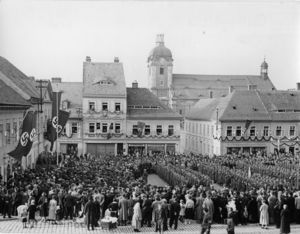
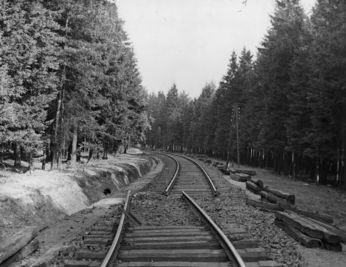
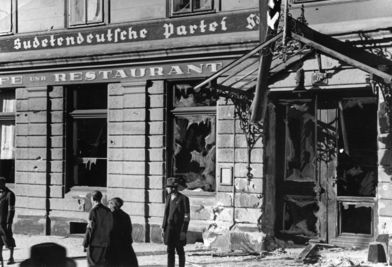
In the Munich Agreement of 29–30 September 1938, the German Reich, Italy, Great Britain and France agreed to the cession to the German Reich of the peripheral regions of Czechoslovakia, which were predominantly populated by Germans. On 1 October 1938, the occupation by the Wehrmacht began. The ‘Sudeten German Party’ (SdP), which had dominated the German party system since the Czechoslovak parliamentary elections of 1935, (SdP), which had dominated the German party system since the 1935 Czechoslovak parliamentary elections, was absorbed into the NSDAP; the former SdP leader Konrad Henlein (1898–1945) became Gauleiter of the NSDAP’s Sudetenland Gau. Former SdP members were able to apply for membership of the NSDAP. From 1938 until the end of the war, around 528,000 people were members of the NSDAP in the Sudetenland; this made the ‘Parteigau’ – measured by the proportion of the eligible voting population – the one with the largest membership in the German Reich.[1]
Political developments in the ‘Reichsgau Sudetenland’ were characterised by tensions between the SS security service (SD) and former members of the German National Socialist Workers’ Party (DNSAP) in Czechoslovakia, as well as members of the SdP’s original leadership circle; these stemmed from conflicts that had existed prior to the invasion. A point of contention between sections of the Gau leadership and the SS was how to deal with the Czech minority. In the SS’s view, this minority should, to a large extent, be Germanised on the basis of racial criteria, whilst, in the view of influential local NSDAP officials, the danger of anti-German sentiments would have persisted even after a so-called ‘ethnic replacement’.
Resistance to the Nazi regime was weak. Following the Wehrmacht’s invasion, thousands of opponents of the Nazis (primarily Social Democrats and Communists), Czechs and Jews were persecuted and imprisoned. The Social Democrats and Communists, whose potential for resistance had been crushed in this way, continued to exist only in small circles and did not re-emerge as significant players until towards the end of the war. Dissent among sections of the population arose on various occasions, for example in response to the Nazis’ church policy, which was rejected by many clergy and sections of the predominantly Catholic population.
Administration
The occupied ‘Sudeten German territories’ were ‘reunited’ with the Reich under constitutional law on 21 November 1938. The largest part of these territories formed the ‘Reichsgau Sudetenland’, which was established by the ‘Law on the Organisation of the Sudeten German Territories’ of 25 March 1939. The Hultschin region (Czech: Hlučínsko, Polish: kraik hulczyński, ziemia hulczyńska) was assigned to the administrative district of Opole in the Prussian province of Silesia, whilst areas of South Bohemia and South Moravia were incorporated into the Reichsgaus of Lower and Upper Danube as well as the administrative districts of Lower Bavaria and the Upper Palatinate. The Administrative Organisation Act came into force on 15 April 1939. The administrative centre was Reichenberg/Liberec. The ‘Reichsgau’ was divided into the three administrative districts of Eger (administrative centre: Karlsbad/Karlovy Vary), Aussig (administrative centre: Aussig/Ústí nad Labem) and Troppau (administrative centre: Troppau/Opava).[2]
A further step towards administrative organisation was the ‘Act on the Structure of the Administration in the Reichsgau Sudetenland’ of 14 April 1939, which came into force on 1 May 1939.[3] This was also known as the ‘Sudeten Gau Act’ and served as a model in the following years for the establishment of further Reichsgaus by the National Socialists. It designated the ‘Reichsgau Sudetenland’ as a state administrative district and a self-governing body under the leadership of a ‘Reich Governor’.
Konrad Henlein was appointed Reich Governor. He presided over most of the Reich special administrations, organisations in the commercial and transport sectors, and the offices of other public-law bodies within the Reichsgau. Only the highest Reich authorities could overturn his directives. Furthermore, with the consent of the Reich ministries, Henlein was authorised to enact regulations, provided these did not contravene Reich laws. However, he was bound by technical directives from the supreme Reich authorities and was subject to the supervisory authority of the Ministry of the Interior.
The role of the Gau self-government, emphasised in the ‘Sudeten Gau Act’, enabled administrative (and, by extension, political) action to take on a specifically regional character, particularly in the fields of education and the ‘promotion of culture and community life’, which included the preservation of historic monuments, museums, libraries, and regional and folk studies. The Gau self-government promoted ‘local history literature’, cinemas, theatres and libraries, as well as the ‘Sudeten German Institute for Regional and Folk Studies’ in Reichenberg. Its remit also included healthcare, physical education, public welfare, youth welfare and youth care, as well as economic affairs.
A distinctive feature of the ‘Reichsgau Sudetenland’ was its role as a testing ground for a planned Reich reform. This was intended to enable a more streamlined administration of the Reich and to realise the desired ‘unity of party and state’. Konrad Henlein symbolically embodied this aim; as both ‘Reich Governor’ and NSDAP ‘Gauleiter’ in a dual role, he reported directly to the ‘Führer’ Adolf Hitler (1889–1945), to whom he, like all other Reich Governors, was required to swear an oath of loyalty and obedience. Should this administrative reform be deemed successful, it was planned to be extended to the entire Reich.
Economy
The economy of the ‘Reichsgau Sudetenland’ was characterised by the consumer goods industry (including the textile and glass industries, and the manufacture of musical instruments) and agriculture. The administrative district of Aussig also possessed a significant industrial area in the form of theBrüx-Duxer lignite mining district, whilst the Eger administrative district boasted theKarlsbad-Marienbad-Franzensbad spa triangle, a region of significant importance to tourism; in the Troppau administrative district, agriculture, the timber industry and the textile industry predominated.
Whilst local entrepreneurs hoped for a recovery in the consumer goods industry, which had been severely affected by the Great Depression, the Reich leadership focused on a structural shift towards the capital goods industry. The war accelerated this development, as businesses vital to the war effort from other parts of the German Reich, threatened by carpet bombing, were relocated to the ‘Reichsgau Sudetenland’ – which had initially been spared the direct effects of the war – whilst many businesses not deemed vital to the war effort were shut down there.
Further economic changes arose in terms of ownership structures. Companies, insurance firms and banks, particularly those originating from the rest of the Reich, were able to acquire expropriated Czech and Jewish enterprises or shares in public limited companies.
Population
According to the May 1939 census, the ‘Reichsgau Sudetenland’ had a population of 2,943,187. The administrative district of Aussig, with 1,328,575 people, was the most populous and densely populated district. The administrative district of Eger had a population of 803,509, whilst the administrative district of Troppau had 811,103 people.[4]
The ethnic composition of the ‘Reichsgau Sudetenland’ was characterised not only by a predominantly German population but also by a Czech minority, which, according to the May 1939 census, comprised 291,198 people (9.9 per cent of the total population). Among the administrative districts, Troppau had the highest number of people of ‘Czech ethnicity’, totalling 160,988 (19.8 per cent of the district’s total population). The discrepancy between the 291,198 people counted in the ‘Reichsgau’ in 1939 and the approximately 700,000 Czechs recorded in this area during the 1930 Czechoslovak census is striking. Among other things, it is attributable to the flight and (often forced) emigration of numerous Czech-speaking residents before and after the Wehrmacht’s invasion in October 1938, as well as by the declaration of ‘German identity’ by around 100,000 people previously counted as Czechs.[5]
From the perspective of the Nazi authorities, a large proportion of the Czech population was to be Germanised as part of a ‘population replacement’ policy. Here, the positions of the SS differed from those of local officials. Whilst the former assumed the existence of individuals ‘capable of Germanisation’ in terms of racial ideology, the latter additionally formulated the category ‘worthy of Germanisation’ in order to be able to give greater weight to national-political criteria. However, the measures for ‘ethnic replacement’ – such as the education of Czech youths in other parts of the Reich and the enrolment of Czech children who were assessed positively according to ‘racial’ criteria in German schools – were implemented only hesitantly and made little progress in view of the course of the war.
Around 40,000 to 45,000 people living in the territory of what would later become the ‘Reichsgau Sudetenland’ were classified as Jews according to Nazi criteria (including those who had previously fled from the Reich to Czechoslovakia ).[6] The majority of the Jewish population fled immediately before or after the Wehrmacht’s invasion or were expelled – particularly following the pogrom night in November 1939. Most of the approximately 2,400 Jews counted in the 1939 census, as well as at least around 1,000 Roma, were deported to concentration and extermination camps and murdered during the course of the war.
Society
Large sections of the predominantly German-speaking population in the territory of the ‘Reichsgau Sudetenland’, like many members of the Czech minority, were shaped by the conflict over nationality that had been raging in the Bohemian lands since the 19th century. Many of the German residents had high expectations regarding the annexation of their settlement area to the German Reich, with hopes for social and economic improvements to their own personal circumstances playing a particular role.
In view of the rapid decline in unemployment, many hopes seemed to be fulfilled, but rapidly rising prices outstripped wage growth. The result was growing disillusionment. There were also increasing complaints about the high number of ‘old Reich Germans’ in positions of authority who had been transferred to the ‘Reichsgau’, and about their behaviour, which was often perceived as arrogant towards the local population. Added to this was widespread anger over the dissolution or incorporation of local organisations – which had proved their worth in the ‘struggle for national identity’ – into Nazi organisations and structures. This was frequently expressed in outbursts of discontent, but did not diminish the fundamental acceptance of belonging to the German Reich and the ‘Volksgemeinschaft’.
After the end of the Second World War, the German population of the ‘Reichsgau’, like other German-speaking inhabitants of the Bohemian lands, was expelled from the re-established Czechoslovakia and forcibly resettled.
After the war, differing perspectives emerged regarding the role of the native German population of the ‘Reichsgau’. In many publications by authors associated with associations of displaced persons, a view of history prevailed well into the 1990s, according to which the Germans in the Bohemian lands were passive victims first of Nazi policy, and subsequently victims of expulsion and forced resettlement from Czechoslovakia, which was re-established in 1945. They were said to have borne no responsibility, or only in isolated cases, for the oppression of the Czech nation and the persecution and murder of European Jews.[7]
On the Czechoslovak side – and, after 1993, the Czech side – the prevailing view, by contrast, was of a German population enthusiastic about National Socialism, which, through its majority support for the Sudeten German Party prior to 1938, had proven itself untrustworthy and had been largely responsible for the break-up of Czechoslovakia and the oppression of the Czech nation both in the ‘Reichsgau Sudetenland’ and in the ‘Protectorate’ Bohemia and Moravia. This was also used to justify the expulsion and forced resettlement of Germans from Czechoslovakia after the end of the war.[8] Furthermore, Czech authors emphasised that sections of the Czech population had been expelled both before and after the Wehrmacht’s invasion in October 1938.[9]
In the meantime, as a result of research into the ‘Reichsgau Sudetenland’—which has been intensified since the turn of the millennium—many of these positions have, on both sides, if not been completely abandoned, at least been put into perspective.[10]
Bibliography
- Freia Anders: Criminal Justice in the Sudetenland 1938–1945. Munich 2008 (Publications of the Collegium Carolinum 112).
- Josef Bartoš: Okupované pohraničí a české obyvatelstvo 1938–1945 [The Occupied Border Region and the Czech Population 1938–1945]. Prague 1978 (Acta Universitatis Palackianae Olumucensis. Fac. philos. Historica 19).
- Detlef Brandes: ‘Ethnic Replacement, Resettlement, Racial Census’. Nazi ‘Ethnic Policy’ in the Bohemian Lands. Munich 2012 (Publications of the Collegium Carolinum 125).
- Jürgen W. Falter: Hitler’s Party Comrades. The Members of the NSDAP 1919–1945. Frankfurt am Main, New York 2020.
- Ralf Gebel: ‘Home to the Reich!’ Konrad Henlein and the Reichsgau Sudetenland 1938–1945. 2nd ed. Munich 2000 (Publications of the Collegium Carolinum 83).
- René Küpper: National Socialist Religious and Church Policy in the Reichsgau Sudetenland. In: Martin Schulze Wessel, Martin Zückert (eds.): Handbook of the History of Religion and the Church in the Bohemian Lands and the Czech Republic in the 20th Century. Munich 2009, pp. 317–357.
- Václav Kural et al.: Sudety pod hákovým křížem [The Sudetenland under the Swastika]. Ústí nad Labem 2002.
- Jörg Osterloh: Nazi Persecution of the Jews in the Reichsgau Sudetenland 1938–1945. Munich 2006 (Publications of the Collegium Carolinum 105).
- Stefan Johann Schatz: The German-language school system in the Reichsgau Sudetenland 1938–45. PhD thesis. Humboldt University of Berlin. Berlin 2019.
- Volker Zimmermann: The Sudeten Germans in the Nazi State. Politics and Public Sentiment in the Reichsgau Sudetenland (1938–1945). Essen 1999 (Publications of the Institute for Culture and History of the Germans in Eastern Europe; Publications of the German-Czech and German-Slovak Historians’ Commission 9).
Web links
- German Historical Museum et al. (eds.): The Occupation of the Sudetenland in 1938. In: lemo – Living Museum Online, 2015. URL: www.dhm.de/lemo/kapitel/ns-regime/aussenpolitik/sudeten (4 January 2022).
- Act on the Organisation of the Administration in the Reichsgau Sudetenland (‘Sudeten Gau Act’) of 14 April 1939. In: www.verfassungen.de, 2004. URL: www.verfassungen.de/de33-45/sudetengau39.htm (4 January 2022).
- Hermann Graml: Henlein, Konrad. In: Neue Deutsche Biographie 8 (1969), pp. 532–534 [online version]. URL: www.deutsche-biographie.de/sfz29722.html (4 January 2022).
Notes
[1] Jürgen W. Falter: Hitler’s Party Comrades. The Members of the NSDAP 1919–1945. Frankfurt am Main, New York 2020, p. 113, pp. 361–392.
[2] Act on the Organisation of the Sudeten German Territories (hereinafter the ‘Organisation Act’) of 25 March 1939. Reich Law Gazette (hereinafter RGBl.) I 1939, p. 745.
[3] Act on the Organisation of the Administration in the Reichsgau Sudetenland of 14 April 1939. RGBl. 1939 I, p. 780.
[4] Volker Zimmermann: The Sudeten Germans in the Nazi State. Politics and Public Sentiment in the Reichsgau Sudetenland (1938–1945). Essen 1999, pp. 148ff.
[5] Zimmermann: The Sudeten Germans in the Nazi State, pp. 279ff.
[6] See Jörg Osterloh: Nazi Persecution of the Jews in the Reichsgau Sudetenland 1938–1945. Munich 2006, p. 57.
[7] Volker Zimmermann: Historical Narratives of Sudeten German Expellee Organisations and ‘Communities of Belief’. In: Zeitschrift für Geschichtswissenschaft 53/10 (2005). Special issue: After the Expulsion: History and the Present of a Controversial Memory. Edited by Jürgen Danyel and Philipp Ther, pp. 912–924.
[8] See, amongst others, Madlen Benthin: The Expulsion of Germans from East Central Europe. A Comparison of German and Czech Cultures of Remembrance. Hanover 2007, pp. 90–122 (Chapter III: The Expulsion in the Culture of Remembrance in Czechoslovakia and the Czech Republic).
[9] Karel Zelený: The Expulsion of Czechs from the Border Region in 1938. Memoirs. Prague 1996; most recently Jindřích Marek (ed.): The Expulsion of Czechs from the Border Regions in 1938. 2nd expanded edition. Prague 2018.
[10] For a nuanced account of the flight and expulsion of sections of the Czech population after October 1938, see: Jan Benda: Útěky a vyhánění z pohraničí českých zemí 1938–1939 [Flight and Expulsion from the Border Regions of the Bohemian Lands 1938–1939]. Prague 2013.
Citation
Volker Zimmermann: Reichsgau Sudetenland. In: Online Encyclopaedia on the Culture and History of Germans in Eastern Europe, 2022. URL: ome-lexikon.uni-oldenburg.de/p32577 (accessed 17 February 2022).
Terms of use for this article
Copyright © University of Oldenburg and the Federal Institute for the Culture and History of Germans in Eastern Europe (BKGE), all rights reserved. This work was produced as part of the project ‘Online Encyclopaedia on the Culture and History of Germans in Eastern Europe’ and may be reproduced and published provided the rights holders’ consent has been obtained. Please contact:
If you have any specialist comments or additions to the text, please contact the editorial team, citing relevant literature and source references.