

Trebnitz/Trzebnica
Trebnitz/Trzebnica
Etymology
The name is thought to be derived from the Polish verb ‘trzebić’ (= to clear, to fell), presumably as a term for a settlement that was established on a cleared area.[1]
Location
Trebnitz is situated at 51° 18′ north latitude and 17° 4′ east longitude, approximately 20 km north of Breslau/Wrocław in theTrzebnickie Hills (Wzgórza Trzebnickie), at an altitude of approximately 160 m above sea level.
<object classid="clsid:38481807-CA0E-42D2-BF39-B33AF135CC4D" id="ieooui"></object>
Political and administrative affiliation
Poland. Trebnitz is now the administrative centre of a district (powiat) in the Lower Silesian Voivodeship (Województwo dolnośląskie).
Common symbolism
The coat of arms of Trebnitz depicts, on a blue field, the white-haired and bearded head of the town’s patron saint, Saint Peter, with a nimbus, flanked by two crossed golden keys (the symbol of the Apostle). This depiction can already be found on medieval seals.
Archaeological significance
On the slope of the hill on the outskirts of the town, popularly known as ‘Katzenberg’, archaeologists have discovered traces of 500,000-year-old settlements of Homo erectus – the oldest in what is now Poland.
Middle Ages
The settlement is first mentioned in 1138. In 1202, the Silesian Duke Henry I the Bearded (c. 1165–1238) and his wife Hedwig of Andechs-Merania (1174–1243) founded a Cistercian abbey in Trebnitz, the first convent in Silesia. In 1224, the settlement was granted market rights, and in 1250, town rights. In 1257, the town acquired the office of mayor from the abbey. From 1323, Trebnitz belonged to the Duchy of Oels (Oleśnica) and, along with it, became a fief of the Bohemian Crown. In 1430, the town and the convent were sacked by the Hussites, and in 1474 by troops of the Bohemian King Matthias Corvinus (1443–1490). In 1480, Duke Konrad of Oels granted the monastery full rights over the town (until 1810).
Early modern period
In the 16th century, Trebnitz was ravaged by several fires and a major plague epidemic. During the Thirty Years’ War, the monastery and the town were severely damaged; from the 1670s onwards, reconstruction took place in the Baroque style. In 1742, the town came under Prussian administration and became partially independent of the monastery.
19th century
In 1816, Trebnitz became the administrative centre of the district of the same name.
Following secularisation in 1810, the monastery and its estates became state property. The monastery buildings were used for a time as a prison and a military hospital, then sold to private individuals and converted into a factory building. In 1870, the Order of Malta acquired part of the monastery buildings and established a hospital there; the Borromean Sisters moved into the other part, and soon afterwards took over the management of the entire monastery complex, devoting themselves to nursing care as well.
The 20th century and recent developments
During the fighting and the Red Army’s occupation of Trebnitz in January 1945, approximately 75 per cent of the town’s buildings were destroyed, including the historic town centre. In April, Trebnitz was placed under Polish administration. Since 1945, Trebnitz and its surrounding area have served primarily as a local recreational area and a residential suburb of nearby Wrocław.
Population trends
In 1776, Trebnitz had a population of 1,974.[2] As a result of the economic boom in the 19th century, the population grew steadily: 4,744 (1875), 5,333 (1890), 8,505 (1939).[3] After the Second World War, the German population was largely expelled from Trebnitz, and Polish residents settled in their place – displaced persons from the former Polish eastern territories and resettlers from central Poland.[4] Today, Trebnitz has a population of 12,952 (as of 2014).[5]
Economic history
The monastery in Trebnitz had served as a place of pilgrimage to St Hedwig since the 13th century; this formed the economic basis of the town.[6] Over the course of the 18th century, Trebnitz developed into a centre for cloth-making. In the 19th century, the textile industry flourished, and a cloth factory was opened in the former monastery building. In 1886, Trebnitz gained a railway link to Breslau. With the opening of the St Hedwig mineral spring in 1888, the town was developed into a spa resort.
History of Religion and the Church
The co-founder of the Cistercian abbey, Duchess Hedwig, chose the convent as her widow’s residence following the death of her husband and was buried in the convent church after her death in 1243. In 1267, Hedwig of Silesia, who was renowned far beyond the borders of Silesia, was canonised.
As the Reformation spread through Silesia during the 16th century, a Protestant congregation was established in Trebnitz. In 1525, a Protestant minister was appointed to the parish church of St Peter and St Paul. The church remained Protestant until 1947; in the town, the Protestant inhabitants formed the majority until 1945 (1890: approx. 63 per cent),[7] today, as in the rest of Poland, Catholics make up the clear majority of the population in Trebnitz, at around 87 per cent; even the former Protestant church of St Peter and St Paul now belongs to a Catholic parish. The monastery continued to exist, but suffered financial losses due to stagnating pilgrim numbers and a decline in donations. In the wake of the Counter-Reformation measures following the Thirty Years’ War, pilgrimage was actively encouraged, in particular through the reconstruction of the church and the erection of a magnificent funerary monument to the saints. The tradition of pilgrimage continues to this day. As early as the Middle Ages, there was a Jewish community in Trebnitz, though it was driven out in the wake of the intensified persecution of Jews around the middle of the 15th century. It was not until the 19th century that Jews resettled in Trebnitz; their community numbered 127 members in 1871 and 167 in 1935.[8] In the 1830s, the community built its first synagogue, which was replaced by a new building in 1871 – due to the growing number of community members – (destroyed by the Nazis in 1938). <object classid="clsid:38481807-CA0E-42D2-BF39-B33AF135CC4D" id="ieooui"></object>
Art History and Architecture
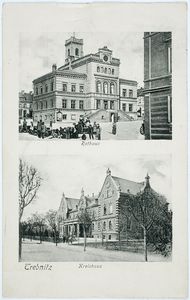
The Baroque town hall stands on the rectangular market square (Ring); it was built as a foundation for a previous building destroyed during the Thirty Years’ War, established by Abbess Sophia I Korczinski (rebuilt after 1945). An earlier building on the site of the parish church of St Peter and St Paul is mentioned as early as the 12th century; it is thought to have been the result of a foundation by the Polish magnate Peter Wlast (c. 1080–1153). In 1854–1855, the church was rebuilt in the Neo-Gothic style; medieval remains have been preserved in the exposed masonry. After 1947, the building was used intermittently as a warehouse and fell into disrepair; in 1987, it was taken over by the Catholic parish. Following extensive renovation, it is once again in use as a place of worship.
On the hill in the park in the north-western part of the town, remains of the castle can still be seen; it was first mentioned in 1322 and razed in 1432.
Evidence of the town’s development as a spa resort includes, amongst other things, the spa complex on ul. Leśna (Buchenwaldstraße, 1887/88), designed by Hubert Jantke (1866–1925); a Neo-Baroque hospital with a chapel on ul. Stawowa (Marienstraße, 1902), as well as numerous villas, mainly in the Neo-Baroque and Art Nouveau styles.
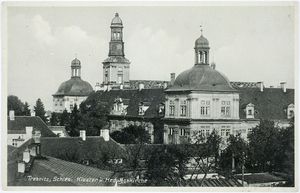
The monastery complex of the former Cistercian abbey consists of the church and the adjoining monastery buildings to the south, which in their present form date from the late Baroque period (1697–1726) and house the provincial house of the Borromean Sisters and the municipal hospital. The monastery church, Romanesque at its core (now the Catholic parish church of St Mary, St Hedwig and St Bartholomew) was built around 1203–1241 (sources mention, amongst others, the stonemason Jakub and the bricklayer Dalemir from Haasenau/Zajączków near Trebnitz). Between 1741 and 1789, the church was given a Baroque makeover under the abbesses Margaretha III von Wostrowsky and Schalka, and Bernarda I Paczinsky from Tenczyn (near Kraków).
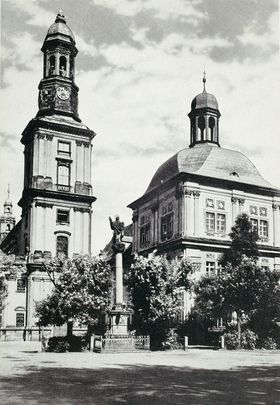
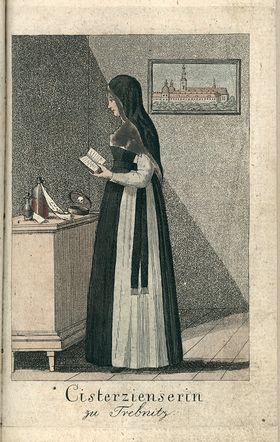
Numerous examples of medieval stone carving have survived, such as the tympanum reliefs in the late Romanesque side portal of the west façade (1218–1230), depicting King David playing the harp, Bathsheba and her maid, the side portal in the northern transept wall (c. 1250; the Virgin Mary enthroned with angels) and the early Gothic portal between St Hedwig’s Chapel and the choir (c. 1290; the Coronation of the Virgin and the Crucifixion).
The interior decoration, featuring works by prominent Silesian artists, dates predominantly from the 18th-century renovation phase, including the Baroque high altar with the painting of the Assumption of the Virgin and the Holy Trinity (1747–1748) by Philipp Christian Bentum (c. 1690–1757)[9] and the pulpit (1739–1745).
In front of the altar stands the archaic-style double tomb of Duke Henry I the Bearded and Konrad von Feuchtwangen, Grand Master of the German Order (d. 1296), dating from around 1685. The central nave pillars are adorned with a cycle of paintings depicting the life of St Hedwig (1735) from the workshop of Michael Willmann (1630–1706); some of the panels on the side altars between the naves are by Willmann himself.
The organ case on the west gallery (1903) was created by Hans Poelzig (1869–1936).
Beneath the choir lies the oldest part of the church, the hall crypt of St Bartholomew, completed in 1214.
The Chapel of St Hedwig, south of the choir and built in 1268 following her canonisation, is the first Gothic building on the territory of what was then Poland; it was commissioned by Duke Wladislaus of Breslau (1237–1270), Archbishop of Salzburg.
At the centre of the chapel stands the tomb of St Hedwig, dating from 1679–1680, with columns of black and pink marble and a wooden canopy, beneath which lies the semi-reclining figure of the saint in alabaster, crafted (c. 1750) by Franz Joseph Mangoldt (1695–1761).
Bibliography
- Krystyna Białoskórska: New findings in research into the architecture and construction history of the Cistercian abbey church in Trzebnica, and the question of the origin of the workshops involved [New research findings on the architecture and construction history of the Cistercian abbey church in Trzebnica and the question of the origin of the workshops involved]. In: Andrzej M. Wywra, Antoni Kiełbasa (eds.): The Cistercian Nuns in the History and Culture of the Polish Lands, the Former Polish-Lithuanian Commonwealth and Central Europe. Poznań 2004, pp. 380–409. Tadeusz Broniewski: Trzebnica. Wrocław 1959 (Silesia in Art Monuments).
- Dagobert Frey: The former Cistercian nuns’ church in Trebnitz – investigations and excavations. In: Deutsche Kunst und Denkmalpflege 11 (1937), pp. 10–23.
- Dagobert Frey, Alfred Zinkler, Günther Grundmann: The Monastery Church in Trebnitz – a monument to German art from the period of colonisation in Silesia. Breslau 1940.
- Guide to the Town and Spa of Trebnitz in Silesia. Published by: ‘Trebnitz’ Transport and Beautification Association. Trebnitz 1926.
- 700 Years of Trebnitz [Commemorative Publication]. Edited by the Trebnitz/Oberschwöditz Local History Society. Edited by Hiltrud Schrade. Trebnitz 1995.
- Joseph Gottschalk: Trebnitz. In: Hugo Weczerka (ed.): Handbook of Historical Sites. Silesia. Stuttgart 1977 (Kröners Taschenausgabe 316), pp. 542–544.
- Heinrich Grüger: The Convent of Trebnitz (Trzebnica) until the end of the Habsburg Counter-Reformation – an overview. In: Józef Swastek, Michał Kaczmarek (eds.): Księga Jadwiżańska. International Academic Symposium: Saint Jadwiga in the History and Culture of Silesia. Wrocław–Trzebnica, 21–23 September 1993 [The Book of Saint Jadwiga. International academic conference: St Hedwig in the History and Culture of Silesia]. Wrocław 1995 (Acta Universitatis Wratislaviensis 1720), pp. 83–98.
- Romuald Kaczmarek: The Mausoleum of St Hedwig in Trzebnica [The Mausoleum of St Hedwig in Trebnitz]. Wrocław, 1993.
- Romuald Kaczmarek, Jacek Witkowski: The Chapel of St Hedwig in Trzebnica. Furnishings and Function [Die Kapelle der hl. Hedwig in Trebnitz]. In: Wywra/Kiełbasa 2004 [see above] Wywra/Kiełbasa 2004 [see above], pp. 345–368.
- Konstanty Kalinowski: The Baroque in Silesia. History, Characteristics and Contemporary Appearance. Munich 1990, pp. 147–150.
- Beata Lejman: Trzebnica/Trebnitz. In: Ernst Badstübner, Dietmar Popp, Andrzej Tomaszewski, Dethard von Winterfeld (eds.), Sławomir Brezicki, Christine Nielsen (eds.): Dehio Handbook of Art Monuments in Poland. Silesia. Munich, Berlin 2005, pp. 958–963.
- Jerzy Rozpe̜dowski: The Cistercian Abbey at Trzebnica in the Middle Ages: the problem of dating and the origin of the workshop [The Cistercian Abbey Church at Trebnitz in the Middle Ages: Questions of dating and the origin of the workshop]. In: Wywra/Kiełbasa 2004 [see above], pp. 410–430.
Web links
- www.trzebnica.sds.pl/ (Trebnitz Monastery website)
- sztetl.org.pl/de/stadte/t/1294-trebnitz-trzebnica/96-lokalgeschichte/69355-lokalgeschichte (online portal on the history of Jews in Poland)
- www.herder-institut.de/bildkatalog/index/index?searchfield_parameter=trebnitz&newperspective=thumbnails (Images of Trebnitz/Trzebnica in the image archive of the Herder Institute, Marburg)
Notes
[1] Stanisława Sochacka: Słownik etymologiczny nazw geograficznych Śląska [Etymological Dictionary of Geographical Names in Silesia]. Opole 2009, p. 98ff.
[2] See the municipality’s website: trzebnica.pl (accessed 10 August 2021).
[3] Michael Rademacher: A History of German Administration from the Unification of the German Empire in 1871 to Reunification in 1990. URL: treemagic.org/rademacher/www.verwaltungsgeschichte.de/ (accessed 10 August 2021).
[4] On the settlement and demographic structure of the Recovered Territories: C[zesław] Osękowski: Society in Western and Northern Poland in the years 1945–1956. Procesy integracji i dezintegracji [Society in Western and Northern Poland in the Years 1945–1956: Processes of Integration and Disintegration]. Zielona Góra 1994.
[5] GUS – Główny Urząd Statystyczny [Central Statistical Office]: stat.gov.pl/obszary-tematyczne/ludnosc/ludnosc/ludnosc-stan-i-struktura-ludnosci-oraz-ruch-naturalny-w-przekroju-terytorialnym-stan-w-dniu-31-xii-2014-r-,6,17.html (accessed 25 September 2015).
[6] Organised pilgrimages to Trzebnica have been recorded since 1448. See Kaczmarek, Witkowski: Kaplica Św. Jadwigi w Trzebnicy, p. 355.
[7] treemagic.org/rademacher/www.verwaltungsgeschichte.de/ (note 3).
[8] Online portal on the history of the Jews in Poland: sztetl.org.pl/de/stadte/t/1294-trebnitz-trzebnica/96-lokalgeschichte/69355-lokalgeschichte (accessed 25 January 2022).
[9] Beata Lejman: Philip Christian Bentum. Malarz śląskiego baroku [Philip Christian Bentum. Painter of the Silesian Baroque]. Warsaw 2008, pp. 90–96.
Citation
Beata Lejman, Tomasz Torbus: Trebnitz/Trzebnica. In: Online Encyclopaedia on the Culture and History of Germans in Eastern Europe, 2015. URL: ome-lexikon.uni-oldenburg.de/p32277 (as at 20 October 2015).
Terms of use for this article
Copyright © University of Oldenburg and the Federal Institute for the Culture and History of Germans in Eastern Europe (BKGE), all rights reserved. This work was produced as part of the project ‘Online Encyclopaedia on the Culture and History of Germans in Eastern Europe’ and may be reproduced and published provided the rights holders’ consent has been obtained. Please contact:
If you have any specialist comments or additions to the text, please contact the editorial team, citing relevant literature and source references.