

Lauenburg and Bütow (Lande)
Lauenburg and Bütow (Lande)
1. Toponymy
The term ‘Landen’ (= regions) Lauenburg and Bütow (Ziemia lęborsko-bytowska) refers to a historical territory comprising the towns of Lauenburg/Lębork and Bütow/Bytów, as well as their surrounding areas. Both towns, after which the surrounding region was in turn named, derive their names from the respective rivers on which they were founded: the Leba (Łeba) near Lauenburg (1338/39: Lewinburg) and the Bütow (Bytowa) near Bütow (1329: dominium et castrum Butowe; 1346: terra butowe and stad Butaw ; 1999 official Kashubian name: Bëtowò).
2. Geography
The regions of Lauenburg and Bütow are situated in the far east of Hinterpommern. Historically, they formed a link between Pomerania and Pomerellia, but were separated from one another by the bailiwick – later the district – of Stolp/Słupsk in Pomerania. The original administrative centre of the Lauenburg region was the Pomeranian castle of Belgard on the Leba/Białogarda (Kashubian: Biôłogarda), whose role was taken over in the first half of the 14th century by the town of Lauenburg, newly founded in the glacial valley of the Leba, a tributary of the Baltic Sea. Lauenburg marked an important stop on the significant Hanseatic trade route between Stolp and Danzig/Gdańsk. Bütow’s location is similarly characterised – in the valley of the originally heavily marshy Bütow, a tributary of the Stolpe (Słupia), the town also developed from the first half of the 14th century onwards at one of the few passable road crossings over the river and was thus of great strategic importance on the edge of the Baltic Ridge, situated on an ancient trade and military route. To the west of Bütow lay a region that was originally independent, with its centre at the castle in Tuchen/Tuchomie. In the late Middle Ages, the region of Tuchen was incorporated into the region of Bütow by the German Order following the completion of the Order’s castle there.
The region, or what later became the district of Lauenburg, lies on the Baltic coast between Lake Leba (Jezioro Łebsko) in the west and Lake Zarnowitz (Jezioro Żarnowieckie) in the east. Before flowing northwards towards the Baltic Sea, the River Leba divides the region into a southern part, characterised by the terminal moraine, and a northern part, characterised by the ground moraine. The Lauenburg district covered an area of 1,289 km² and had a population of just under 64,000 in 1939, of whom almost a third lived in Lauenburg. At that time, the small town of Leba had a population of just over 2,800. With an area of 617 km², the district of Bütow was the smallest district in the province of Pomerania until 1945. Of the 24,000 inhabitants in 1939, more than half lived in the only town, Bütow.[1] The Bütow region is characterised by a hilly landscape rich in forests and lakes, which forms part of the terminal moraine, the Baltic Ridge; its highest point here is the Schimmritzberg (Siemierzycka Góra) at 256 metres above sea level. In ecclesiastical terms, there was a marked difference between Lauenburg and Bütow until the Reformation: whilst the latter area belonged to the Diocese of Cammin, Lauenburg was part of the Diocese of Kuyavia, with its seat in Leslau/Włocławek.
3. History and Culture
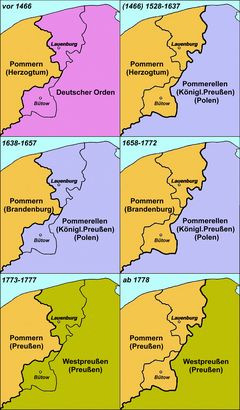
The regions of Lauenburg and Bütow have been shaped by an eventful history involving Pomerelia, Poland, the German Order, the Ascanian Margraves and the Dukes of Pomerania. They form part of the original settlement area of the Pomeranians. Since the emergence of a western tribal duchy – later known as Pomerania – and an eastern tribal duchy – later known as Pomerellia – during the 12th century, both regions had become borderlands. Whilst the Lauenburg region was held by the Samborids, the ruling dynasty of Pomerelia, until the 13th century, the Bütow region had already fallen at an early stage to the Ratiborids, a branch of the House of Greifen, who ruled in the Sławno-Stolp area.Sławno–Stolp, a branch of the House of Greifen. Following the extinction of the Samborids in 1294, the entire area between Stolp and Danzig came under the suzerainty of the Margraves of Brandenburg for a decade and a half, before they ceded almost all of Pomerelia to the German Order in 1309. This included Lauenburg, whilst Bütow only came under the Order’s control in 1329, via a roundabout route. In 1341, the Order, as the new sovereign, first granted Lauenburg, and then in 1346 Bütow, a charter of town privileges under Kulm law. At the end of the 14th century, Order castles were built in both towns; in the case of Bütow, these have survived almost entirely, whilst in the case of Lauenburg, only parts remain.
In 1466, under the terms of the Second Peace of Toruń, the Order lost, amongst other territories, Lauenburg and Bütow to the Polish Crown. King Casimir IV (Kazimierz IV Jagiellończyk, 1427–1492) immediately pledged both territories to Duke Eric II of Pomerania (c. 1425–1474). In 1526, this pledged possession was converted into a fief of the Polish Crown. Whilst all the other territories of the Dukes of Pomerania were part of the Holy Roman Empire of the German Nation, Lauenburg and Bütow remained Polish fiefs until the extinction of the House of Greifen. From 1637 to 1657, the two territories had been confiscated by the Polish Crown as extinguished fiefs, following which extensive efforts at recatholicisation began.
In the Treaty of Bromberg/Bydgoszcz in 1657, Poland finally enfeoffed the Great Elector (Frederick William of Brandenburg, 1620–1688) with Lauenburg and Bütow. This was accompanied by the continued existence of a whole series of special administrative structures (including, amongst other things, a chief provincial governor), which were only gradually abolished following the integration of both territories into the Province of Pomerania from 1771 onwards. However, some areas, such as the judicial system, were initially still assigned to institutions in the neighbouring Province of West Prussia, which had been newly formed in 1773. The Lauenburg-Bütow district, established in 1777, was divided in 1846, with Lauenburg and Bütow each becoming the seat of a district administration. Apart from the estate of Draheim, Lauenburg and Bütow were the only areas in Pomerania before 1945 that had an indigenous Catholic population dating back to the Counter-Reformation, although this remained numerically small compared to the Protestants living there. Furthermore, it was only in the two districts of Lauenburg and Bütow – and to a lesser extent in the neighbouring district of Stolp to the west – that there was a Kashubian-speaking minority, some of whom were Protestant and some Catholic.
After 1945, Lauenburg was assigned to the Gdańsk Voivodeship (Województwo gdańskie), then became part of the Słupsk Voivodeship (Województwo słupskie) from 1975 to 1999, before becoming part of the new Pomerania Voivodeship (Województwo pomorskie) with its administrative centre in Gdańsk, which in German usage essentially corresponds to the historical region of Pomerelia. In the case of Bütow, the decision was made in 1945–1946 to assign it to the Koszalin Voivodeship (Województwo koszalińskie), from which the path, via its assignment to Słupsk from 1975 onwards, ultimately led to the Pomerania Voivodeship in 1999, as was the case with Lauenburg.
Bibliography
- Ernst Bahr, Klaus Conrad: Lauenburg. In: Helge bei der Wieden, Roderich Schmidt (eds.): Handbook of Historical Sites in Germany. Mecklenburg/Pomerania. Stuttgart 1996 (Kröners Taschenausgabe 315), p. 228–230.
- Ernst Bahr, Roderich Schmidt: Bütow. In: Helge bei der Wieden, Roderich Schmidt (eds.): Handbook of Historic Sites in Germany. Volume 12: Mecklenburg/Pomerania. Stuttgart 1996 (Kröners Taschenausgabe 315), pp. 171–173.
- Gerhard Bronisch, Walter Ohle, Hans Teichmüller (eds.): The District of Bütow, P.p. The Art and Cultural Monuments of the Province of Pomerania 1. 2nd ed. Stettin 1939.
- Reinhold Cramer: History of the Lauenburg and Bütow Regions. Two volumes. Königsberg in Prussia 1858.
- Peter Johanek, Franz-Joseph Post (eds.), Thomas Tippach (ed.): *The Book of Towns of Hinterpommern*. Revised edition. Published by the Institute for Comparative Urban History at the University of Münster. Stuttgart 2003 (*German Book of Towns*. Handbook of Urban History 3,2).
- Klaus-Dieter Kreplin, Haik Thomas Porada, Dirk Schleinert: The Catalogue of the Non-State Archives of the Bütow District as at 1939/40 by Erich Winguth (†). Introduction and commentary. In: Baltic Studies – Pomeranian Yearbooks for Regional History (New Series) 86 (2000), p. 115–143.
- Gerard Labuda: Inwentarze starostwa Bytowskiego i Lęborskiego z XVII i XVIII w [Inventories of the Bytów and Lębork Starosties from the 17th and 18th centuries]. Toruń 1959 (Inwentarze i lustracje starostw w Prusach Królewskich 2/Fontes 46 [Inventories and lustration records of the starosties in Royal Prussia 2/Sources 46]).
- Haik Thomas Porada: The ‘Inner Circles’ in Pomerania – Excursion by the Working Group for Pomeranian Church History (e.V.) through Eastern Hinterpommern in August 2000. In: Pomerania – Culture and History 38 (2000), No. 3, p. 2–7.
- Zygmunt Szultka, Bogdan Wachowiak: Wizytacje domen bytowskiej i lęborskiej z XVI wieku [Visitations of the sovereign’s domains in Bytów and Lębork in the 16th century]. Warsaw, Szczecin 2009.
Notes
[1] All population figures cited are taken from: Dietmar Lucht: Pomerania: History, Culture and Economy up to the Outbreak of the Second World War. 2nd ed. Cologne 1998 (Historical Regional Studies – German History in the East 3), pp. 182–185.
Citation
Haik Thomas Porada: Lauenburg and Bütow (Lande). In: Online Encyclopaedia on the Culture and History of Germans in Eastern Europe, 2014. URL: ome-lexikon.uni-oldenburg.de/p32542 (as at 18 October 2021).
Terms of use for this article
Copyright © University of Oldenburg and the Federal Institute for the Culture and History of Germans in Eastern Europe (BKGE), all rights reserved. This work was produced as part of the project ‘Online Encyclopaedia on the Culture and History of Germans in Eastern Europe’ and may be reproduced and published provided the rights holders’ consent has been obtained. Please contact:
If you have any specialist comments or additions to the text, please contact the editorial team, citing relevant literature and source references.