

Institute for Local History, Käsmark
Institute for Local History, Käsmark
The ‘Institute for Regional Research’ (IHF) in Käsmark/Kežmarok in Slovakia played a significant role in the history of the ‘Carpathian Germans’ in the Slovak State, which existed from 1939 to 1945. Both Reich authorities and the country’s own ‘German Party’ (DP) assigned the IHF a crucial role in the cultural and political ‘Gleichschaltung’ of the German minority. During its brief existence, from early 1941 to late 1944, the IHF gained regional significance within the context of a supra-regional network of research institutions that dealt with German minorities in accordance with Nazi ethnic policy.
At an academic level, the IHF should “bring together all those working in the field of Carpathian German local history, establish a research council and ensure the support of early-career researchers, [...] continue to expand its library, establish a collection of photographs and an archive, and also promote the publication of local history works and establish links with other similar Institutes”[1], as the German Institute for Foreign Affairs (DAI) put it in a memorandum to the Reichsführer-SS. In fact, during its brief existence, the IHF was able to fulfil these requirements to a greater or lesser extent.
The DP chairman and ‘ethnic group leader’ Franz Karmasin (1901–1970) described the Institute’s political tasks as ‘strengthening German identity’ in Slovakia, binding the Slovak Germans to the Reich, and the creation of “new forms of relationship between the ethnic groups” in the country – primarily Germans and Slovaks, to a lesser extent the Hungarian minority, and certainly not Jews or Roma. Furthermore, the IHF was intended to ‘combat any form of local individualism’ and – in the words of the German envoy – act as a “spiritual bond uniting all Germans in Slovakia”, so that there would be “no ‘Deutsch-Probener’, no ‘Zipser’ or ‘Pressburg Germans’”, but “simply Germans.”[2] The establishment of the IHF should be viewed in the context of the efforts at that time to bring the various German‘ethnic groups’ of South-Eastern Europe closer together and to bind them more closely to the Reich. Events such as the ‘Käsmark Cultural Week’ in July 1943, which was attended by representatives of almost all German minorities, underlined the importance of regional research institutions for this process.
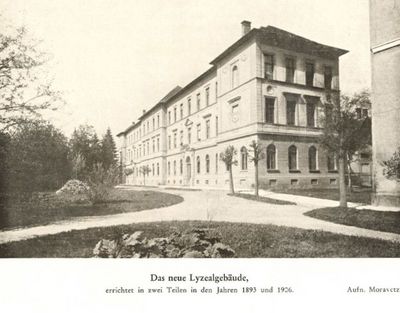
When it was founded in January 1941, the IHF comprised departments for ‘Folklore and Customs’ and for ‘Genealogical Research and Family History’, as well as an archive of folk songs and folk music. The Protestant Lyceum in Käsmark made its old school building and its library, containing some 30,000 volumes, available to the Institute. A Research Council was established, comprising 17 members, including the German envoy in Pressburg/Bratislava, an official from the Volksdeutsche Mittelstelle (VoMi, the SS-controlled central authority for ‘German ethnic policy’), leading ethnologists ofthe ‘Third Reich’, scholars from the German minority, representatives of the ‘Volksgruppenführung’ and two members of staff from the Institute. The fact that some members held full-time or part-time positions within the SD (SD = Security Service of the Reichsführer-SS) indicates a high level of interest on the part of the Reich Security Main Office in the Käsmark Institute.
At the time of its foundation, the DP’s ‘Main Cultural Office’ and the DAI were the Institute’s two sponsoring bodies, although the German Legation in Pressburg was also involved from the outset. However, whilst the DP was to remain one of the IHF’s most important pillars (and at times also an adversary), on the part of the Reich authorities the growing importance of the VoMi soon overshadowed the DAI.
From the outset, the IHF had a distinctly political mission that took precedence over all academic tasks. Through close cooperation with the DP’s branches, particularly the ‘Karpatendeutsche Erzieherschaft’ (Carpathian German Teachers’ Association), as well as regular media contributions, the IHF’s work was intended to influence a broad public in line with the National Socialist ‘policy on German identity’.
The IHF was founded on 9 January 1941 in Käsmark, a small town in the Upper Spiš region (Slovak: Vyšný Spiš) in eastern Slovakia, which at the time was largely German-speaking. The key driving force behind the initiative to establish a central research centre for Spiš or ‘Carpathian German’ local history, and later director of the institution, was Johann Liptak (also spelled Lipták, 1889–1958), the most renowned Spiš German local historian of his time. The political involvement and financial support of the DP, as well as from Reich German authorities, made it possible to realise the project on this scale.
In mid-1942, the VoMi (at the request of the DP) arranged for the appointment of the Sudeten German researcher couple Franz Josef Beranek (1902–1967) and Hertha Wolf-Beranek (1912–1977). Unlike Liptak, the Beraneks were regarded as academically ‘modern’ in the spirit of the times, with good connections to leading circles of ‘völkische’ scholarship in the Reich; they were considered politically trustworthy and ‘immune’ to the ‘separatism’ and ‘Magyarism’ of many Spiš Saxons, who were attached to old regional customs or loyalties, including those towards Hungary.
During their 20-month tenure in Käsmark, the Beraneks took on the bulk of the Institute’s tasks, including the establishment of a folklore archive, research into the history of German settlement in Slovakia, collaboration with the ‘German teaching staff’ and publications in the DP’s press outlets. The institute’s actual director, Liptak, worked only on a voluntary basis; his health was poor and he tended to adopt a rather passive stance. A planned reorganisation of the IHF – like other projects – never progressed beyond the planning stage.
The IHF sought to raise its profile further through the publication of its own series of works and through academic conferences (which were co-organised and funded by the DP). In September 1942 and 1943, ‘German University Weeks’ were held in Käsmark, attended by leading academics from the German Reich. A third University Week was planned for 1944 but did not take place due to the course of the war.
Owing to personal conflicts between the parties involved and dissatisfaction, particularly with Franz Beranek’s work performance, the couple were transferred to Prague in December 1943, followed by a dispute over the return of ‘borrowed’ material from the Institute and a final break with the VoMi and the DP. The Beraneks were succeeded at the IHF by various part-time staff, mainly teachers from the Käsmark Lyceum. Between February and November 1944, only the VoMi folklorist Ingeborg Kellermann (1918–1993) worked full-time at the IHF. The changing staff made it difficult for the Institute to continue its work with any real purpose during its final months.
The Slovak National Uprising in late summer 1944, together with the advancing Red Army, posed an existential threat to the Germans in eastern Slovakia and led to an abrupt end to the IHF. Most of the material was transported to Kunnersdorf/Kunratice in Bohemia in November 1944. Liptak was first evacuated to Austria and later to Bavaria; Kellermann was already working in refugee care in Vienna at that time. After the end of the war, the Institute was not re-established.
Bibliography
- Rudolf Melzer: History as I Lived It. A Retrospective on a Generation of Carpathian Germans. Part 2. From 1939 to 1945 and What Followed. Stuttgart 1998.
- Christof Morrissey: Institute for Local History Research in Käsmark (Slovakia). In: Michael Fahlbusch and Ingo Haar (eds.): Handbook of Ethnic Studies. Munich 2008, pp. 260–265.
- P. Rainer Rudolf, Eduard Ulreich: Biographical Encyclopaedia of the Carpathian Germans. Stuttgart 1988.
Web links
- https://www.hsozkult.de/conferencereport/id/tagungsberichte-148 (Report on a conference at which the IHK was also presented)
- https://www.hsozkult.de/publicationreview/id/reb-6431 (Review of M. Beer et al. (eds.): ‘Southeast Research in the Shadow of the Third Reich’, in which the IHK is mentioned)
Notes
[1] Federal Archives, Berlin-Lichterfelde (Barch BL), files of the former Berlin Document Centre (BDC), Franz Josef Beranek. German Institute for Foreign Affairs to the Reichsführer-SS, 5 February 1941.
[2] Barch BL, R 70 Slovakia 47/110, p. 10. See also Grenzbote, 24 March 1941.
Citation
Morrissey, Christof: Institute for Local History Research, Käsmark. In: Online Encyclopaedia on the Culture and History of Germans in Eastern Europe. 2021. URL: ome-lexikon.uni-oldenburg.de/p32727 (as at 7 February 2022).
Terms of use for this article
Copyright © University of Oldenburg and the Federal Institute for the Culture and History of Germans in Eastern Europe (BKGE), all rights reserved. This work was produced as part of the project ‘Online Encyclopaedia on the Culture and History of Germans in Eastern Europe’ and may be reproduced and published provided the rights holders’ consent has been obtained. Please contact:
If you have any specialist comments or additions to the text, please contact the editorial team, citing relevant literature and source references.