

Eger/Cheb
Eger/Cheb
Etymology
The Czech name Cheb can be traced back to the Old Czech form of ‘ohyb’ (bend) or to the Germanic term ‘Chub’, meaning a high or sloping location. The German name ‘Eger’ can be derived from the Old High German form ‘Agria’ (the fast-flowing/wild river). The flow of the River Ohře, which runs through Eger, thus gave the town its name. The Czech form ‘Ohře’ is based on a loanword from West Germanic.[1] Both the ‘Cheb’ and ‘Eger’ variants have been documented since the 14th century; since 1945, the official name has been ‘Cheb’.
Location
Eger is the westernmost town in the Czech Republic and is situated at 50°5’ north latitude, 12°22’ east longitude, 459 m above sea level and around 170 km west of Prague (Praha). The name ‘Egerland’ (Chebsko) for a historical region in the west of the Czech Republic is derived from the town. Furthermore, Eger has been the centre of the Euregio Egrensis since 1993.
Topography
Eger is situated on the River Eger (Ohře) in the centre of the Eger Basin (Chebská pánev), which is bordered to the east by the Kaiserwald (Slavkovský les) and to the west by the Fichtelgebirge. To the north-east lies the Soos Nature Reserve, which is situated within theOhře Graben.
Political and administrative affiliation
Czech Republic. Eger is situated in the district of Eger (Okres Cheb), which forms part of the Karlovy Vary Region (Karlovarský kraj).
Common symbolism
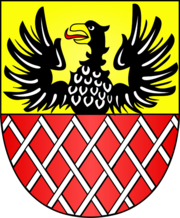
The town’s current coat of arms reflects Eger’s historical character by depicting the continuity of its historical rights and the town’s development. The shape of the shield dates from the 14th century, whilst the colour scheme dates from the 16th century. The main motif is a black eagle with outstretched wings on a yellow background, which recalls the town’s time as a free imperial city and is situated in the upper part of the shield. In the lower part of the shield, a five-barred white or silver grille on a red background – interpreted as a portcullis – symbolises the protection afforded to the population by the town’s fortifications.
Modelled on the coat of arms of Czechoslovakia, a silver double-tailed lion – the former symbol of Bohemia – was depicted on a red background in place of the eagle from 1961 until the 1990s.
Middle Ages

Presumably on the site of a former Slavic settlement, a castle site already existed in the 9th century at the bend in the River Ohře – the town’s present-day location – the existence of which was confirmed by archaeological excavations in the 1930s and 1960s. The ongoing colonisation of the area from the Bavarian Ostmark led to the settlement of German colonists. Eger was first mentioned in a document on 13 February 1061 as ‘Egire’. In a charter, King Henry IV granted a certain Otnant, a servant and ministerial of the Salian royal house, a territory in the northern part of the Nabburg Mark, which belonged to the Nordgau, bounded by three rivers (the Krumme Naab, the Schurbach and the Trebnitz) and a road. The document described this path as a road leading from Eger (via que procedit de Egire) and passing through Schirnding, Arzberg and (Markt-)Redwitz on its way to Kulmain and Kemnath. The old castle was expanded in the 11th century to serve as the administrative centre of the new lords, the Margraves of Vohburg. In 1125, they built a new castle there. On 12 July 1213, King and later Emperor Frederick II signed the Golden Bull of Eger in Eger, which had been granted town status in 1179. Following the death of the last Staufer Emperor, Conrad IV, and during the so-called Interregnum, the Bohemian King Přemysl Ottokar II occupied the town in 1265. During this period, Eger was also declared a Free Imperial City (1277). In October 1322, the town and its surrounding area were transferred by the German Emperor Louis IV of Bavaria to the Bohemian King John of Luxembourg in return for a payment. Although the town’s status and the autonomy associated with it were formally guaranteed in a charter at the same time, it nevertheless lost this status in the years that followed. In 1349, Eger was granted the right to mint coins. In 1350, as in other major cities of the Empire, riots broke out against the local Jewish community; in 1430, a decision was taken to permanently expel the Jews. During the so-called ‘Nobles’ Feud against Eger’ (1381–1396), the rural nobility of the Vogtland region launched raids against the imperial city of Eger due to the poor economic situation. In the ‘Peace of Eger’, concluded on 5 May 1389 at the Imperial Diet in Eger, King Wenceslaus IV of Bohemia was able to secure the allegiance of the south-western German imperial cities and thereby prevent further unrest. However, the situation in Eger and the surrounding area only gradually stabilised; it was not until the beginning of the 15th century that the raids were finally brought to an end. During the Hussite Wars, the town sided with the anti-Hussite coalition. Under Emperor Sigismund of Luxembourg, the town also took part in the campaigns against the Hussites. In 1430, the Hussites carried out acts of arson and looting, but major damage was averted following negotiations. The ‘Treaty of Eger’ (1459) established the border between Bohemia and Saxony.
Modern times
The first half of the 16th century in Eger was characterised by conflict between the town and the local nobility. It was not until late in the period that the Reformation took hold, and the population eventually adopted the Lutheran faith. In 1609, Emperor Rudolf II denied the town religious freedom, and following the Battle of White Mountain (1620), Emperor Ferdinand II ordered the implementation of the Counter-Reformation.
During the Thirty Years’ War, the town – situated on the main route between the Empire and Bohemia – was forced to supply passing imperial troops and was captured on several occasions. Albrecht von Waldstein, known as Wallenstein, was assassinated in Eger on 25 February 1634. In light of the experiences during the Thirty Years’ War, Emperor Ferdinand III issued a decree in July 1652 ordering the expansion and conversion of Eger into a military fortress. The work was not largely completed until the 1740s. In the 17th century, the town’s economic situation recovered, leading to a stabilisation of the political situation as well.
The Eger Provincial Assembly, which consisted of leading figures from the town, the nobility and the Church and represented the Eger region in negotiations with the King of Bohemia, was convened for the last time in 1721, when it issued a declaration of support for the ‘Pragmatic Sanction’. In 1723, Eger was granted the status of a royal town. As part of the administrative reforms under Empress Maria Theresa and Emperor Joseph II, the town was incorporated into the system of Bohemian district administration. During the War of the Austrian Succession (1740–48), Eger was besieged twice, and the population suffered greatly as a result. Following the dissolution of the Holy Roman Empire of the German Nation in 1806, the Imperial Enclave of Eger did not become part of the Crown of Bohemia, but was assigned to the territory of the Habsburg Monarchy. In 1809, a major fire broke out in the northern part of the town, destroying parts of the medieval built environment. From the mid-19th century onwards, Eger finally became the seat of the Eger judicial district within the Eger district. During the First World War, Eger was a garrison town. Around 20,000 soldiers from the Eger military district died in the First World War.
Contemporary History
Following the establishment of the Czechoslovak Republic, there were efforts by German parties and politicians to place the town of Eger and the Eger region under the jurisdiction of the Province of German Bohemia and, ultimately, German Austria. These plans failed in the autumn of 1918, and from that point onwards Eger formed part of the territory of Czechoslovakia. Between 1938 and 1945, the town belonged to the German Reich. On 26 April 1945, Eger was liberated by American troops. Between 1945 and 1946, the majority of the German population was expelled and their property confiscated. In 1968, the Red Army occupied Eger; it was not until 1990 that the first democratic local elections since 1948 were held.
Administration
The first mayor of the town of Eger is recorded as early as 1281. In 1852, the mayor was elected by the municipal council for the first time. Following the First World War, a citizens’ militia was formed on 1 November 1918, and on the same day a district national committee was established, headed by Mayor Anton Friedrich (1862–1923). On 22 October 1922, a delegation from the town approached the President of the Czechoslovak Republic to seek self-determination, but without success.
During the interwar period, Eger was a typical administrative and educational town in north-western Bohemia. At the head of the state administration stood the district authority with its various departments. The town council, on the other hand, was the highest authority of the independent municipal administration. The mayor, two deputies and 11 town councillors formed the town council and constituted the town’s official representation.
Following the occupation by German troops on 1 October 1938 and its incorporation into the German Reich, Eger formed its own municipal district within the Reichsgau Sudetenland from 1 May 1939 as part of the reorganisation of the districts. Following the liberation in 1945, a new municipal administration was elected.
Today, Eger comprises 19 cadastral districts.[3]
Population
Between the 15th and 18th centuries, the population of the town of Eger averaged around 6,000; the inhabitants were exclusively German-speaking. In the 19th century and the first half of the 20th century, Eger grew steadily, mainly due to the influx of German migrants. Whilst around 9,487 people lived in the town in 1826, by 1890 the figure had risen to 18,658. In 1910, the town had a population of around 25,457, and in 1930, 31,406. According to the census of 17 May 1939, 35,507 people lived in Eger; by 1945, the figure had risen to around 45,000. In 1947, following the expulsion, the population had fallen to just around 15,000. Today, over 30,000 people live in Eger. In 1880, 15,477 Germans from the German-speaking regions, 1,402 Germans from the Reich and 201 Czechs lived in Eger.[8] The number of Germans from within the Reich (24,979) and Czechs (3,493) had risen steadily until 1930.[9] Following the expulsion of the German population between 1945 and 1947, the proportion of the German population was less than 1 per cent.
Economy
Eger’s favourable geographical location in terms of transport, situated on a settlement route, a transport route and, later, a trade route, encouraged (long-distance) trade as early as the Middle Ages. The earliest goods exported from Eger were hides and leather; later, these included cloth, hats, felt and other handicrafts. Trade also took place in raw materials from the Bohemian mining regions, such as tin and, from the 16th century onwards, silver. At the same time, Eger was already developing its own market structure. In a charter dated 16 April 1306, King Albrecht I granted the town its first formal market privilege. The goods that had also been traded at the market since the Middle Ages included cloth, wool, lead and copper. In addition, mead – produced in Eger and renowned beyond the region – and local beer were on offer. Traders, particularly from the surrounding countryside, came to the market in Eger selling agricultural produce such as beetroot, cabbage, peas and cereals, as well as fruit, dairy products and livestock.
Modern economic development and the associated boom in the town of Eger were attributable to its connection to the emerging railway network. In 1865, a line was built between Eger and Hof, and the first trains of the Bayerische Ostbahn AG arrived in Eger from Waldsassen. Thanks to continuous expansion, the east-west link between Nuremberg, Eger and Prague was established in the 1880s.
Large parts of the station were destroyed during an American bombing raid in April 1945. In the 1970s, the destroyed station building was replaced by a new structure. Eger has also been home to a military airfield since 1916/17; this was destroyed in 1945 and, following its reconstruction, was used for military purposes again until the fall of the Berlin Wall in 1989. Civil aviation has been possible there since 2010.
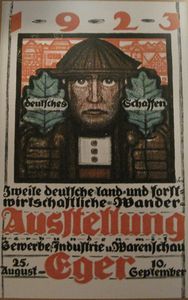
By the beginning of the 20th century, the town’s economic structure had changed; according to the official business census of 27 May 1930, there were a total of 1,656 businesses. 917 of these were in the craft and industrial sectors, whilst 739 were in the retail sector. The most important economic sectors were: breweries, the food industry, the textile industry, the metal industry, leather production, the electrical engineering industry, and the chemical-technical and ceramics industries. Of particular note were the M. Fischer, a major manufacturer of agricultural machinery; the branch factory of the English bicycle and motorbike brand Premier, established in 1893; and the ES-KA factory, founded in 1911, which also produced bicycles and motorbikes; none of these companies exist today.
Today, Eger is primarily home to the textile and engineering industries, whilst tourism also plays a major role. Until the mid-19th century, the spa town of Franzensbad/Františkovy Lázně belonged to the municipal authorities of the town of Eger. The water from the healing spring, originally known as ‘Egerwasser’ or ‘Egerer Sauerbrunn’, helped to make Eger internationally renowned.
Military history
The organisation of a militia and the independent waging of war and feuds were strictly regulated in Eger during the Middle Ages. Furthermore, from the 14th century onwards, mercenaries and town militiamen were recruited or appointed by the town council. For voluntary military service, there were shooting societies, which were mostly recruited from among the journeymen of the trades. These were brought together in the Privileged Rifle Corps and merged into the National Guard in 1848. After 1852, the Rifle Corps was reinstated in its former form.
Following a decree by Emperor Ferdinand III in July 1652, Eger was expanded into a border fortress with two moats and seven large bastions towards the end of the 17th century. Eger had been a garrison town since 1748. Various military units were stationed in the town until 1918. During the interwar period, the airfield was home to, amongst others, a squadron of the Czechoslovak Armed Forces’ No. 1 Aviation Regiment. During the Second World War, the airfield was expanded by the German military, and the Eger aircraft factory was also established. After 1945, the airfield and military buildings were taken over again by the Czechoslovak military.
In September 2010, a war cemetery containing the remains of around 5,600 German soldiers was inaugurated.
Society
Until the beginning of the 20th century, a large proportion of the population worked in agriculture or the skilled trades, whilst a smaller proportion were employed in the retail sector. After the Second World War, many residents found employment in the industrial sector.
Following the establishment of Czechoslovakia, the predominantly German or German-speaking population of Eger sought to maintain or achieve autonomy for the town and the Eger region. On 1 October 1933, Konrad Henlein (1898–1945) founded the Sudeten German Homeland Front in Eger, which was renamed the Sudeten German Party (SdP) in 1935. Following the end of the Second World War and the German occupation, the German population was expelled from the town and the surrounding area, and their property was confiscated. Oďer’s railway station, owing to its convenient location, served as a ‘hub’ for the deportation of Germans from Bohemia.
History of Religion and the Church
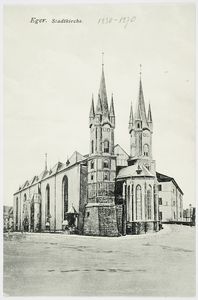
The area around Eger has belonged to the Diocese of Regensburg since the first documented mention of the parish of Eger (around 1140). The first church was dedicated to St John the Baptist. The second church to be built, at the beginning of the 13th century, was the three-nave basilica of St Nicholas. Of the original structure, only the west portal and the lower part of the tower remain today; the nave, chancel and sacristy date from the Gothic period. The Order of the Teutonic Knights exercised the right of patronage until 1693, when it passed to the town. During the last third of the 16th century, the majority of the population had converted to Lutheranism. It was not until the end of the 17th century that the Counter-Reformation measures of the Regensburg Ordinariate were successfully completed and the inhabitants returned to the Catholic faith. In 1808, the parish was separated from the Diocese of Regensburg and assigned to the Archdiocese of Prague. Franciscan friars arrived in Eger around 1247. After their first church burnt down in 1270, the Gothic Franciscan church, together with the monastery and cloister, was consecrated in 1285. The complex is still preserved today. The Poor Clares are first mentioned in a document in Eger in 1273. The very well-preserved Baroque St Clare’s Church, built between 1707 and 1711, has now been deconsecrated and serves as a concert venue. The Dominicans built a church and monastery in 1296. St Wenceslas’ Church, built between 1674 and 1688, now stands on the site of the former Dominican church. The former hospital church of St Bartholomew, belonging to the Order of the Knights of the Cross with the Red Star, was built in 1414. Following damage sustained during the Second World War, the Gothic building was renovated in the 1970s and used as an exhibition hall until 1997, before being returned to the Order of the Knights of the Cross with the Red Star. The Jesuits came to Eger in the wake of the Counter-Reformation, but were unable to establish a permanent presence there. The Sisters of Mercy of the Holy Cross came to Eger in 1868 and devoted themselves to promoting education and nursing. They established the first private girls’ primary school in 1870 and a modern convent building (1931–33) with its own church. They were forcibly resettled in October 1953; the convent was confiscated and converted into barracks. The Protestant congregation was founded around 1862 and built the Friedenskirche between 1869 and 1871. A Jewish community is thought to have existed since the 12th century, but is only documented from the 14th century onwards. The synagogue was built between 1364 and 1375; alongside it stood a hospital, a school and a community centre. Following the expulsion of Jews in the 13th and 14th centuries, a new community was established, though this disbanded in the 18th century. Owing to the town’s economic rise in the 19th century, a Jewish community developed once more, and the new synagogue was inaugurated in 1893. Following the German occupation of Eger, the synagogue was burnt down in 1938; the members of the Jewish religious community (established in 1871) either emigrated or were deported. Until the mid-19th century, Eger was exclusively Catholic (1857: 99.8 per cent). Between 1880 and 1930, the number of Catholics declined, whilst the proportion of Protestants rose, reaching 6.0 per cent in 1930. The proportion of Jewish residents stood at 2.8 per cent in 1910, falling to just 1.6 per cent by 1930.
Special cultural institutions
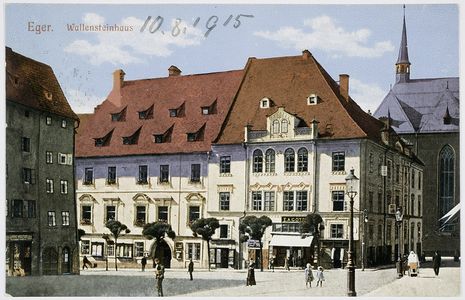
As the town underwent redevelopment in the second half of the 19th century, cultural and social life in Eger also flourished. The municipal theatre was built between 1873 and 1874 by Karl Haberzettel in the Neo-Renaissance style. The earliest documented evidence of theatre in Eger dates back to the 15th century, whilst numerous performances in the 19th century attest to the lively cultural scene, which ultimately made the construction of a new theatre necessary. The so-called ‘Sängerhalle’, which had originally been erected for the German-Bohemian Singers’ Festival on the Brühlwiese in 1898, was replaced by a new structure in 1931. During the Second World War, it was temporarily erected at the airfield and destroyed in an air raid in 1945.
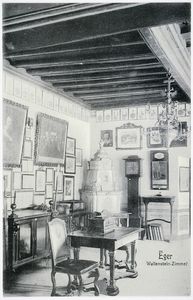
The Eger Museum, founded in 1873, is housed in the 15th-century Gothic town house (Pachelbel House) where Wallenstein was murdered on 25 February 1634. In addition to Wallenstein’s death chamber and his personal effects, the museum displays numerous antiques and pieces of furniture. It also houses a collection documenting the 20 villages in the Eger region near the border that were abandoned following the expulsions after 1945.
An archivist was appointed in 1732. From 1835 onwards, the archive was managed continuously by full-time town archivists. The collections were not damaged during the world wars and are now held at the State District Archive in Eger.
In 1889, the wholesale wine merchant Heinrich Welzel built a mixed-use residential and commercial building, which Rudolf Seidl converted into the ‘Gloria Palast’ cinema in 1937 and subsequently ran, following approval from the local authorities. After the First World War, the cinema building itself was demolished.
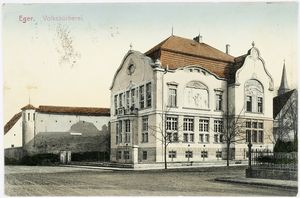
Out of gratitude for his professional success, Dominik Kreuzinger, who had been the owner of the M. Fischer engineering works since 1899, endowed the public library, or municipal library, in Eger. The Art Nouveau building, completed in 1911, was financed from the endowment fund of Kreuzinger, who died in 1903. After 1989, the library was modernised and, following the renovation of the building, once again serves as a public institution in Eger.
Education and Science
A Latin school had existed since the Middle Ages, run by the Jesuits until 1773. From 1850, the grammar school comprised eight years of education and remained a strictly humanistic educational institution until after the Second World War.
From the 15th century onwards, German schools for girls and boys also developed, which continued to exist until the 20th century following the reforms of Maria Theresa. The best-known schools were the Rudolfinum and the Obertorschule. A Czech school was opened in 1925.
Today, Cheb is a university town (home to the School of Economics at the University of West Bohemia) and offers a wide range of vocational schools, secondary schools and schools providing further education. There is also a teacher training college.
Everyday culture
In Eger, seven associations were founded in the 19th and 20th centuries which were dedicated to the preservation of (folk) music and played an important role in the town’s cultural life. Since 1996, the ‘Eger Organ Summer’ has taken place annually in July and August at St Nicholas’ Church.
In the world of sport, the former football club FC Union Cheb – founded in 1951 as VSJ Sokolovo Cheb and dissolved in 1996 – was the most successful club in Cheb. Its successor club, FK Hvězda Cheb, has been in existence since 2001 and currently plays alongside FC Cheb in the 5th division (Karlovy Vary Regional Championship/Karlovarský krajský přebor).
Art History
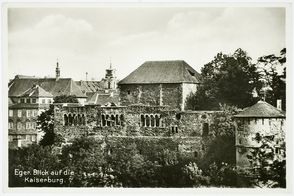
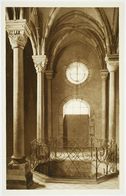
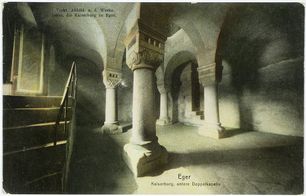
The Imperial Castle was built in the second half of the 12th century on the site of a Slavic fortification. Of the original Romanesque fortifications, the Romanesque double chapel – dedicated to St Erhard and St Ursula – has survived, alongside the Black Tower and part of the eastern rampart. The town’s most valuable building in terms of art history was built at the end of the 12th century next to the castle palace and is divided into a lower and an upper chapel, dedicated to St Martin and the two saints mentioned above, respectively.
On the market square, next to the Baroque town hall, stands the Stöckl von Eger (Czech: Špalíček). This unique complex of houses, the landmark of the market square, consists of eleven medieval houses which were originally built in the 13th century as wooden market stalls and butcher’s shops and were later converted into stone buildings. According to the oldest town view from 1472, the basic layout has been preserved; a third row of houses on the western side of the square was demolished in 1809. In front of the Stöckl stands the Hercules Fountain, featuring a statue of the ‘Wild Man’ holding a gilded club, with which he has been protecting the town’s coat of arms since 1728. Originally, the fountain – which dates from 1606 – featured a wooden sculpture, which was replaced by ‘Hercules’ in 1738. The second fountain on the market square, known as the Roland Fountain, dates from 1591. It is adorned with a statue of the knight Roland, who symbolises the rights of the imperial city.
The joiners and woodcarvers based in Eger made a significant contribution to Baroque art. The so-called ‘Eger relief inlays’ are three-dimensional, coloured inlays that were used in furniture decoration. They were produced, for example, for caskets or cabinet cupboards as a special form of inlay work.
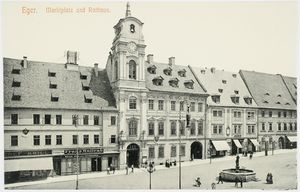

The improvement in the economic situation during the second half of the 17th century was also reflected in a flurry of building activity and the architectural enhancement of the town in the 18th and 19th centuries. The old town hall of Eger has not survived; it is thought to have been destroyed in the town fire of 1270. The new building was constructed in the Gothic style in two phases during the 14th and 15th centuries. In 1697, two adjoining houses were purchased so that the town hall could be rebuilt in the Baroque style. Between 1723 and 1728, the building was constructed to a design by the Prague court architect Giovanni Battista Alliprandi (1665–1720).
A fire in 1809 damaged several major medieval buildings, which were never rebuilt. For example, St John’s Church on Johannesplatz and the old synagogue were lost. The two towers of St Nicholas’ Church were also partially destroyed, so a temporary roof was erected until 1864. The two destroyed towers were the only works in his hometown by the Baroque architect Johann Balthasar Neumann (1687–1753), who was born in Eger.
The uninhabited castle fell into disrepair over time. The castle courtyard was filled with rubble from the demolished fortress, and the castle palace became a ruin. Eger developed into a modern town, particularly around 1900. The new, uniform ring road was built in place of the original moats and outer fortifications. The Protestant church (1871), the Rudolfinum (1874) and the theatre (1874) were also erected here.
The new, modern Eger Bridge, which was officially opened in May 1899, was seen as a symbol of the town’s opening up and the associated building activity. However, in April 1945, the German inhabitants blew up the bridge out of fear of the American army. The two world wars and their aftermath left a lasting mark on the life of the city and its population.
History of Books, Printing and Media
The origins of book printing in Eger date back to the 15th century. During a second phase of development, beginning in 1570, various printers are recorded. The third phase began in the 17th century and continued into the 20th century. There were three major printing works in Eger during the interwar period: the firm Kobrtsch & Gschihay; Dr Hans Kraus’s printing works, sold to the Egerland Press Association in 1921; and Georg Adler’s printing works. In addition, there were smaller printing works run by Karl Ernst Köhler (1906), Josef Götz (1914) and Josef Helm (1926).
The first newspaper in Eger was published in 1738 under the title ‘Egrische Ordinari Postzeitung’. The ‘Egerer Anzeiger’ was published as a weekly from 1847; it was renamed the ‘Egerer Zeitung’ in 1868 and was ultimately published as a daily. The newspaper “Das Egerland – Christlich-German Volksblatt für Westböhmen”, founded in 1897, was also discontinued.
The magazine “Unser Egerland” was published by Alois John from 1897 onwards. Notable annual publications included the ‘Egerer Jahrbuch’ (1871–1930) and the ‘Kalender für das Egerland’ (1911–1942).
Bibliography
The poet Friedrich Schiller came to Franzensbad in 1791 for a spa treatment and to Eger to carry out research into the life of Wallenstein. He took up residence in the building housing the ‘Zum goldenen Hirsch’ inn, which has been known as the ‘Schillerhaus’ ever since.
Culture of memory and remembrance
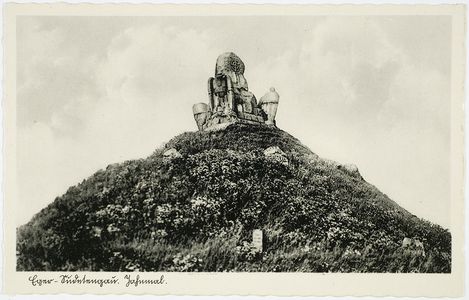
In August 1913, the Jahn Monument was unveiled on an artificially constructed hill on the outskirts of the town. It was intended to symbolise the unity of the German population of Austria-Hungary and the German Empire. In October 1945, the Czech inhabitants of Eger removed the three eagles from the monument.
On Grünberg Hill (Zelená hora), about 4 km west of the town, there is a Bismarck Tower (1909).
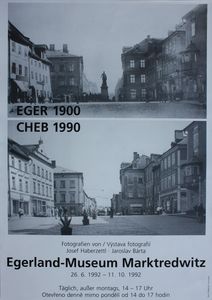
The historic town centre of Cheb was designated an urban conservation area in 1981, and the town hall on the market square has been a listed building since 1988.
The Egerland Museum in Marktredwitz houses numerous artefacts relating to the culture and history of the Germans in Eger. The museum also explores the memories of the displaced Egerlanders and how they coped with the loss of their homeland.
Bibliography
- Jaroslav Bárta, Josef, Haberzettl: Eger 1900–1990. Egerland Museum, Marktredwitz, 26 June 1992–11 October 1992. Marktredwitz 1992.
- Jaromír Boháč, Jiří Strádal: Cheb v zrcadle času [Cheb Through the Ages]. Cheb 2003.
- Jaromír Boháč: Cheb. Zmizelé Čechy [The Vanished Bohemia]. Prague 2010.
- Jaromír Boháč, Lorenz Schreiner: Monuments in the Eger Region. Documentation of a German cultural landscape between Bavaria and Bohemia. Eger 2005.
- Frank Boldt: Cheb. A City of European History. An Essay on German-Czech Identity. Prague et al. 2010.
- Hermann Braun: Marktredwitz and Eger. Marktredwitz 1961.
- Karlheinz Hengst: ‘Eger – Ohře – Cheb’ as linguistic evidence of ethnic coexistence in neighbouring Bohemia since early times. In: Neues Archiv für sächsische Geschichte 84 (2013), pp. 211–221.
- Karlheinz Hengst: Ethnic coexistence since early times as reflected in the names ‘Eger – Ohře’ and ‘Cheb – Eger’. In: Beiträge zur Namenforschung 49 (2014), pp. 289–302.
- Karlheinz Hengst: Why is Eger called ‘Ohře’ as a river and ‘Cheb’ as a town? In: Erzgebirgische Heimatblätter 35 (2013), Issue 1, pp. 3–5.
- Kateřina Iterská: Cheb 1322–1972, Cheb 1972.
- František Kubů: Chebský městský stát [The City-State of Cheb/Eger]. České Budějovice 2006.
- Vinzenz Prökl: Eger and the Eger Region. History of the Town and the Eger Region. Prague 1845.
- Eva Šamánková: Cheb. Prague 1974.
- Heribert Sturm: Eger. History of an Imperial City. Augsburg 1951/52.
- Anton Zankl: The Eagle and the Lion. History and Legend of the Coats of Arms of Bohemia and Moravia. Prague 1945.
Web links
- tic.cheb.cz/ (official website of the town of Cheb)
- encyklopedie.cheb.cz/de/ (interactive encyclopaedia of the town of Cheb)
- www.hrad-cheb.cz/de/ (official website of Cheb Castle)
- www.muzeumcheb.cz/ (official website of the Cheb Museum)
- www.herder-institut.de/bildkatalog/wikidata/Q193719 (images relating to Eger/Cheb in the image archive of the Herder Institute, Marburg)
Notes
[1] German ‘Agriā ’ corresponding to Early West Slavic ‘Ogr(j)a’.
[2] In it, Frederick II granted the bishops the right to freely elect their own bishops and renounced his rights to spolia and regalia.
[3] URL: www.uir.cz/katastralni-uzemi-obec/554481/Obec-Cheb (accessed: 19 February 2017).
[4] Taxable citizens of the town plus the estimated value of non-taxable persons.
[5] Sturm: Eger, p. 13.
[6] Sturm: Eger, p. 13.
[7] F. Heller: The Sudetenland in Figures. In: Karl Hübl (ed.): Peasantry and Agriculture among the Sudeten Germans. Munich 1963, pp. 602–608, here p. 603.
[8] Sturm: Eger, p. 228. Others: 5.
[9] Sturm: Eger, p. 228. Germans from the Reich (1930): 2,812; others (1930): 119.
[10] Sturm: Eger, pp. 228–229.
Citation
Raffael Parzefall: Eger/Cheb. In: Online Encyclopaedia on the Culture and History of Germans in Eastern Europe, 2017. URL: ome-lexikon.uni-oldenburg.de/p32372 (accessed 12 November 2021).
Terms of use for this article
Copyright © University of Oldenburg and the Federal Institute for the Culture and History of Germans in Eastern Europe (BKGE), all rights reserved. This work was produced as part of the project ‘Online Encyclopaedia on the Culture and History of Germans in Eastern Europe’ and may be reproduced and published provided the rights holders’ consent has been obtained. Please contact:
If you have any specialist comments or additions to the text, please contact the editorial team, citing relevant literature and source references.