

Don region
Don region
Names in other languages
Russian: Donskie kozaki, Zemli vojska Donskogo (1783–1870)
Regional names: Priazov’e ( ‘region on the Sea of Azov’), Podon’e ( ‘region on the Don’).
Etymology
The River Don, from which the region takes its name, is derived from the early historical name of the river Tanais, which also referred to an Ionian trading colony founded in the 5th century BC in the estuary region on the Maeotian Sea (Sea of Azov). Presumably formed from the Old Iranian word*dānu – ‘watercourse’ – by the Iranian-speaking Scythians and Sarmatians to become ‘Tanais’, the name was subsequently also used in Ancient Greek. For centuries, this emporion (trading post) formed the easternmost outpost of the known world and linked it with the steppe peoples of the South Russian Plain. With the expansion of the Muscovite Empire southwards and the emergence of the Cossacks from the late 15th century onwards, the Russian name ‘Don’ came into common use.
Location
It was not until the St Petersburg era (1700–1917) that the Don region had reasonably fixed borders; in the Russian Middle Ages, it was an extension of the Wild Field (Russian: dikoe pole), into which, from the 14th/15th century onwards, East Slavic and other ethnic groups had migrated into the territory of the Golden Horde and, later, the Crimean Khanate; some settled there as (mounted) defence farmers and became Cossacks. At the end of the 18th century, Russia defined the boundaries of the Don Cossack region (51.3°–46.2° north latitude, 37°–44° east longitude).
Topography
Part of the Central Russian and Donets Plateaus. Loam and clay soils; forested only in the north-west, otherwise steppe regions, black earth; in the south, the Manych Depression. Numerous watercourses (the Don, Donets, Medvediza, Chopjor, Kalitva, Chir, Sal, Manych) are partly navigable, particularly in spring. Until the railway was built, the Don River was the most important transport route, via which timber could also be shipped from the Voronezh region.
Historical Geography
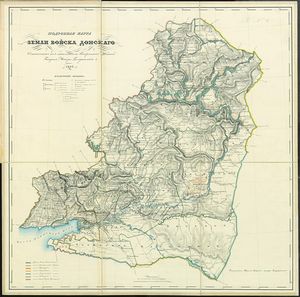
In 1783/92, the territory between the lower reaches of the Don and the Kuban finally came under Russian rule: from 1783 to 1870 as the ‘Land of the Don Cossacks’, then until 1917 as the ‘Territory of the Don Army’ (Russian: Oblast’ vojska Donskogo), from May 1918 to January 1920 the Vsevelikoe vojsko Donskoe (Great Don Army), and from March 1920 to October 1924 the Donskaya oblast’ (following the transfer of the Taganrog District and the western part of the Donets District to the Ukrainian SSR). Parts of the Taganrog District and those parts of the Donets District that had been incorporated into the Ukrainian Donetsk Governorate were annexed in 1924 to the newly established North Caucasus Region, with its capital at Rostov. In 1924, parts of the Taganrog and Donets Districts were returned to the Don Region. From October 1924: Severo-Kavkazskij kraj; from January 1934: Azovo-Černomorskij kraj; from 1938: Rostovskaja Oblast’. This administrative boundary has essentially remained in place to this day. The repeated changes, particularly to the south-western border with Ukraine , between 1802 – when the Taganrog municipal district was founded – and the final establishment of the Rostov Region (1938) had an impact on the German colonists living there, who had settled in the Mius District (from 1887: Taganrog District).
Prehistory and Early History
From the 4th century BC to the 3rd century AD, the coasts to the north and east of the Sea of Azov belonged to the Bosporan Kingdom (Regnum Bospori), which came under Roman suzerainty from 63 BC. From 230 onwards, the Ostrogoths migrated into the region; they retreated to the Crimea at the start of the Migration Period during the Hunnic invasions of 372–455. In the Early Middle Ages, from the 7th to the 11th century, the area was part of the Khazar Empire. The Pechenegs and Avars established short-lived kingdoms; the Cumans (Polovtsians) ruled from 1061 to 1240, whilst the Golden Horde reigned from 1241 to 1422. Following their withdrawal, the Crimean Khanate (under Ottoman rule from 1475) remained in the Don region until 1783.
Middle Ages
From late antiquity until the establishment of the Crimean Khanate as a branch of the Golden Horde in the 15th century, the region was characterised by instability caused by the migrations of steppe peoples. One exception was the trading port of Azov, which was held by Genoese merchants until 1475. From the end of the 15th century, Slavs migrated in from the north. From 1261/70, the Genoese outpost of Azov (Tana) existed in the delta region on the left bank of the Don, just as coastal stretches on the northern shore of the Sea of Azov and on the Cimmerian Bosporus lay as Genoese enclaves within the territory of the Crimean Khanate. Azov remained under Genoese control until 1475, when it became an Ottoman fortress within the Crimean Khanate, which remained an Ottoman vassal from 1475 to 1783. As a fortress and port, the town controlled the mouth of the Don and the surrounding areas.
Modern times

In 1696, the Cossacks captured the fortress for the first time, but Russia was forced to return it to the Ottoman Empire in 1711. At that time, the border between the two empires ran along the lower reaches of the Manych and the Yegorlyk; to the north and east of these rivers, Cossacks settled (in the Azov Governorate from 1708 to 1725, and in the Voronezh Governorate from 1725 to 1775). The fortress was occupied by the Russians a second time from 1737 to 1739, and then permanently following the Treaty of Küçük Kainardji in 1774. From the 16th century onwards, Slavs settled to the north and east of the Sea of Azov within the territory of the Crimean Khanate; by the early 17th century, these Orthodox Cossacks already accounted for half the population of what would later become the Don Cossack region.
In the 18th century, it took Russia three attempts to conquer the Crimean Khanate (1709, 1739 and 1781–84). One reason for Russia’s expansion into the Don region was the Cossack uprising led by Ataman Kondratij A. Bulawin (c. 1660–1708), which in 1707–1708 engulfed the entire territory that would later become the Don Cossack region. The uprising was triggered by attempts by the Tsarist government to capture serfs who had fled to Cossack territory (‘runaways’) and return them to their landlords. From 1708 to 1725, the area was assigned to the Azov Governorate; from 1725 until the suppression of the Pugachev Rebellion in 1775, it belonged to the Voronezh Governorate; after which it was once again assigned to the Azov Governorate for a few years, until 1783, when the Land of the Don Army was established, and in 1870, when the Don Army region, now with clearly defined borders, was established as an administrative unit.
The town was first founded in 1698 by Peter I (1672–1725), who initially established Taganrog on the Sea of Azov as a fortress and designated it a port in 1709. Azov had to be returned to the Ottomans in 1712 and was only re-established following the victory of Catherine the Great (1729–1796) in the First Russo-Turkish War (1768–1774). In 1778, Armenian refugees were settled in Nakhchivan, east of what would later become the city of Rostov-on-Don; the settlement was granted town privileges upon its foundation and quickly developed into a commercial and trading centre. In 1788, Taganrog’s status as a fortress was revoked. In 1805, the administrative centre was moved from Cherkassk – which was threatened by flooding from the Don – to Novocherkassk, situated at a higher elevation on the River Aksai.
In 1802, the area around Taganrog became the seat of a town magistracy, in order to centralise the tasks and functions of the town, which had by then grown into an important port and trading centre. From the late 18th century onwards, Greek merchants and seafarers settled there. Armenians, Italian seafaring merchants and, later, Tatars joined the settlement. Initially, the districts surrounding the municipal administration belonged to the Yekaterinoslav Governorate, whilst the narrower Don Delta formed an exclave of the Don Cossacks, who were engaged in fishing there. The boundaries of the municipal district were altered several times; for example, in 1807, Rostov and Nakhichevan were incorporated into the district, until it was dissolved in 1887 and, together with both districts, incorporated into the territory of the Don Army.
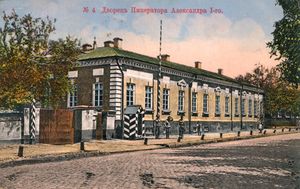
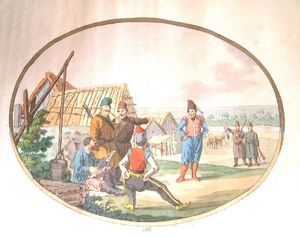
Among the town mayors were noblemen of German-Baltic descent, such as Baron Balthasar von Campenhausen (1772–1823), who served from 1805 to 1810 and developed the town’s infrastructure. In 1809, he converted an existing commercial school into a classical grammar school, which remained the only secondary school in the Don region for decades. Under his leadership, a Catholic church was consecrated in 1810 and work began on improving the harbour and customs facilities. It was during this period that the first Germans began to settle there, mostly qualified specialists, craftsmen, officers and civil servants. However, they left few traces behind. The earliest reports come from the pastor responsible for the German colonies on the Mariupol Plan, a state-sponsored settlement of German colonists established in 1823 to the north-west of the port city of the same name. Taganrog was thus the first town in the Don region where Germans settled. In December 1825, Emperor Alexander I died whilst on a visit to Taganrog.
From the mid-1830s onwards, this process was repeated in Novocherkassk, where a small German community had established itself. The town never attained the economic significance of Taganrog, which continued to flourish throughout the first half of the 19th century. The reason for this was its trading port, which, following the Napoleonic Wars, became Russia’s most important export port in the eastern Black Sea region and attracted numerous non-Russians.
Unlike Taganrog, whose municipal administration specifically granted special rights to foreigners, Novocherkassk remained economically stifled until the 1905 Revolution by Cossack legal institutions, such as the ban on land acquisition by non-Cossacks. Germans lived there only in small numbers as specialists. The population was also not particularly multi-ethnic; three-quarters were members of the Cossack class. In 1842, three Lutheran families with a total of 17 members lived there; by 1896, the Protestant congregation had grown to 193 Lutherans . There were 135 Catholics living in the town, meaning that there were likely to have been over 200 people of German descent. In the same year, work began on the neo-Gothic construction of a Protestant church ; ten years later, a neo-Baroque Catholic church was also completed not far from it.

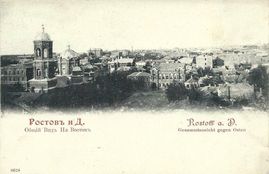
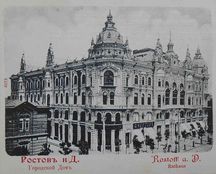
The development of Rostov, however, took a different course. The town was founded in 1749 as a customs post on the border with the Ottoman Empire, at the mouth of the small river Temernik where it flows into the Don. In 1761, slightly to the east of this, in the centre of what is now the city, the Fortress of Dmitry of Rostov (Russian: Sv. Dmitrij Rostovskij) was built, partly by General Engineer Alexander Riegelmann (1720–1789), who was also the fortress’s commander from 1774 to 1782. The Armenian twin town of Nakhchivan remained legally and functionally separate from the fortress. It was not until 1845 that Rostov, which by then had a population of over 10,000, was freed from its fortress regime and granted town status. This marked the beginning of the river port’s rapid development as an economic centre, particularly as the port cities on the coast of the Sea of Azov were threatened by Allied warships during the Crimean War and, in some cases, were even damaged. In 1861, the first railway line (the South-Eastern Railway) reached Novocherkassk and was extended as far as Rostov.
In 1868, a consulate of the North German Confederation was established in Rostov, headed by the Greek merchant Scaramanga until 1884, when the Bremen merchant August Behrmann took over the post. Germans and Austrians founded charitable and social societies: a cycling club and a child welfare society. These were usually headed by German entrepreneurs, whilst national charitable societies were presided over by the consuls.
In May 1904, Rostov and Nakhichevan were placed under the authority of a city captain, a post which was also held by people of German descent: initially by Count Fyodor K. Kotzebue-Pilar von Pilchau (1848–1911). The twin city was the largest in the Don region and had by then developed a sizeable industrial working class. At the end of 1905, an anti-Jewish pogrom took place in the city, leaving 176 dead and 500 wounded; the businesses of German entrepreneurs were also affected.[1]
After the outbreak of war in 1914, both the German and Austrian consulates were closed and German associations were dissolved.
Contemporary History
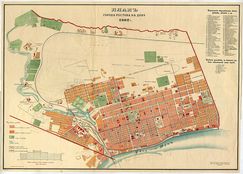
Initially, the colonists and the lower classes of the town’s German population were scarcely affected by the changes brought about by Soviet rule, which began in 1920.
In the Taganrog district, which had been ceded to the Ukrainian SSR in 1920, a German teacher attempted in the summer of 1924 to establish a seven-form German school in the older and remote colony of Peter-Paul (Russian: Petropavlovka, Ukrainian: Petropavlivka), south-east of the small town of Amrosiivka (Ukrainian: Amrosiïvka, now in the Donetsk region), which was apparently intended to serve a wider catchment area. Success, however, was enjoyed by the Association of South Russian Colonists and Citizens of German Origin, which was formed in Taganrog in January 1921. During the famine year of 1921, its Rostov branch set itself the aim of boosting the economic strength of the German colonies and harnessing it for foreign trade. The Union’s economic centre was in Taganrog, where it operated a mill, a bakery and macaroni factory, a sausage factory, a workshop producing carriage grease, and a collection depot for hides. This was probably an attempt to avoid the expropriation of German-owned businesses. In November 1921, it had a total of 8,761 members, the majority of whom were colonists. The association did not survive the NEP (New Economic Policy).
After that, the Germans no longer had their own associations, although prayer groups were apparently still able to meet in the colonies. In the summer of 1941, most of the Germans on the Don were deported to the Asian regions of the Soviet Union. After troops from the German Army Group South had reached the Don in the autumn, SS Action Group D reported on the dire straits of the approximately 300‘ethnic German’families in the Taganrog area.[2] On 29 October 1941, the Wehrmacht, the SS-Gestapo of Einsatzgruppe D and local police forces murdered the Jewish urban population at the Petrushina Gorge west of the city; on 11–12 August 1942, a massacre took place near Rostov (Snake Gorge) in which 27,000 Rostov residents, predominantly Jews, were killed. The German occupation lasted from October 1941 to August 1943, with a six-month interruption in early 1942 for Rostov following a Soviet counter-offensive. In Taganrog, German occupation authorities established themselves, including district agricultural officers. At the beginning of 1943, the total population was recorded as 92,033 people, including 511 Germans (313 of whom were women).
This exhausts the available data on the Germans in the former Don region. It was not until the 1970s that some of them returned to their old homeland from exile. Their numbers were increasingly supplemented by Russian-German skilled workers and academics from other parts of the country, but German associations were only able to re-emerge after the end of the Soviet Union . They are mostly linked to small Protestant church congregations.

Administration
The supreme holder of state authority and head of the administration was the Army Ataman (Russian: vojskovoj nakaznoj ataman), appointed by the Tsar from 1775 onwards. The titular population was organised into stanitsas (Russian: stanica, Ukrainian: stanytsia– a Cossack village settlement) and was subject to long-term compulsory military service. Consequently, extensive agriculture was typical of the districts governed by Cossack law in the sparsely populated steppe region, i.e. little cereal cultivation, but instead livestock farming, particularly horse breeding. Active and retired Cossack officers owned large tracts of land, which they usually did not cultivate themselves but leased out. This is where the beginnings of German settlement can be traced.
In the decades when German settlers arrived in the Don region, they initially went unnoticed by the Cossack local administration, as they acquired private land in small groups comprising a few families or as individual families. From 1887 onwards, the Cossack administration discovered that German settlements had been established, particularly in two western districts, Taganrog and Donets. Many colonies had only German names. Right up until the end (1919), the Cossack administration failed to compile a complete record of all German settlements and the number of Germans, partly due to the settlers’ high mobility. The liquidation of German landholdings under the laws of 1915 proceeded arbitrarily in the Don region, but above all unsystematically, and had not been completed when it was suspended in 1917.
Population
Due to the influx of non-Cossack populations (Russian: inogorodnye) from the end of the 18th century onwards, the titular population declined steadily. A pastor from Grunau reported on the first German colony (Golodajewka, Mius district) following his visit in 1847. The next records do not appear until 20 years later. From the 1860s onwards (the era of reforms under Alexander II), legal changes made settlement in the Don region possible. In 1862, only farmers were granted colonist status; craftsmen, traders and others in the colonies lost this status. In 1871, the colonists became settler-owners (Russian: posel’janin-sobstvennik). In 1874, the colonists, who had previously been exempt from military service, were made subject to universal conscription. More importantly, the law on land ownership was liberalised in 1868: Whereas, until then, Cossacks had only been able to lease their land to non-Cossack settlers – a provision which the early German colonists in the Taganrog district, with its special status in place until 1887, had been making use of since 1862 – wealthy Cossacks were now permitted to sell their own land (i.e. not communal Cossack land). The establishment of the first credit banks, particularly in Taganrog, facilitated this process, as the German settlers were regarded as reliable and solvent borrowers.
They came from the settler districts near Berdyansk and from the Mariupol Plan, which had been newly established there 40 years earlier by Germans from the Black Sea provinces and the Chernigov Governorate (Russian: Černigov, Ukrainian: Černihiv). This was, therefore, a process of internal colonisation. Following a period of prosperous development, the next generation – or their grandchildren – could be provided with new land in a sparsely populated area. The new settlers therefore had an advantage over the Russian peasants freed from serfdom in 1861, who had moved to the Don region – and here, in particular, to the Mius district – as the latter still had to pay a redemption fee for a long time to come and rarely had any capital at their disposal. The settlement of the mostly Protestant colonists took place in the district of the Don region closest to Mariupol and Berdyansk, which was the least influenced by the Cossacks both legally and demographically – specifically, the western part of the Mius district. This early and intensive settlement meant that by 1890, around 79 per cent of all German landholdings in the entire Don region were concentrated in this district. From the 1880s onwards, German colonies began to emerge again, now primarily in the Donets district, and these too developed rapidly.
At the time of the 1897 census, members of the Cossack class accounted for less than half of the total population. At that time, 34,855 Germans lived in the Don region, more than half of them in the Taganrog district alone. In total, around 2,500 lived in the three towns of Rostov, Taganrog and Nakhichevan. In 1904, the German consul in Rostov reported 2,888 German nationals, including rural settlers.[3] In the Donets district, there were between 5,000 and 6,000 Germans in 1914; roughly the same number were to be found in all the other districts and in the few new towns of Aleksandrovsk-Grušëvskij ( -Šachty since 1920), Kamensk (K.-Šachtinskij since 1927) and Millerovo, which was granted town status in 1925 with a population of 12,800, of whom 489 were Germans.
By 1923, the urban communities had shrunk: Rostov and Nakhichevan still had 1,500 Germans (1926: just over 1,900), Taganrog 435 (1926: 86,456 inhabitants, 1939: 188,808 inhabitants). In 1937, 33,311 Germans were counted in the Rostov region.[4]
Economy
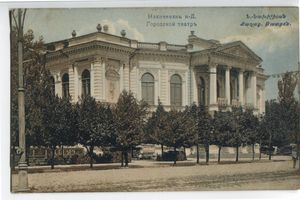
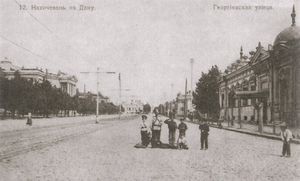
The most significant economic factor was initially the municipal administration, established at the beginning of the 19th century, which was a response to the rapid development that had been taking place since the end of the 18th century. Taganrog attracted merchants, seafarers and entrepreneurs from southern Europe, and later German specialists as well. The Armenian town of Nakhchivan was also characterised by its supra-regional influence through the trade in land. In the second half of the 19th century, Rostov underwent rapid industrialisation and became the most important trading centre, which diminished Taganrog’s significance. After the Crimean War, German craftsmen, clerks and others settled in Rostov. In 1874, the German brewery ‘Südbayern’ (Južnaja Bavarija) was founded; in 1893, it passed to the Moscow merchant Engelbert Stucken, who had arrived in Rostov in 1889. The owner was the Moscow trading house Karl Stucken; master brewer Ernst K. Prophet succeeded him, first as a tenant around 1900 and then as director from 1906.[5] There were also German breweries in Taganrog, Novocherkassk (Basener) and Azov. Smaller German breweries operated in Kamenskaya (now Kamensk-Shachtinsky), in Nakhichevan, in Ust-Medveditsk and in Novocherkassk.
In Rostov, there were further food-processing businesses run by Germans, such as the sausage factory of Adolf Lohse (1837–1911), which opened in 1867; his heirs opened a second meat-processing plant in the city and supplied the entire Don region.
Furthermore, Central Europeans were active in the metalworking industry. Other smaller German and Austrian enterprises operated in Rostov, Nakhichevan, Novocherkassk, Taganrog and Millerovo. Most of these factories, as well as German coal-mining companies in the districts neighbouring the Donbass, were founded after the turn of the century.
Rostov was the main centre of entrepreneurial activity by Central Europeans; this also extended to chemists’ goods, consumer goods and luxury items, some of which were imported from overseas. Germans worked as lawyers or doctors and in technical professions; by the turn of the century, some had already attained senior positions, such as Karl Reinhold Samson von Himmelstjerna (1846–?), Chair of the District Court, Vladimir Seeler, the representative of the Don and Kuban Zemstvo Federation; Jürgens, the public prosecutor; Strasburger, the district postmaster; and Rudolf Hultin, the head of department at the State Bank. They also served as town councillors. Germans ran commission businesses, such as the trading firm Münch & E. Hinkel, which supplied diesel engines and locomobiles imported from Augsburg.
In 1928, Rostov was merged with Nakhichevan. Alongside the various activities of the German townspeople, the colonists were engaged in agriculture, particularly in cereal production and livestock farming. From 1915 onwards, this foundation was threatened by liquidation laws, but the agricultural settlements soon recovered after 1920. However, collectivisation and the dekulakisation of the 1930s had a profound impact. After the Second World War, industry in the towns of the Don region was greatly expanded, whilst the coal and steel industry in the eastern Donbass continued to develop.
Military history

Military events in what would later become the Don region had shaped the area since late antiquity and delayed the establishment of permanent settlements. It was not until after Catherine II’s Second Turkish War (1787–1791) that conditions stabilised. The region remained peaceful until the First World War. From 1915 onwards, refugees from Russian Poland, Lithuania and Latvia arrived in the Don region. In January 1918, the Red Guard drove out the Don Cossack administration; Ataman Alexei Kaledin (1861–1918) committed suicide. In early 1918, Taganrog became the scene of Bolshevik terror. Following the October Revolution, the Kiev Ensign School, with 400 officer cadets, was transferred to the city to act as a force for maintaining order.[6] Following fighting with Red units, the latter surrendered in early February 1918 and were brutally murdered by the Bolsheviks. The commander of the Russian Northern Army, which invaded East Prussia in August 1914, General Paul von Rennenkampff (1854–1918), was living in the city at that time. He was in hiding under an assumed name, but was found by the Bolsheviks in mid-March and ordered to cooperate. After refusing several times, he was shot in mid-April 1918. At the same time, the Cossacks in Novocherkassk rose up against the Reds. However, it was not until early May 1918 that they were able to drive out the Red Army troops with the help of German forces marching into the Taganrog district. In June 1918, a Bolshevik landing attempt was made near Taganrog from the port city of Yeysk (in the Kuban region), which was repelled by German troops.[7] Following the withdrawal of the Germans, the headquarters of the White Southern Army was based in Taganrog in 1919. Towards the end of 1919, the army fled via Rostov to the Kuban.
Following the German Wehrmacht’s invasion of the Soviet Union , German troops and Nazi organisations first appeared in the Taganrog district in October 1941. They established their headquarters in the town. Immediately – as had happened in Rostov – the Jewish population was murdered. By 1943, the population had fallen to just half of what it had been in 1939. To the east of the town, in 1941–42, heavy fighting took place with the Red Army on the heights by the Sambek River, though the Red Army was eventually forced to retreat. In August 1943, the Germans left the town, whilst the Kuban bridgehead (Kerch Strait) was held until spring 1944. As a result of the fighting, the Protestant church in Rostov was so badly damaged that it had to be demolished.
Society
From around 1860 onwards, the social life of the Germans took place exclusively within the sphere of the Protestant parishes, initially in Taganrog, and later in Novotcherkassk and Rostov, though on a scale that is difficult to ascertain. It was only there that, around 1900, leisure and welfare associations were founded by Germans, Austrians and Swiss, which were linked either to the church or to the consulates. All these associations were suspended after 1914. Attempts to run interest groups in the early Soviet era were not met with lasting success. As the parishes shrank, particularly when pastoral posts were not filled, the sole pillar supporting community life ceased to exist in the 1920s. There were no periodicals of their own; apart from economic and industrial enterprises, there were no German institutions in the Don region.[8] Around 1930, therefore, all traces of the German presence in the Don region disappeared.
History of Religion and the Church
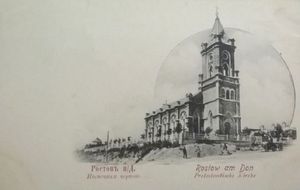
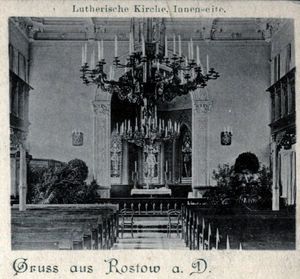
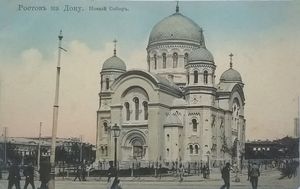
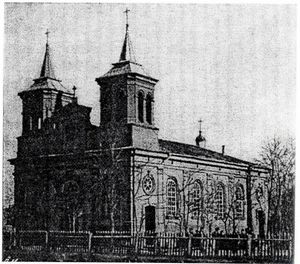
The local population was predominantly Orthodox and , from the 19th century onwards, also had a network of Orthodox churches . Before the Crimean War (1853–1856), an Evangelical Lutheran congregation of 100 people was established in Taganrog, which was visited annually by the vicar from Grunau (parish of the Mariupol Plan inthe Evangelical Second South Russian Deanery).
The Rostov parish, which was upgraded around 1900 and had around 1,800 souls in the town (1906/07: 2,200 souls, of whom 2,150 were German), had ambitious plans to build its own secondary school, for which a building site near the church was being sought.[9] However, due to a lack of funds, this did not come to pass; rather, the church authorities lamented the secularising and Russifying influences amongst the Germans in the town, which had a population of around 235,000 in 1914. Children from German families did not have a command of the German language, which the clergy were striving to preserve. Despite the presence of wealthy German entrepreneurs and civil servants, interest in the church and school – and thus in German culture as a whole – waned.
From 1879 to 1898, Taganrog was the permanent seat of the Second South Russian Deanery; thereafter, until 1919/20, it was Rostov. From 1920 to 1930, Rostov was the seat of the Rostov Deanery. Around 1914, some 30,000 of the total of 35,000 Germans in the Don region are thought to have been Protestants . Swabian Pietists from the Berdiansk colonist district founded one of the first colonies in Ostheim (Mius district) in 1869. From 1876 to 1923, they were ministered to by their own preachers. In 1886, the first Protestant colonial parish was established in Rosenfeld near Ostheim and a house of prayer was built. Provost Johannes von Törne (1858–1936) was sent into exile in Tsaritsyn in 1915 and did not return until 1917. The remaining Protestant clergy continued to carry out their ministry in the Don region. It was not until May 1918 that Cossack authority was re-established in the Don region. In mid-May 1918, a German occupation regiment arrived in the Donets District.
AlthoughCatholic parishes were initially established from 1810 onwards (Taganrog, Rostov c. 1880, the vicariate of Novocherkassk 1900/04, Grüntal 1907/18, Josefsheim/Pogorelovka, Donets District, after 1920), they remained relatively inconspicuous, or pastoral care was provided by parishes from outside the Don region.
The main Orthodox cathedral in Rostov, dedicated to Alexander Nevsky, was demolished in 1930, after which the House of Councils was built on the site. Only the buildings of the Roman Catholic Church in Taganrog and Novocherkassk remain to this day; in the latter town, the Protestant church , which is used by Baptists, also survives.
Education and Science
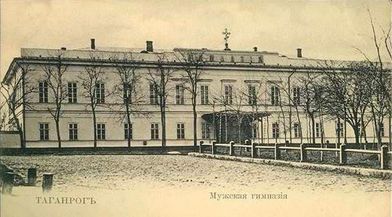
The German Protestants ran church schools in the towns, whilst many settlements had village schools. In Novocherkassk there was a Cossack grammar school, a Zoological and Veterinary Institute from 1840, and the Polytechnic Institute from 1907. From the late 19th century onwards, there were several higher education institutions in Rostov. In the summer of 1915, the University of Warsaw was evacuated to Rostov to escape the advancing German troops; it was the first university in the city and the second in the Don region. Further universities were established mainly after the Second World War. The Regional Library was built in Rostov in the early 1990s.
Bibliography
In 1898, Pavel Filevskij wrote a history of Taganrog (Istorija goroda Taganroga), omitting the German period (reprinted in Taganrog in 1996). G. A. Chebotaryov published a history of Rostov in 1910. After the Second World War, local historians once again took up the history of these towns, drawing heavily on older sources (Oleg Gavryushkin, Vladimir Sidorov).
The myth of the Don Cossacks and the Civil War era have given rise to a number of works of fiction, some of which are well known. Mikhail Sholokhov (1905–1984) was awardedthe Nobel Prize in Literature in 1965 for his novel *The QuietDon* (*Tichij Don*). Two German authors, Theodor Kröger (1897–1958; *Heimat am Don*) and Elisabeth Rein (1897–?; *Kaukasischer Sommer*), describe German life in the period before and during the First World War. Marion Aten (1892–1961), Arthur Orrmont (1922–2007; *Last Train over Rostov Bridge*) describe the period of the Civil War. The Catholic writer Reinhold Schneider (1903–1958) titled a story centred on Emperor Alexander I *Taganrog* (written in 1940). The Russian author Genrich B. Gofman (1922–95) wrote *The Hero of Taganrog*. Documentary Novel (Geroi Taganroga. Dokumental’naja povest’; Moscow 1968), a fictional account of the Soviet resistance movement during the German occupation from 1941 to 1943.
Culture of memory and remembrance
Whilst there is a rich culture of memory and remembrance following the resurgence of Cossack identity since the end of the Soviet Union, such a culture is completely absent amongst Germans, even within the Russian-German Association in Germany.
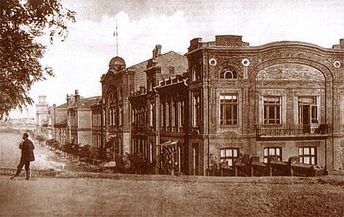
A predominantly Russian culture of remembrance exists above all in the oldest towns of the Don region: Taganrog, Novocherkassk and Rostov-on-Don. There, architectural and visual monuments have been preserved or newly created, documenting a rich – and, more rarely, multi-ethnic – history dating back to the late 18th century. Taganrog, which remained the most multi-ethnic city until the Second World War, with a significant Greek community that played an important economic and political role, boasts numerous architectural monuments dating from the early 19th century. A larger-than-life statue of Peter the Great was erected in 1903, whilst one of Anton Chekhov was not erected until 1960 to mark the centenary of his birth. This makes Taganrog the place in the Don region where memories are most strongly rooted in the bourgeoispre-revolutionary era, even though the ‘Oath of Youth’ monument, commemorating the underground movement during the German occupation from 1941 to 1943, was unveiled in 1973 in front of the classical grammar school. The German occupiers, for their part, re-erected the Peter the Great monument—which had been removed by the Bolsheviks—during those years and named a street after the German-Baltic second town captain, Balthasar von Campenhausen.
In 1961, a stele was erected in the harbour area in honour of Giuseppe Garibaldi, who had visited the city several times as a sailor in the 1830s. To the east of the city, a memorial was erected on the Sambek River at the site of fierce fighting between the Wehrmacht and the Red Army.
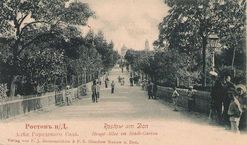
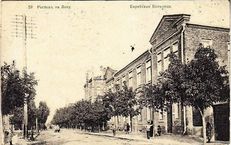
Official municipal commemoration in Rostov refers not only to the city’s origins as a fortress but also to the great strike of 1902 (monument erected in 1967), the anti-Jewish pogrom of 1905, and the fighting during the Second World War, which have been commemorated with monuments, including a monument to the 30,000 Jews, Sinti and Roma from Rostov who were murdered in 1943 (Smijovskaya Balka, 1973), a stele to the ‘Heroes of the Soviet Union’ (1973) and a monument commemorating the expulsion of the White Civil War troops (‘Tachanka’, 1977). Alongside the prevailing classicism and neoclassicism in its architecture, the city is characterised by a pan-Russian or pan-Soviet culture of remembrance that marginalises historical elements of non-Russian origin. In terms of historical memory, present-day Rostov is primarily situated within the 20th century.
The approximately 35,000 Germans who lived in the Don region between 1860 and 1941 remain largely absent from public memory to this day; nor, for that matter, are the Greeks who have been settling there since the 18th century, although some place names bear witness to Greek origins (‘Lakedemonovka’). The situation is different for the Armenian settlers. To this day, a strong Armenian minority with its own cultural institutions lives in the Proletarsky district of Rostov, formerly known as Nachichevan. Jews are remembered primarily as victims, in particular of the German mass killings between 1941 and 1943; several memorials were erected in their honour after 1992.[10] With the exceptions of Taganrog and Novocherkassk, the culture of remembrance and commemoration is strongly shaped by the Soviet era and the military and wartime events of the 20th century.
Bibliography
- Erik Amburger: The Pastors of the Protestant Churches in Russia from the Late 16th Century to 1917. Erlangen 1998.
- O. V. Erochina: German Entrepreneurship in the Economic Complex of Southern Russia, 1860–1930s. Volgograd 2011.
- A. I. Gozulov: Settlement figures from the 1926 census in the North Caucasus Region. Rostov-on-Don 1929.
- Robert H. McNeal: Tsar and Cossack, 1855–1914. London 1987.
- Reinhard Nachtigal: The Don Germans 1830 to 1930. Augsburg 2005 (Russian translation: Donskie nemcy 1830–1930. Augsburg 2007).
- Ibid.: Taganrog as a Historical Site: Russia’s ‘Pearl of the South’ and its Significance for Western Europe. In: Forum for Eastern European Ideas and Contemporary History 9,2 (2005), pp. 117–155.
- Nemcy Rossii. Ėnciklopedija [The Germans of Russia]. Vol. 1–3. Moscow 1999–2006.
- Dietmar Neutatz: The ‘German Question’ in the Black Sea Region and in Volhynia. Politics, Economy, Mentalities and Everyday Life in the Tension between Nationalism and Modernisation (1856–1914). Stuttgart 1993.
- D. Neutatz: Oblast’ Vojska Donskogo [The Territory of the Don Army], in: Germans of Russia. Encyclopaedia. Vol. 2 (K – O). Moscow 2004, pp. 669–672.
- Shane O’Rourke: Warriors and Peasants. The Don Cossack in Late Imperial Russia. London 2000.
- Rostov-na-Donu. Atlas from the Fortress to the Capital of the Don Region [Rostov-on-Don. An Atlas from the Fortress to the Capital of the Don Region]. Rostov-on-Don, n.d.
- Josef Schnurr: The Churches and Religious Life of the Russian Germans. Protestant Section. Stuttgart (2nd ed.) 1978.
- A. G. Tereščenko/A. L. Černenko: Rossijskie nemcy na юге России и в Кавказе [The Russian Germans in the South of Russia and the Caucasus]. Rostov-on-Don 2000.
Notes
[1] Nachtigal’, Rajnchard: The Germans of the Don, 1830–1930. Augsburg 2007, pp. 146 ff.
[2] Benjamin Pinkus/Ingeborg Fleischhauer: The Germans in the Soviet Union. History of a National Minority in the 20th Century (= Eastern Europe and International Communism, 17). Baden-Baden 1987, pp. 250–253. p. 253: ‘First and foremost, a “decent standard of living” for these ethnic Germans must be ensured.’
[3] Nachtigal: The Germans in the East, pp. 70 and 111.
[4] All-Union Population Census of 1937: General Results. Collection of Documents and Materials. Moscow 2007, p. 100.
[5] Nachtigal: Dondeutsche, pp. 88–91. Of the 1,600 shares in Južnaja Bavarija, Stucken & Co. held 1,262; the remaining shares were held by other German shareholders, including E. K. Prophet. The brewery had 99 employees, and its annual turnover amounted to 500,000 roubles. There were two other small German breweries in Rostov: Donskaja Bavarija and Mjunchen. The city was the centre of the South Russian brewing industry.
[6] Peter Kenez: *Civil War in South Russia. The First Year of the Volunteer Army*. Berkeley, Calif. , 1971, pp. 58 ff. and 120 ff.
[7] Aleksandr V. Mirgorodskij: Krasnyj desant 1918 goda [The Red Landing Forces of 1918]. St Petersburg 2022.
[8] Tereščenko: Rostov, p. 349, claims that German culture has been revived in the city, which had just over 1,000 Russian Germans in 1979. Following the collapse of the Soviet Union, the ‘Deutsches Haus’ (German House ) and the ‘Vidergeburt-Don’ association were founded, but since then many Germans have emigrated to the Federal Republic of Germany. Contacts with the twin town of Dortmund have existed since 1977.
[9] Nachtigal: Dondeutsche, pp. 98–104, 128–130.
[10] https://www.memorialmuseums.org/denkmaeler/view/812/Denkmal-%C2%BBSchlucht-des-Todes%C2%AB-f%C3%BCr-die-Juden-der-Stadt-Taganrog
https://www.memorialmuseums.org/denkmaeler/view/355/Denkmal-%C2%BBSmijowskaja-Balka%C2%AB
https://www.memorialmuseums.org/denkmaeler/view/1582/Erinnerung-an-Aleksandr-Petscherski-in-Rostow-am-Don.
Citation
Reinhard Nachtigal: Don Region. In: Online Encyclopaedia on the Culture and History of Germans in Eastern Europe. 2025. URL: ome-lexikon.uni-oldenburg.de/p32556 (accessed 6 March 2025).
Terms of use for this article
Copyright © University of Oldenburg and the Federal Institute for the Culture and History of Germans in Eastern Europe (BKGE), all rights reserved. This work was produced as part of the project ‘Online Encyclopaedia on the Culture and History of Germans in Eastern Europe’ and may be reproduced and published provided the rights holders’ consent has been obtained. Please contact:
If you have any specialist comments or additions to the text, please contact the editorial team, citing relevant literature and source references.