

Krumau/Český Krumlov
Krumau/Český Krumlov
Etymology
The place name has been recorded in various phonetic forms since the second half of the 13th century: Chrumbenowe (1253), Krummenowe (1260) or Crumnaw (1283). The most common etymological explanation derives the name from the German phrase ‘burc ûf der krumben ouwe’ (castle on the crooked floodplain), which seems plausible given the town’s location in a bend of the Vltava River. Through sound changes, the form Krumau, which is in common use today, developed. The Czech place name Krumlov evolved from the German form through the dissimilation of the two nasals and the adaptation of the ending to the Czech place-name pattern ending in -ov. The epithet ‘Bohemian’ first appears in a Latin text from 1439: Boemo-Crumloviensis; the Czech variant first appeared in 1459 (in a Rosenberg document – in the genitive case: Crumlowa Czeského), though it only became common from the mid-16th century onwards, presumably to distinguish it from Moravský Krumlov (Moravian Krumau).
Location
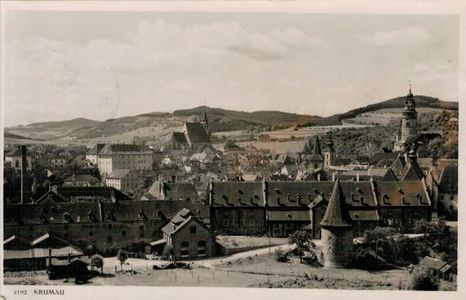
Krumau is situated in the southern part of the Czech Republic, 180 km from Prague (Praha) and 25 km from the border with the Federal Republic of Germany (Bavaria), at 48° 49′ north latitude, 14° 20′ east longitude, 492 m above mean sea level.
Topography
The town lies in the Vltava Valley, at the foot of the Blanský Forest Nature Reserve (Czech: Blanský les).
Political and administrative affiliation
Czech Republic. Krumau is the administrative centre of the Krumau district (Okres Český Krumlov).
Common symbolism
On the blue field of the town’s coat of arms stands a silver town wall with an open gate and a raised brown wooden grille. The town wall is flanked by two silver towers. Each tower has two narrow, tall windows and a red gabled roof. Between the towers is a silver shield bearing three ravens in flight, each carrying the red Rosenberg rose in its beak. Above the shield is a tournament helmet with crest covers, red and silver on the right, blue and silver on the left. The red Rosenberg rose serves as the crest on the crowned helmet.
The town flag consists of three horizontal stripes with a width ratio of 1:4:1. In the centre of the white stripe is a red rose with a golden centre and green sepals.
Prehistory and Early History
The earliest evidence of human presence within the city’s present-day boundaries dates back to the Palaeolithic period. There is scant evidence of settlement from later periods (Neolithic, Bronze Age, Hallstatt period, La Tène period). For the period between the 8th and 12th centuries, there is sporadic evidence of settlement. It was not until the intensive land development of the 13th century that a permanent settlement was established here.
Middle Ages
The first written reference does not concern the town, but the castle, and is found in a charter issued in 1253 by the future King of Bohemia, Přemysl Ottokar II (1233–1278). Among the witnesses listed here is a ‘Witiko de Chrumbenowe’. The first owners of the castle and the town were the Lords of Krumau, a branch of the South Bohemian Witigon family, which died out in 1302. Krumau then passed to the King of Bohemia, who, in the same year, bestowed the town, together with the surrounding villages and estates, upon the Chief Chamberlain Heinrich von Rosenberg (d. 1310). A few years later (1309), Krumau was mentioned as a town for the first time in a document originating from Heinrich’s chancellery.
The lord of the manor, his officials and servants mostly lived within the castle grounds. However, many also settled in the wider surrounding area. This is probably how the castle settlement of Latrán came into being. The name derives from the Latin ‘latus’ (side, in the architectural sense meaning a building outside the main complex) and to this day refers to one of the town’s districts. The town of Krumau received its oldest surviving charter in 1347 from Peter I of Rosenberg (1291–1347).
During the Hussite Wars, Ulrich II of Rosenberg (1403–1462) stood alongside King Sigismund (1368–1437). Neither the town nor the castle was destroyed by the Hussites. One might even speak of a cultural heyday during this period, to which the numerous prominent figures who sought refuge and safety here also contributed.
The Rosenberg brothers, Wok II (1459–1505), Peter IV (1462–1523) and Ulrich III (1471–1513) issued a significant charter in 1494 which, amongst other things, granted the citizens of Krumau the rights of residents of a royal town. As a result, the inhabitants of Latrán were placed at a disadvantage compared with those of Krumau’s town centre. The legal and administrative union of Latrán and the town centre took place in 1555.
Modern times
In the second half of the 16th century, the town’s cultural life was determined almost exclusively by the desire for prestige of the last members of the influential magnate family, the two brothers Wilhelm (1535–1592) and Peter Wok von Rosenberg (1539–1611). However, Wilhelm’s extensive renovation of the castle and other building projects resulted in considerable financial burdens, which Peter Wok attempted to resolve after his brother’s death (1592) by selling the Krumau domain (1601) to the Bohemian King and Emperor Rudolf II (1552–1612). In 1602, he moved his seat to Wittingau, and Krumau ceased to function as a royal residence. After two decades of imperial administration (from 1612 to 1619, Krumau belonged to the Bohemian King and Emperor Matthias; from 1619 to 1622 to Ferdinand II), Krumau passed into the possession of the Styrian noble family, the Eggenbergers. In the third generation, Krumau once again became a royal seat in 1665 under Johann Christian I von Eggenberg (1641–1710). He remained childless, which was probably the reason why all the Eggenberg estates in Bohemia were transferred to his nephew Adam Franz von Schwarzenberg (1680–1732) in 1719. In the mid-19th century, however, the Schwarzenbergs focused more on Frauenberg Castle (Hluboká), which later became their residence. The once-splendid town of Krumau subsequently became an insignificant small town.
Contemporary History
Following the collapse of the Habsburg Monarchy in 1918, German-Bohemian politicians proclaimed the so-called ‘Böhmerwaldgau’, with its centre in Krumau, in an attempt to secure the region’s independence from the newly formed Czechoslovakia. At the end of 1918, however, the town was occupied by the Czechoslovak army and incorporated into the republic.
Under the Munich Agreement, signed on 30 September 1938, a large part of the Czech border region was ceded to the German Reich. Krumau was among these territories. The districts of Krumau and Kaplitz, which lay directly on the border with Czechoslovakia and, five months later, with the Protectorate of Bohemia and Moravia, respectively, became part of the Reichsgau Oberdonau. A plebiscite originally envisaged in the Munich Agreement was not held due to German pressure. When the Wehrmacht marched into Krumau on 8 October 1938, it was given a jubilant welcome by the German population. On 20 October 1938, the incorporation was symbolically sealed by a visit from Adolf Hitler, whom the German population of Krumau greeted with great enthusiasm. In November 1938, the town’s name was changed; the former (Bohemian) Krumau was now called Krummau an der Moldau, a move intended to emphasise the town’s German character. Streets and squares were also renamed. On 4 December, by-elections to the ‘Greater German Reichstag’ took place. On a single list of candidates, the German inhabitants of Krumau were able to vote for Adolf Hitler as well as the former Sudeten German SdP politicians – now members of the NSDAP – Konrad Henlein and Karl Hermann Frank. The majority of members of Henlein’s Sudeten German Party were transferred to the NSDAP.
The mayor was no longer elected but appointed on the recommendation of the NSDAP. In 1940, the new mayor was the Sudeten German National Socialist Quido Knapp (1890–1945). Knapp came from a ‘völkisch’ background; before 1933, he had been a member of the nationalist German National Party.
Czech schools and organisations were closed down or banned. The majority of the Czech population fled or were expelled.
During the so-called ‘Reichskristallnacht’ from 9 to 10 November 1938, riots against the Jewish population also took place in Krumau. The interior of the synagogue was looted and destroyed.
The owner of Krumau Castle, Adolph Schwarzenberg (1890–1950), was forced to leave Krumau and go into exile; his property was confiscated by the Gestapo in 1940.
German communists and social democrats were persecuted.
There were no armed clashes during the war, and material damage was also limited. On 7 May 1945, Krumau was liberated by the US Army.
In the border regions with a predominantly German population, conditions for the re-establishment of Czechoslovak administration were difficult after the end of the war, as only a few residents of Czech nationality had remained there since 1938. In places where there were not enough Czechs living, so-called local administrative commissions were set up. One such commission was established in Krumau as early as 9 May 1945. On 28 May, it was transformed into a district administrative commission. The forced resettlement of the German population began in February 1946 and lasted until the end of the year.
In 1947, the castle and palace complex in Krumau, together with the rest of the Schwarzenberg family’s estates, was nationalised.
From the 1950s onwards, the town’s boundaries were gradually extended through the incorporation of neighbouring areas. Functional new housing estates sprang up on the outskirts of the town. In 1963, Krumau was declared an urban conservation area, and restoration work began in 1971. Nevertheless, many of the significant artistic monuments did not regain their present splendour until the 1990s.
In the wake of the ‘Velvet Revolution’ of 1989, a general strike also took place in Krumau on 27 November 1989, and a branch of the Civic Forum (Občanské Forum – OF) was formed. Its representatives sent a petition to the government, drawing attention to the dire state of Český Krumlov’s historic centre and asking for support in saving this cultural heritage. Their efforts were successful. In 1992, Český Krumlov was inscribed on the UNESCO World Heritage List.
Population
Given the town’s location in a border region, it is reasonable to assume that part of the population was German-speaking as early as the Middle Ages. At the beginning of the 16th century, German-speaking entrepreneurs, mining experts and miners arrived in connection with ore mining and processing. Alongside Czechs and Germans, ‘Welsche’ (Italians) and Jews also lived here. During the 17th and 18th centuries, a dispute arose in the town over the use of the Czech language in churches and schools. In the first half of the 17th century, the German-speaking citizens – who were numerous in the town – demanded that German-language church services be moved from the smaller St Jodokus Church to the large main church of St Veit. In this context, a census was carried out in 1653 to determine the language spoken. Regardless of the results (29 people who spoke only Czech, 163 residents who were fluent in both languages, 66 Germans with a minimal knowledge of Czech and 1,752 people who spoke only German), which some contemporaries already considered to be biased, the Archbishop of Prague confirmed the status quo.
From the 1870s onwards, disputes arose in Krumau between the Czech and German populations. Society became increasingly divided into a German and a Czech section. In the second half of the 19th century, German-speaking citizens organised themselves into German associations (the School Association, the Bohemian Forest League, the German Men’s Choral Society) and Czech-speaking citizens into Czech ones (e.g. Čtenářská beseda [Reading and Discussion Circle], Řemeslnická jednota [Craftsmen’s Association]).
At the end of September 1938, Krumau had 8,800 inhabitants, of whom 2,400 were Czechs and 160 were Jews. By April 1939, only 350 Czechs and three Jews remained in the town.[1]
After the end of the war, the majority of the German-speaking population was expelled, causing the town to lose 75 per cent of its inhabitants. Czech resettlers moved to Krumau, with 4,500 arriving in 1946 alone.
Population trends in Krumau[2]:
| 1869 | 1880 | 1890 | 1900 | 1910 | 1921 | 1930 |
|---|---|---|---|---|---|---|
| 7,701 | 8,106 | 8,903 | 9,412 | 9,485 | 9,078 | 9,709 |
| 1950 | 1961 | 1970 | 1980 | 1991 | 2001 | 2015 |
|---|---|---|---|---|---|---|
| 8,441 | 9,294 | 10,430 | 13,776 | 14,108 | 14,443 | 13,193 |
Economy
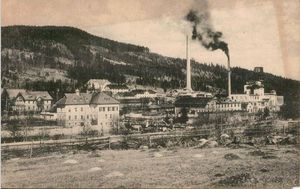
In the Middle Ages, an important trade route, known as the Linz Trail, ran through the Krumau region. Mining flourished here in the late 15th century, and reports of the extraction and processing of silver and other precious metals can be found right up until the 18th century. In the 19th century, graphite mining began. Beer brewing was an important industry; the town was home to both a townspeople’s brewery and a stately brewery. Three factories mark the beginning of the industrial age in Krumau: the flax and hemp spinning mill, the cloth factory and the paper mill. Paper production had been a tradition in the town since the 16th century; in modern times, it is primarily associated with the name of Ignác Spiro (1817–1894), a Jewish entrepreneur who purchased the paper mills in 1861 and expanded them into a modern enterprise, the most significant of its kind in the Habsburg Monarchy at the time.
History of Religion and the Church
The first monks in the Krumau region were the Cistercians who arrived in Hohenfurth (Vyšší Brod) in 1258 from Wilhering in Austria. The Hohenfurth monastery served as the burial place of the Rosenberg family for 350 years. Thanks to the Rosenbergs’ support, the Cistercians were able to establish a large domain during the 13th and 14th centuries. In 1263, the Cistercian monastery of Goldenkron (Zlatá Koruna) was founded by the Bohemian King Přemysl Ottokar II; together with other foundations such as the town of Budweis/České Budějovice (1265), was intended to form a bulwark of royal power and a counterbalance to the Rosenberg dominion.
In the town of Krumau, Peter I of Rosenberg had the parish church of St Veit built between 1309 and 1317. After his death, his widow Catherine of Rosenberg founded the convent of the Friars Minor and the Poor Clares in 1350. Associated with this convent was the magnificent festival of the Exposition of the Relics, which took place annually until 1417.
During the Hussite period, the Rosenbergs were initially sympathetic to the ideas of the Reformation ; however, under the impression of the violence perpetrated by the Hussite Utraquists as they swept through the country, the Rosenberg ruler Ulrich II returned to Catholicism. In 1420, the Hussites captured the Goldenkron monastery, whilst the town of Krumau managed to defend itself successfully.
In the 15th century, Krumau was an important Catholic town and one of the key centres of early Humanism in Bohemia. Towards the end of the 15th and at the beginning of the 16th century, German miners brought the Lutheran faith with them. The Jesuits, brought to Krumau in 1584 by Wilhelm von Rosenberg (1535–1592), were intended to curb the growing influence of the Lutherans and Utraquists . In the years following the Battle of White Mountain (1620), all non-Catholic priests were forced to leave the country, and in 1627–28, Catholicism – which had deep roots in South Bohemia – was declared the only tolerated religion. Towards the end of the 18th century, the overwhelming majority of the population professed this faith.
In 1773, as part of the Enlightenment reforms of Emperor Joseph II (1741–1790), the Jesuit grammar school and the Jesuit college were dissolved; in 1782, the Minorite and Poor Clare monasteries were also dissolved.
The presence of Jews in Krumau is documented as far back as the first half of the 14th century. King John of Luxembourg (1296–1346) permitted four Jewish families to settle in the Rosenberg domain; Charles IV (1316–1378) increased the number of families to six. In 1494, the Jews were expelled from the town. A ban on their settlement was subsequently imposed, which was not lifted until the second half of the 18th century. From that point onwards, the number of Jews began to rise. A prayer society was founded in 1855. By 1880, there were 103 people of the Jewish faith living in Krumau.
At the beginning of the 20th century, the Jewish community had a synagogue built (1908–09), in which services were held until 1938. During the Second World War, the interior was destroyed by the Nazis , though the building itself survived. Of the 111 Jews who had lived in Krumau before the war, only two returned after the war ended. The majority were murdered by the Nazis . The synagogue was initially used for services by American soldiers, then by the Czechoslovak Hussite Church; from 1968 onwards, it served for many years as a storeroom, for example for the valuable Baroque scenery of the Castle Theatre. After 1990, the synagogue passed into the ownership of the Jewish Community in Prague, was renovated and now houses the permanent exhibition ‘The World of the Krumau Jews’.
Special cultural institutions
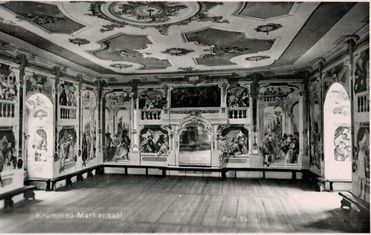
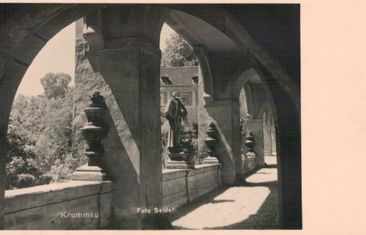
Seidel Photo Studio Museum: Josef Seidel (1859–1935) is known as the ‘Photographer of the Bohemian Forest’: he and his son František took thousands of photographs of the landscape in the Czech-German-Austrian border region, documenting villages that have long since disappeared. In 1905, Josef Seidel had a house built in Krumau with a modern photographic studio; almost the entire interior and equipment, including order books, thousands of glass negatives and postcards, have been preserved.
Egon Schiele Art Centrum: Housed in the building of the former 16th-century town brewery is a cultural centre featuring a permanent exhibition on the life and work of the painter Egon Schiele (1890–1918), as well as temporary exhibitions by renowned Czech and international artists.
Egon Schiele had an ambivalent relationship with Krumau. He loved his mother’s birthplace and hometown, and was greatly inspired by Krumau. In 1910, he moved here with two fellow painters, who, however, soon caused a stir as unconventional artists. A year later, Schiele moved into a garden cottage with his partner, but he too left the town as early as August 1911.
Regional Museum: The Krumau Regional Museum is housed in the building of the former Baroque Jesuit seminary. It also features a ceramic model of the town – the largest of its kind in the world.
Open-air theatre with a revolving auditorium: The theatre performances owe their success to the setting of the Krumau Castle Gardens, the architecturally significant Bellarie Pleasure Palace, which serves as a backdrop, and the revolving auditorium, which seats almost 650 spectators.
Art History
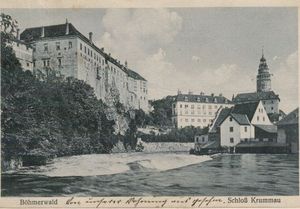
Castle and palace complex: The earliest mention of Krumau Castle dates from 1253. It is believed to have been built in the first third of the 13th century, or perhaps even as late as the end of the 12th century. Heinrich I von Rosenberg (d. 1310) began its conversion into a noble residence; in the second half of the 16th century, the castle was transformed into a Renaissance palace under Wilhelm von Rosenberg. A further reconstruction took place during the reign of Josef I Adam of Schwarzenberg (1722–1782); at the same time, the Baroque palace theatre was built, and the Mantle Bridge and the Masked Hall were given their present appearance.
The castle and palace complex is the second-largest in the Czech Republic after Prague Castle and one of the most monumental in Central Europe. It comprises forty buildings, grouped around five courtyards, and extensive palace gardens. The castle is situated on a high rocky outcrop above the River Vltava and is the town’s landmark.
The complex consists of the following building complexes:
– Lower Castle – the oldest part of the complex, the so-called Small Castle with its tower,
– Upper Castle – the central part, grouped around the Third and Fourth Palace Courtyards,
- Mantelbrücke – a multi-storey bridge spanning the Hirschgarten, connecting the palace with the theatre and the palace gardens,
- Baroque Palace Theatre – one of the few surviving Baroque theatres in the world, dating from 1681,
- Summer Riding School,
- Winter Riding School,
- Palace Gardens – comprising a French section with the cascade fountain and an English section featuring the Bellarie pleasure palace and the open-air stage.
The town centre, nestled amongst the bends of the Vltava, is connected to the other parts of the town by three bridges. The street layout and the regularly laid-out main square have remained virtually unchanged since the town’s foundation. There are a large number of well-preserved town houses here in the Gothic and Renaissance styles, as well as several Baroque buildings.
St Veit’s Church is a Gothic three-nave hall church dating from the first half of the 15th century. It was extended and remodelled in the 17th and 18th centuries.
Latrán is a historic district situated to the north of the city centre and directly below the castle. It is connected to the city centre by the so-called Bader Bridge. There are numerous small Gothic houses here. Other interesting monuments include the Budweiser Gate – the youngest and, at the same time, the only surviving gate in the medieval city walls – St Jodokus’ Church, the Castle Brewery (now the Eggenberg Brewery) and the Minorite Monastery (now the Monastery of the Order of the Cross with the Red Star).
Bibliography
- Václav Bedřich et al: The History of the Town of Český Krumlov [The History of the Town of Böhmisch Krumau] / Český Krumlov: The Town Český Krumlov [Český Krumlov: The Town of Český Krumlov]. Český Krumlov 2009.
- Jan Müller: Český Krumlov. Castle and Palace. Prague 1996.
- Věra Ptáčková (ed.): Baroque Theatre at the Castle in Český Krumlov: a collection of papers for the specialist seminar in Český Krumlov, 27–30 September 1993 [Baroque Theatre at the Castle in Český Krumlov: Proceedings of the specialist seminar in Český Krumlov, 27–30 September 1993]. Prague: Institute for the Preservation of Historical Monuments; České Budějovice: Theatre Institute, 1993.
- Franz Alexander Heber: Czech Castles, Palaces and Fortresses. Volume Three, South Bohemia [Bohemian Castles, Palaces and Fortresses. Volume Three, South Bohemia]. Prague 2008.
- Karel Kuklík, Pavel Kuklík, Ivan Slavík: Český Krumlov. Prague 1996.
- Martin Gaži, Petr Pavelec: Český Krumlov: From a Residential Town to a World Heritage Site [Böhmisch Krumau: From a Residential Town to a World Heritage Site]. České Budějovice: National Heritage Institute. Regional Office in České Budějovice [National Heritage Institute. Regional Office in České Budějovice] 2010.
- VěraMašková(1992): On the expulsion of refugees and the German population from the Český Krumlov district in 1945–1946. In: Výběr: Journal of History and Local Studies of South Bohemia 29 (1), pp.16–22.
- Petr Pavelec: Český Krumlov, an enchanting town in the heart of Europe: A guide to the town and castle. České Budějovice 2001.
- Pavel Slavko: The Castle Theatre in Český Krumlov. Český Krumlov: Foundation of the Baroque Theatre at the Castle in Český Krumlov. 2001.
- Záloha, Jiří: The District of Český Krumlov (Böhmisch Krumau) at the End of 1938. In: Contacts and Conflicts. Bohemia, Moravia and Austria: Aspects of a Millennium of Shared History. Edited by Thomas Winkelbauer. Waidhofen an der Thaya 1993,441–446.
Web links
- https://encyklopedie.ckrumlov.cz/de/mesto_histor_himeck/
- https://de.czech-unesco.org/cesky-krumlov/vorstellung/ (Krumlau on the Czech UNESCO World Heritage website)
- http://www.esac.cz/de/egon_schiele_art_centrum/ (Schiele Art Centrum website)
- https://muzeumck.cz/(Regional Museum)
- https://www.herder-institut.de/bildkatalog/wikidata/Q605208 (Images of Krumau from the Herder Institute’s image archive, Marburg)
Notes
[1] Jiří Záloha: A Brief History of the Český Krumlov Region. Český Krumlov 1983, p. 141.
[2] Jiřina Růžková et al.: Okres Český Krumlov [Český Krumlov District]. In: Historical Encyclopaedia of Municipalities of the Czech Republic 1869–2001 (Part I) [Historical Encyclopaedia of Municipalities of the Czech Republic 1869–2001 (Part I)]. Edited by the Czech Statistical Office, Prague 2006, pp. 202–203.
The last two references: http://www.obyvateleceska.cz/%C4%8Desk%C3%BD-krumlov/%C4%8Desk%C3%BD-krumlov/545392
Citation
Markéta Ederová: Krumau/Český Krumlov. In: Online Encyclopaedia on the Culture and History of Germans in Eastern Europe, 2024. URL: ome-lexikon.uni-oldenburg.de/p43866 (as at 21 October 2024).
Terms of use for this article
Copyright © University of Oldenburg and the Federal Institute for the Culture and History of Germans in Eastern Europe (BKGE), all rights reserved. This work was produced as part of the project ‘Online Encyclopaedia on the Culture and History of Germans in Eastern Europe’ and may be reproduced and published provided the rights holders’ consent has been obtained. Please contact:
If you have any specialist comments or additions to the text, please contact the editorial team, citing relevant literature and source references.