

The Oder-Neisse border
The Oder-Neisse border
1. Definition
The Oder-Neisse border between the Federal Republic of Germany and the Republic of Poland is formed by the rivers Oder (Polish: Odra) and Lusatian Neisse (Czech: Lužická Nisa, Polish: Nysa Łużycka), which run north to south. The Oder has its source in the Czech Republic, north-west of Koslau (Czech: Kozlov), at Fiedelhübel (Fidlův kopec). The Lusatian Neisse has its source in the Czech Republic, comprising the tributaries Wiesentaler Neisse (Czech: Lučanská or Lužická Nisa), White Neisse (Czech: Bílá Nisa or Rýnovická Nisa), Black Neisse (Czech: Černá Nisa) and the Gablonz Neisse (Czech: Novoveský potok) in the Jizera Mountains in the Czech Republic. At Ratzdorf, the Lusatian Neisse flows into the Oder, which empties into the Szczecin Lagoon (Polish: Zalew Szczeciński) and flows into the Baltic Sea via the Peenestrom, Swine (Polish: Świna) and Dievenow (Polish: Dziwna) rivers.
2. Concept and origins
In the summer of 1944, Joseph Stalin (1878–1953) had established a communist government for Poland in the form of the LublinCommittee, with which the USSR concluded a secret treaty on 27 July 1944 that provided for the Oder–Neisse border. In December of the same year, Charles de Gaulle (1890–1970) also expressed his support to Stalin for a border along the Oder and Neisse rivers. At the Yalta Conference in February 1945, Winston Churchill (1874–1965) and Franklin D. Roosevelt (1882–1945) referred only to the Oder border. Until the Potsdam Agreement, it remained unclear to the Western Allies whether the Glatz Neisse or the Lusatian Neisse was intended to serve as the border river.
Intellectual precursors
The idea of a German-Polish border along the Oder and Neisse rivers stems from the ‘Polish Western Idea’ (polska myśl zachodnia), the origins of which date back to the 19th century. The ‘Western Idea’ characterises a political and ideological movement that was fixated on Poland’s territorial expansion westwards. Its proponents held a specific view of Poland’s past, with the centre being a reference to the territorial configuration of the medieval Polish Piast Empire, with borders roughly along the Oder and the Lusatian Neisse. These ‘Piast’ notions of territorial expansion westwards were accompanied by a hostile attitude towards the German neighbour.
At the Versailles peace negotiations in 1919, the nationalist and Germany-sceptical politician and chief negotiator of the Polish delegation, Roman Dmowski (1864–1939), a politician with nationalist and anti-German leanings and the chief negotiator of the Polish delegation, demanded that the re-established Polish state be extended to include the then Prussian provinces of Posen, West Prussia (including Danzig ), Upper Silesia and the southern part of East Prussia. These demands remained unfulfilled to this extent, although Germany did cede territory and East Prussia was separated from the rest of the Reich.
From political concept to reality – the Second World War
After the Second World War, the historical and political concept put forward by a number of Polish politicians and intellectuals became a reality on which the victorious powers of the war agreed. With the Battle of Stalingrad in the winter of 1942–43 – a turning point in the Second World War – which the German Reich lost, the three Allies – the USA, Great Britain and the Soviet Union – began to reach an agreement on the post-war territorial order. A central yet contentious issue in this regard was the future western border of Poland and the eastern border of Germany. Although Stalin had conceded, following Hitler’s invasion, that the German-Soviet border agreements made under the Hitler–Stalin Pact (23 August 1939) were invalid, he refused to return what had been eastern Poland after the war, as the London government-in-exile had expected. Instead, Poland was to receive East and West Prussia, Hinterpommern, the Neumark and Silesia in the west at Germany’s expense as compensation, as had been prejudged at the conferences in Tehran (28 November – 1 December 1943) and Yalta (4–11 February 1945) between the ‘Big Three’.
Churchill and Roosevelt agreed to the border changes, as the Soviet Union, a country with vast resources, was needed as a partner in the fight against the German Reich. The territorial concessions to Poland as far as the River Oder would decisively weaken post-war Germany and – so the hope in London and Washington went – make it easier for the Polish government-in-exile to ultimately relinquish its claims to eastern Poland. As the Soviet Union had borne the brunt of the Second World War in Eastern Europe and wielded influence over the fate of the countries of Eastern Central Europe, Stalin was in a dominant position.
Stalin’s objectives in his policy towards Poland were the consolidation of the Soviet Union’ s western border in line with the Curzon Line of 1920, to perpetuate German-Polish antagonism, and to bind Poland to the Soviet Union as the sole guarantor of its territorial integrity in the face of anticipated German border revisionism. This was intended to legitimise the Polish Communists as guardians of territorial integrity in their homeland. The border along the Oder and the Lusatian Neisse was finally confirmed at the Potsdam Conference (17 July – 2 August 1945), after Stalin had presented the Western Allies with a fait accompli: the transfer of administrative sovereignty to the provisional Polish government in early summer 1945 and ‘uncontrolled’ expulsions of Germans from a strip of land east of the Oder and Neisse rivers. The Western Allies agreed to this border arrangement partly in the hope of being able to exert influence on Poland’s democratic development in the future.
The provisional Polish government also took part in the Potsdam Conference; alongside communist forces, it included a number of politicians in exile, such as Stanisław Mikołajczyk (1901–1966). For the Polish side, far-reaching territorial compensation in the west was a conditio sine qua non for any future peace settlement with Germany.
The two post-war German states
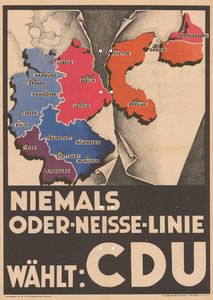
Until 1949, Germany was divided into four occupation zones: one American, one British, one French and one Soviet. During this period, it had no executive branch capable of effectively conducting foreign policy or formulating a binding German position on the question of Germany’s eastern border. However, even before the founding of the Federal Republic of Germany (FRG) and the German Democratic Republic (GDR) in May and October 1949 respectively, German positions on the Oder–Neisse line were beginning to take shape.
Within the West German political landscape (with the exception of the KPD), there was a consensus that the Oder–Neisse border was unacceptable. This consensus found expression in the Basic Law and the principle of reunification enshrined therein, as well as in the claim that the Reich borders of 1937 were legally valid. It was only through the conclusion of a peace treaty – so the widespread view in the Federal Republic – that the border issue could be definitively resolved in this sense. In the Federal Republic of the 1950s and early 1960s, Poland and the Oder–Neisse border were perceived primarily through the prism of expulsion and the loss of the German eastern territories. Individual memories of the lost homeland were quickly incorporated into a state-sponsored culture of remembrance, supported by the formation of regional associations and the Federation of Expellees (BdV). During the Adenauer era, the aim was to integrate the millions of refugees and displaced persons into society and to represent their interests in party politics. For decades, public memory of their regions of origin and their forced migration was linked to the border issue, influenced by it and, to some extent, exploited for political ends.
In the Soviet Occupation Zone (SBZ), the Socialist Unity Party of Germany (SED) initially opposed the Oder–Neisse line, no doubt partly because a disproportionately large number of refugees and displaced persons from the former eastern territories had come to the SBZ and, in many cases, had settled there. However, the ‘Cold War’ between the Soviet Union and the Western Allies, which began in 1947–48, led to a clear commitment to the Oder–Neisse border. On 6 July 1950, Otto Grotewohl (1894–1964) and Józef Cyrankiewicz (1911–1989) signed the Görlitz Agreement, in which, under Soviet pressure, the existing German–Polish state border was declared an ‘inviolable border of peace and friendship’[2] . For Germans in the GDR, the Oder–Neisse border was geographically close, but until the 1970s it was either impossible or extremely difficult to cross and was banned from public discourse. Anyone who criticised the ‘peace border’ ran the risk of being criminalised as an enemy of peace and a fascist. The four million displaced persons in the GDR were prohibited from forming organisations based on regional ties. The deliberate attempt to erase memories of one’s homeland and displacement from the public consciousness also stemmed from the doctrine whereby the SED rejected any historical shared responsibility for National Socialism and its consequences. The Poles suffered a similar fate to the East Germans; they, too, were not permitted to engage in any public debate regarding the loss of Lemberg/Lwów/Lwiw or Wilna/Vilnius/Wilno.
The Allies in the post-war period
The ‘Cold War’ between the Soviet Union and the Western Allies, which began in 1947–48, altered the significance of, and attitudes towards, the Oder–Neisse border. In 1945, according to the Western powers’ vision, the Oder–Neisse territories were intended to ‘strengthen’ Allied Poland at the expense of the German Reich; In the late 1940s and throughout the 1950s, the US and British governments in particular – in the wake of the East-West confrontation – called, at least verbally, for a revision of this border with the intention of weakening communist Poland and winning over the German people. From the outset, the German-Polish border issue and its discussion at international conferences were hampered by the imprecise wording chosen by the ‘Big Three’ in Potsdam. In their official statements up until the mid-1960s, the USA, the UK and France did indeed confirm the reservation contained in the peace treaties regarding freely agreed border arrangements for a unified Germany. However, this did not mean that the Federal Republic could expect support from the three Western powers for a united Germany, provided that it extended beyond the Oder–Neisse line.
Particularly under the Kennedy administration, the US encouraged the Federal Government to seek a settlement with Poland on the border issue, so that the Polish Government could free itself from its enforced dependence on the Soviet Union. Since the mid-1960s, French policy had left no doubt as to the immutability of the German-Polish border. In the UK, sympathies for Poland and a sense of treaty-based fairness towards the Federal Government were in balance on the border issue. On the Rhine, the political parties tended to interpret every statement from Washington, London or Paris regarding the peace treaty reservation as support for Bonn’s Oder-Neisse position. The Federal Government reacted with great unease when this stance proved to be outdated, for example following de Gaulle’s state visit to Poland in 1967 and his demonstrative visits to the Oder-Neisse territories.
The People’s Republic of Poland and the Polish diaspora
Poland’s demand for recognition of the Oder-Neisse border did not change after 1945. From 1949/50 onwards, it was directed primarily at West German policy and legislation, but also at the Western Allies. The original rationale for Poland’s westward shift – the idea of compensation – was superseded as early as the 1940s by other arguments, above all the historical-geographical – albeit seemingly artificial – argument for a return to supposedly ‘original Polish’, Piast territories. This demand, which was presented in varying ways depending on the audience and the overall political situation, gradually began to have an impact in the Western world, given the impressions left by the Nazi reign of terror in Poland. Over the years, Poles responded to the right to a homeland demanded by the German expellees – including in the Charter of the Expellees of 5 August 1950 – was met, over the years, by the Poles with an ever-stronger emphasis on the right to a homeland for those Poles born since 1945 in the former German eastern provinces, whose families, for their part, had not infrequently been expelled from their old homelands in the eastern territories lost to the Soviet Union. In terms of domestic politics, the Polish demand for recognition of the border had an integrating effect, as there was a consensus on this stance across all strata of society and within the Catholic Church. At the same time, it tied the country politically to the Soviet Union and served to legitimise Poland’s political class, which had not come to power through free elections.
It was not least representatives of the Polish exile community who drew attention to this serious dilemma, which corresponded to the unrealistic notion prevalent in conservative circles in the Federal Republic of Germany that that Poland was a spineless satellite of the Soviet Union and that one need only liberate the Poles from communism in order to regain, as it were, the territories beyond the Oder and Neisse rivers from them as an act of free self-determination. Juliusz Mieroszewski (1906–1976), a German expert at the influential exile journal *Kultura*, noted with regret in 1961 that Germany’s defeat in the Second World War had not yet transformed German political thinking, and warned: “If Germany maintains its intransigent stance on the issue of the Oder-Neisse territories, there will be no détente in Eastern Europe, and the Poles will adopt a stance that turns every enemy of Germany into their ally […].
The Churches in Germany and the Border Issue
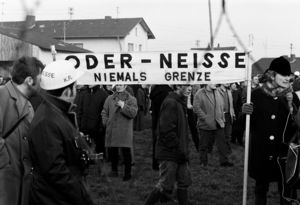
In the mid-1960s, the Protestant churches and the Catholic Church in both German states, as well as in Poland, expressed views on the Oder-Neisse border that differed from those of the Federal Government. They did so primarily out of ethical conviction, fully aware of the guilt Germans had incurred as a result of the Second World War and the crimes committed against Poles. On 1 October 1965, the ‘Council of the Protestant Church in Germany’ (EKD) published the memorandum *The Situation of the Displaced Persons and the German People’s Relationship with their Eastern Neighbours*. The memorandum made a case for reconciliation and for free political reason by placing historically conditioned German guilt and ethical conduct towards Poland at the centre of its argument and rejecting the fruitless confrontation of ‘right against right’ that had been practised for years.[4]
In November of the same year, the Polish bishops drafted a message of reconciliation addressed to their Catholic counterparts in Germany, which earned them sharp criticism from the Polish government, as it, amongst other things, acknowledged the suffering of Germans who had lost their homelands and asked for forgiveness. The German bishops’ diplomatically cautious response fell well short of the EKD memorandum with regard to the Oder–Neisse border. The Bensberg Circle of Catholic Intellectuals, on the other hand, spoke out in favour of recognising the existing German-Polish border in a memorandum dated 2 March 1968. At the same time, it sensitively addressed the emotional state of the displaced persons and emphasised the willingness of many of them to seek reconciliation.
Whilst earlier statements by individual West German intellectuals, such as Karl Jaspers (1883–1969) or Golo Mann (1909–1994), which tended towards recognition of the Oder–Neisse border, had met with little public response, the EKD memorandum in particular sparked a wide-ranging debate in both German states about relations with Poland and the border issue. Although it provoked vehement protests from the regional associations, it nevertheless contributed significantly to a shift in public opinion. In December 1967, for the first time, a relative majority of West Germans came out in favour of recognising the Oder–Neisse border.
The New Ostpolitik
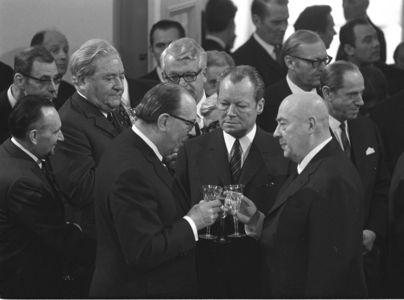
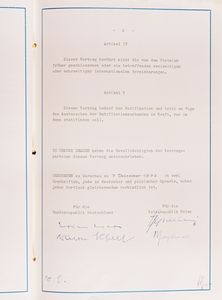
The shifts in social attitudes and the generational change in the Federal Republic of Germany during the second half of the 1960s ultimately enabled the social-liberal coalition led by Chancellor Willy Brandt (1913–1992) and Foreign Minister Walter Scheel (1919–2016), which had been pursuing a ‘New Ostpolitik’ aimed at détente since 1969, to conclude a ‘normalisation treaty’ with Poland on 7 December 1970, the core of which was the mutual recognition by the Federal Republic of Germany and Poland that the Oder–Neisse line constituted Poland’s western border. Although the treaty contained a ‘no-impact clause’ regarding previously concluded treaties (e.g. the reservation concerning the peace treaty), it made the establishment of diplomatic relations possible and, by acknowledging responsibility for German war crimes in Poland, helped to ease tensions between the governments and, above all, between the two societies.
In the 1970s, a wide range of contacts were established between the societies of the two German states and Poland. On 1 January 1972, the governments of the GDR and Poland agreed to visa-free travel, a move which was welcomed by the populations on both sides of the Oder and Neisse rivers and taken up by millions. It was non-state actors, in the form of town twinning schemes and the emerging German-Polish associations, that ensured contacts between the Federal Republic of Germany and Poland were numerous and independent of state influence.
The latter was all the more important given that official relations between Bonn and Warsaw remained strained. Reasons for this included, amongst other things, the protracted ratification of the treaty with Poland in May 1972 in the German Bundestag, and the rulings of the Federal Constitutional Court – following appeals by the Bavarian State Government and the CSU – of 31 July 1973 and 7 July 1975, which caused irritation to the Polish government because they reaffirmed that the territorial status – and thus also the Oder–Neisse border – could only be definitively settled through a peace treaty between the Four Powers. It was to take more than a decade before the Christian Democrats, who had been in power since October 1982, at least respected the ‘political binding effect’ of the treaty, even for a reunified Germany. On the one hand, the Christian-Liberal government provided symbolic and material support to the German minorities in Eastern Europe as well as to organisations representing displaced persons; on the other hand, it effectively continued the Social Democrats’ Ostpolitik.
The final border settlement of 1990–91
With the revolutionary autumn of 1989 and the end of the division of Europe and Germany, the Oder-Neisse border took on an unexpected relevance for Germans and Poles alike. The first democratically elected Polish government under Tadeusz Mazowiecki (1927–2013) hoped for a binding statement on the Oder–Neisse border during Helmut Kohl’s (1930–2017) state visit to Poland in November 1989.
The peace settlement, as envisaged for Germany in the Potsdam Agreement, now became the number one item on the agenda for all political actors in the midst of the hectic and ultimately successful European diplomatic efforts. Under the Two-Plus-Four Agreements on the reunification of Germany, at Poland’s insistence, first the two German states and then the reunified Germany were called upon to conclude a border treaty with Poland. Within the Christian Democrats, the border issue led to a major crisis in the spring of 1990. The liberal wing of the CDU, with the support of Warsaw and the first freely elected GDR government under Lothar de Maizière, pressed for a public and binding statement on the Oder-Neisse border. Kohl avoided making such a statement, primarily out of consideration for the displaced persons within the CDU/CSU. In response to this controversy, the German Bundestag and the GDR People’s Chamber issued identical declarations on 21 June 1990, emphasising the inviolability of the border and the renunciation of territorial claims.
The Two Plus Four Treaty, signed on 12 September 1990, enabled the two German states to reunify, subject, amongst other things, to the condition that the reunified Germany and the Republic of Poland confirm the border between them in a treaty binding under international law. On 14 November 1990, the Foreign Ministers Hans-Dietrich Genscher (1927–2016) and Krzysztof Skubiszewski (1926–2010) signed the German–Polish Border Confirmation Treaty. Together with the German–Polish Neighbourhood Treaty (17 June 1991), this was ratified by the German Bundestag on 16 December 1991 and came into force on 16 January 1992. This marked the effective conclusion, under international law, of a political and territorial dispute that had lasted for decades.
Bibliography
- Heike Amos: The SED’s Policy on Displaced Persons, 1949–1990. Munich, 2009.
- Sabine Dorothea Bamberger: The Oder–Neisse Border in the Polish Press, 1950–1990. Marburg 1990.
- Dieter Bingen: The Oder–Neisse Border. In: Ewa Kobylińska, Andreas Lawaty, Rüdiger Stephan (eds.): Germans and Poles. 100 Key Terms. Munich 1992, pp. 406–413.
- Roland Gehrke: The Polish ‘Western Idea’ up to the re-establishment of the Polish state after the end of the First World War. The origins and rationale of Polish territorial claims against Germany in the age of nationalism. Marburg 2001 (Materials and Studies on East Central European Research 8).
- Karoline Gil, Christian Pletzing (eds.): Granica. The German–Polish Border from the 19th to the 21st Century. Munich 2010 (Colloquia Baltica 19).
- Kerstin Hinrichsen: The Oder–Neisse Border. Until Further Notice? In: Hans Henning Hahn, Robert Traba (eds.): German–Polish Sites of Remembrance. Vol. 1. Paderborn 2015, pp. 497–517.
- Hans Georg Lehmann: The Oder–Neisse Conflict. Munich 1979.
- Christian Lotz: The Interpretation of Loss. Controversies in the Politics of Memory in Divided Germany concerning Flight, Expulsion and the Eastern Territories (1948–1972). Cologne et al. 2007 (New Research on Silesian History 15).
- Christian Lotz: The Contentious Maps. Polish, East and West German Representations Abroad and the Dispute over the Oder–Neisse Border (1945–1972). Leipzig 2011.
- Andreas Malycha: ‘We have recognised that the Oder–Neisse border is the border of peace’. The SED and the New Eastern Border, 1945 to 1951. In: Deutschland-Archiv 33 (2000), pp. 193–207.
- Krzysztof Miszczak: Declarations and Realities: Relations between the Federal Republic of Germany and the (People’s) Republic of Poland from the signing of the Warsaw Treaty to the Agreement on Good Neighbourliness and Friendly Co-operation (1970–1991). Munich 1993.
- Klaus Rehbein: The West German Oder–Neisse Debate. Berlin 2006.
- Wolfgang Wagner: The Emergence of the Oder–Neisse Line in Diplomatic Negotiations during the Second World War. Stuttgart 1964.
- Michael Weigand: The Discussion on the German–Polish Border during the Reunification Process of 1989–90. Munich 2004.
Notes
[1] This border between Poland and the Soviet Union had already been announced by the Western Allies in December 1919, but did not hold due to the Polish–Soviet War, which continued until 1921. It was given its name after the British Foreign Secretary, George Curzon (1859–1925), proposed it in July 1920 as the armistice line between Poland and the Soviet Union.
[2] Görlitz Agreement of 6 July 1950, https://www.verfassungen.de/ddr/deutschpolnischesabkommen50.htm (accessed: 26 June 2026).
[3] Juliusz Mieroszewski: Is Germany Returning to the East? Berlin 1961, p. 30.
[4] The Situation of the Displaced Persons and the German People’s Relationship with their Eastern Neighbours. A Protestant Memorandum. Hanover 1965, p. 29.
[5] As stated on 6 February 1985 by Volker Rühe, then deputy leader of the CDU parliamentary group, in the German Bundestag, dip21.bundestag.de/dip21/btp/10/10119.pdf (accessed 27 October 2020).
Citation
Burkhard Olschowsky: The Oder–Neisse Line. In: Online Encyclopaedia on the Culture and History of Germans in Eastern Europe, 2018. URL: ome-lexikon.uni-oldenburg.de/p32798 (accessed 27 October 2020).
Terms of use for this article
Copyright © University of Oldenburg and the Federal Institute for the Culture and History of Germans in Eastern Europe (BKGE), all rights reserved. This work was produced as part of the project ‘Online Encyclopaedia on the Culture and History of Germans in Eastern Europe’ and may be reproduced and published provided the rights holders’ consent has been obtained. Please contact:
If you have any specialist comments or additions to the text, please contact the editorial team, citing relevant literature and source references.