

Moravian Ostrava/Ostrava
Moravian Ostrava/Ostrava
Etymology
The industrial city of Ostrava grew out of a small fishing village. It is therefore thought that the name may be derived from the Slavic word ‘ostrov’ ( meaning ‘island’) or ‘ostry’ (meaning ‘sharp’ or ‘rapid’), as in both cases a connection to water can be established. This also applies to etymological links to the river Ostrawitza (Czech: Ostravice).
In the 15th and 16th centuries, the name Deutsch-Ostrau (Germanica Ostrava) was also in use. From the 17th century until after the Second World War, the town’s name was Moravian Ostrau (Czech: Moravská Ostrava). Following the incorporation of a number of Silesian settlements, in particular Polish Ostrau (Czech: Polská Ostrava), the name became Silesian Ostrau (Czech: Slezská Ostrava); however, following a territorial reform in 1941, this name became obsolete, as the city now extended beyond the Moravian border into Silesia. The official renaming of Moravian Ostrava to Ostrava and Moravská Ostrava to Ostrava took place in 1946. The historic Moravian Ostrava is now part of the municipal district of Moravian Ostrava and Přívoz (Czech: Moravská Ostrava a Přívoz).
Location
The town is situated at 49° 50’ north latitude and 18° 17’ east longitude, approximately 335 m above sea level in a low-lying area near the mouths of the Ostravice (Czech: Ostravice), Lučina (Czech: Lučina) and the Oppa (Czech: Opava) into the Oder (Czech: Odra).
Topography
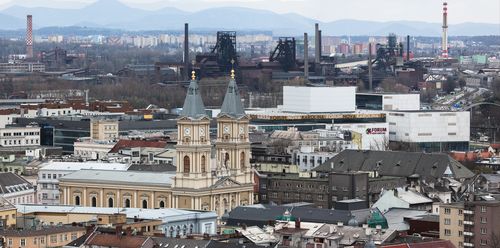
To the south, the Ostrau region is bounded by the Carpathians and the Moravian Beskids, and to the north-west by the Moravian Lowlands. The north-east has no natural boundary due to the Oda Valley. Before industrialisation and urbanisation began in the mid-19th century, this area, rich in marshes and floodplains, was predominantly agricultural, comprising numerous small feudal villages (Waldhufendörfer), with the small town of Ostrau as its centre.
Region and political and administrative affiliation
The statutory city (Czech: statutární město) of Ostrava is now the administrative centre of the Moravian-Silesian Region (Czech: Moravskoslezský kraj) and is situated in the far north-east of the Czech Republic.
Common symbolism

The coat of arms of the town of Ostrava is identical to the historic coat of arms of Moravian Ostrava. The oldest depiction of this coat of arms dates from 1664. The official town coat of arms depicts a saddled white horse, ascending to the left as seen by the viewer, without a bridle, and in the background a shining star on a blue field; according to other depictions, it features a golden rose with green sepals and a red pistil. According to legend, the coat of arms was bestowed by Theodorich von Neuhaus, Bishop of Olomouc (1281–1302), in recognition of the town’s citizens’ assistance in relieving the besieged Hochwald Castle (Czech: Hrad Hukvaldy).[1] According to another version, an unbridled horse caused confusion in the enemy camp during a siege of Ostrau, thereby helping the people of Ostrau to break out and ultimately secure victory. It is considered certain, however, that these accounts ‘lack any historical basis and were composed later than the coat of arms.’[2]
Since 2007, the city has used the brand name OSTRAVA!!! as its logo; this is omnipresent in the cityscape and is the name under which Ostrava successfully promotes itself to the outside world.
Nicknames
The steel heart (and black lungs) ofthe Republic/Czechoslovakia, the Black City, the Forge of Socialism, the City of 100 Chimneys, the Moravian Klondike.
Prehistory and Early History
The earliest evidence of human settlement in what is now the city area dates back to the Stone Age. The oldest finds come from Landeck Hill (Czech: Landek), situated on the River Oder. The best-known find dates from 1953. This is the so-called Venus of Petershofen (Czech: Petřkovická venuše), a female torso made of haematite, approximately 23,000 years old and just under five centimetres tall. The figurine is housed at the Archaeological Institute of the Czech Academy of Sciences in Brno.
Middle Ages
The granting of German town charter (Magdeburg Law)[3] took place between 1267 and 1279, when Moravian Ostrava was first referred to as a town in a document (1267). Polish Ostrava was first mentioned in a document as early as 1229. The development of the settlement into a fortified border town is largely attributable to Bruno von Schauenburg, Bishop of Olomouc(also known as Bruno von Holstein-Schaumburg, c. 1205–1281), the former provost of St John’s in Lübeck. In 1362, the Bohemian King Charles IV (1316–1378) granted permission for the first annual fair, which laid the foundations for the town’s development into a market town of regionalimportance.
Bruno von Schauenburg had already encouraged Germans, particularly those from the Elbe region, to settle there, which gave rise to the name Deutsch-Ostrau (to distinguish it from the older, Slavic-populated Polnisch-Ostrau on the other side of the Ostrawitza, which belonged to Poland ).
Modern times
Ostrava was scarcely affected by the Hussite Wars(1419–1434). During the Thirty Years’ War, the town was first occupied and then plundered by Danish and later Swedish troops. Ostrau was one of the places in Moravia most severely affected by the hostilities. Fires (1556, 1675, 1763), floods (1649, 1655, 1670, 1695) and epidemics repeatedly set Ostrava’s development back: in 1585, 1625 and 1715, large sections of the population perished in the plague. When the Silesian hinterland of the town passed to Prussia following the First Silesian War in 1742, vital trade and transport links were severed. Compensation for this only came when Galicia passed to Austria in 1772 and Bukovina in 1774, thereby removing the customs barriers to these two neighbouring regions. During the War of the Bavarian Succession (1778–79), the Prussian army advanced as far as Polish Ostrava before the conflict was settled on 13 May 1779 with the Treaty of Teschen. Owing to the high concentration of workers in the mines and smelting works, the town became a centre of the labour movement in the Bohemian lands during the 19th century.
Contemporary History
Following the coup (Czech: převrat) in 1918, the Ostrava industrial region – and in particular the immediately adjacent Cieszyn Silesia – became a bone of contention between the (newly) constituted Polish and Czechoslovak states, both of which laid claim to the territory. The German parties (conservative, social democratic and nationalist) called for theEast Moravian-Silesian industrial region to be declared an independent republic, out of consideration for ethnic and economic interests.
In the 1935 Czechoslovak parliamentary elections, the Sudeten German Party (SdP) emerged as the strongest force in the Ostrava constituency, winning 19.1 per cent of the vote.[4] This made the region a stronghold of the Henlein movement in Czechoslovakia.
Following the occupation of further parts of Czechoslovakia by Germany and Poland in the wake of the Munich Agreement of 1938, Ostrava became an almost completely encircled border town, accessible only via a narrow strip of land to the south. The situation was exacerbated by the arrival of numerous refugees and displaced persons from the occupied territories. Following the occupation of the town by German troops on 14–15 March 1939, Ostrava became part of the Protectorate of Bohemia and Moravia and, in accordance with the ‘Führer Decree’ of 16 March 1939, belonged to the ‘Greater German Reich’. The Germans of Ostrava welcomed the Wehrmacht as liberators. Immediately afterwards, as part of ‘Operation Gitter’, numerous actual and potential opponents of the new rulers were arrested on the basis of lists of names drawn up in advance. Interventions in the education system were aimed at erasing all traces of the Czechoslovak state.
Industry in Ostrava was converted to serve the war effort. By 1941, German companies and banks had taken over the entire mining and iron sector, as well as the majority of the chemical and engineering industries. Owing to its importance to the German armaments industry, Ostrava was repeatedly targeted by Allied bombing raids. During the first and most devastating attack in 1944, 409 people lost their lives, around 1,500 were injured and 1,256 were left homeless.[5]
On 30 April 1945, Ostrava was liberated by the Red Army following heavy fighting during ‘OperationOstrava-Troppau’, which lasted around 20 days. During the fighting for the town, 1,142 members of the Red Army were killed, whilst the German side suffered over 1,300 casualties. In addition, there were 388 civilian casualties.[6] The 1st Czechoslovak Independent Armoured Brigade also took part in the liberation as part of the 4th Ukrainian Front. Its crew, numbering just under 1,500 men, consisted of Volhynian Czechs, Rusyns from Carpathian Ukraine (which belonged to Czechoslovakia from 1920 to 1938 and from 1944 to 1946), as well as Czechs and Slovaks.[7]
After the Second World War
The city’s reconstruction took place as part of the ‘Budujeme Ostravu’ (Eng. ‘We are rebuilding Ostrava’) plan, which was primarily intended to alleviate the housing shortage. The city’s immediate post-war development is closely linked to the name of Josef Kotas (1891–1966), who, as a member of the Communist Party, had been elected mayor of Ostrava as early as 1938 and held this office from 1945 to 1960 following his return from exile in Britain. During his term of office, the foundations were laid for Ostrava’s development into a modern socialist metropolis and industrial city.
As early as September 1947, a court was convened to bring legal proceedings against those responsible for crimes committed during the occupation. By 1947, proceedings had been brought against 1,636 people. The death penalty was imposed on 41 occasions and carried out on 38 occasions.[8] Following the Communist takeover in 1948, a series of political trials took place in the wake of ‘Operation Beskydy’ (Czech: akce Beskyd). Five people were sentenced to death and executed in Ostrava in 1950–1951 for anti-communist activities.
In the wake of the invasion of several Warsaw Pact states during the Prague Spring, Ostrava was occupied by a Soviet motorised rifle division in August 1968. The subsequent so-called ‘normalisation’ (Czech: normalizace) was more radical in Ostrava than in other parts of the country.
The largest protest during the ‘Velvet Revolution’ (Czech: Sametová revoluce) in 1989 was the general strike and the demonstration on what was then People’s Police Square (renamedMasaryk Square from 24 December) on 27 November 1989, which was organised by the opposition Civic Forum (Czech: Občanské fórum). Two days later, a demonstration took place at the same location, consisting mainly of supporters of the Communist Party (KPČ). This demonstrated the level of support the KPČ enjoyed in a region predominantly populated by miners and industrial workers. The post-reunification era was symbolically heralded in Ostrava by a visit from President Václav Havel (1936–2011) on 3 February 1990.
Population
At the beginning of the 19th century, Moravian Ostrava was one of the smallest towns in the region. An initial census, carried out in 1754–1755, recorded just 192 residential buildings with a population of around 1,150. By 1800, the population had risen to around 1,550.[9] A rapid increase in the population occurred in the wake of industrialisation. The influx of workers came mainly from Galicia.
Population trends between 1869 and 2016 in figures:
Year | Population[10] |
1869 | 38,598 |
1880 | 56,128 |
1890 | 84,492 |
1900 | 144,550 |
1910 | 186,084 |
1921 | 198,438 |
1930 | 219,528 |
1950 | 215,791 |
1961 | 254,297 |
1970 | 297,171 |
1980 | 322,073 |
1991 | 327,371 |
2001 | 316,744 |
2016 | 292,681[11] |
The city’s population is currently declining slightly. For over 25 years, Ostrava has been losing at least 1,000 people a year. As a result, the population has fallen from a record high of 332,599 (1992) to 288,882 (2018).[12]
The results of the latest Austrian surveys on national affiliation in the Ostrava metropolitan area (respondents were asked about their everyday language) were as follows (figures in per cent):[13]
Everyday language | 1880 | 1890 | 1900 | 1910 |
Czech | 74.8 | 66.3 | 55.0 | 52.2 |
German | 16.0 | 21.9 | 22.7 | 31.2 |
Polish | 6.2 | 11.8 | 22.3 | 16.6 |
The 1921 Czechoslovak census officially revealed the following figures for Moravian Ostrava and Silesian Ostrava regarding the proportions of the three largest nationalities:[14]
Czechs | Germans | Jews | Poles | Others | Foreigners | |
Moravian Ostrava | 24,293 | 9,879 | 1,666 | Not specified | 798 | 5,138 |
Silesian Ostrava | 18,803 | 820 | 403 | 79 | 9 | 2,776 |
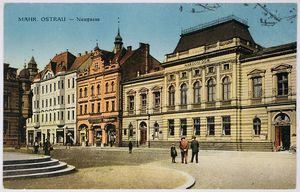
Compared with other towns in Bohemia or Moravia, rivalries between the various ethnic groups played a lesser role in Ostrava. Social differences were a more significant factor in local conflicts and loyalties within the industrial region. This was also facilitated by the fact that almost all of Ostrava’s inhabitants had only recently moved there and traditional social hierarchies were virtually non-existent. During elections, the same names could sometimes be found on both German and Czech electoral lists.
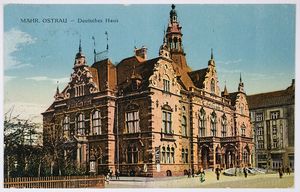
Conflicts between the nationalities only intensified towards the end of the 19th century, during the term of office of Mayor Adelbert Johanny (1846–1919) between 1888 and 1901. A symbol of this is the establishment of the three national centres: the ‘Czech House’ (Czech: Národní dům) in 1894, the ‘German House’ in 1895 and the‘Polish House’ (Polish: Dom Polski) in 1900.
Linguistically, too, the Moravian Czech spoken in the region was strongly influenced by German, Slovak and Polish. A striking feature, similar to Polish, is the stress on the penultimate syllable (in Czech, the stress is always on the first syllable), as well as a shortening of vowel length, which in Czech occurs in both short and long forms. This gives rise to the well-known saying that the people of Ostrava have a ‘short tongue’ (Czech: krátký jazyk) or a ‘short beak’ (Czech: krátký zobák or zobak).
Economy
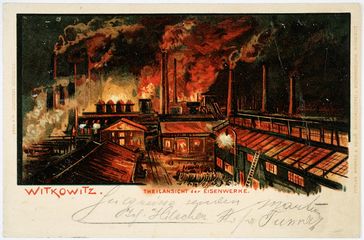
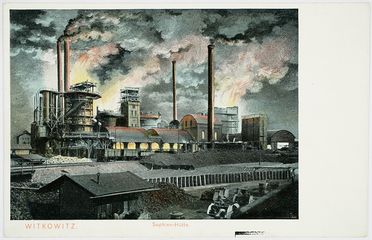
Around 1770, the blacksmith Keltička is said to have come across ‘black stone’ , in Polish Ostrau. This discovery of coal proved to be a turning point for Ostrau and the entire region. From then on, they were shaped by mining and the steel industry. The first ironworks was founded in 1828 by Rudolf of Austria (1788–1831), Archbishop of Olomouc. In the second half of the 19th century, the Witkowitz Ironworks became one of the most important companies in the monarchy under the leadership of Emil Holz (1840–1915), a director originally from Stuttgart.
The headquarters of the major coal and steel companies were initially mostly based in Vienna. After 1918, the Czechoslovak Nostrification Act (Czech: Nostrifikační zákon) required the relocation of company headquarters to Czechoslovakia, so that profits and taxes would not flow abroad.
Following the nationalisations of 1948, the Ostrava coal and steel complex was systematically expanded to become the country’s most important industrial centre. In 1994, the last mine in Ostrava ceased operations and, after more than 200 years, the city’s mining tradition came to an end.
In 1847, Ostrava was connected to the European railway network via the Emperor Ferdinand Northern Railway.
History of Religion and the Church
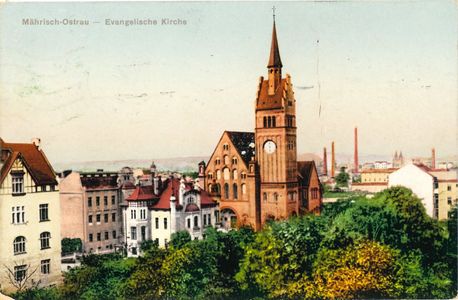
From time immemorial, Ostrava had belonged to the Diocese of Olomouc in ecclesiastical matters. After Bishop Bruno of Schauenburg had granted the town its town charter, it became necessary to build a church as a symbol of a town governed by German law. The Gothic Church of St Wenceslas (Czech: Kostel sv. Václava), which was subsequently built, probably between 1270 and 1278, is now one of the town’s most important architectural monuments. In the course of alterations and extensions, a number of Gothic elements were lost, whilst elements from other architectural styles (Baroque, Classicism, Neo-Gothic) were added. Its original appearance has therefore been significantly altered. Another prominent Catholic church in the city centre is the Church of the Redeemer, built in the Neo-Renaissance style, which was elevated to the status of cathedral in 1996 by Pope John Paul II (1920–2005) in 1996, following the establishment of the Diocese ofOstrava-Tropau; today it is the Cathedral of the Divine Saviour (Czech: Katedrála Božského Spasitele), which was completed in 1889 after approximately six years of construction, based on plans by Gustav Meretta (1832–1888). The Catholic wooden Church of St Catherine (Czech: Kostel sv. Kateřiny) in the district of Hrabová, dating from 1564, which burnt down in 2002, was reopened as early as 2004. Between 1905 and 1908, the Roman Catholic Church of the Virgin Mary (Czech: Kostel Panny Marie Královny), featuring two towers in the Neo-Baroque style, was built in Marienberg (Czech: Mariánské Hory).
Well into the 18th century, the region’s population remained largely Catholic, not least because of the ban on members of other faiths settling there. Even the Edict of Tolerance issued by Emperor Joseph II (1741–1790) in 1781 did little to change this situation at first. As late as 1838, there was reportedly only one non-Catholic Christian in Moravian Ostrava.[15] For the Protestant population, who flocked to the region particularly in the wake of industrialisation, there were a few churches operating under the Edict of Tolerance, for example in Nieder Bludowitz/Dolní Bludovice. The Protestant church built in 1566 in what is now the district of Silesian Ostrava was lost in 1654 during the Counter-Reformation. In 1860, a Protestant church was built on the road between Moravian Ostrava and Witkowitz, financed by donations, in particular from Baron Rothschild, and with the assistance of the Gustav Adolf Society. A Protestant congregation has existed again since 1875. It was not until between 1905 and 1907 that the Protestant Church of Christ (Czech: Evangelický Kristův kostel), built in the Dutch Renaissance style, was erected in Moravian Ostrava itself.
Jewish Ostrau
Before the Second World War, Ostrava was home to the third-largest Jewish community in Czechoslovakia, after Prague and Brno. The Jewish population was an important and active part of society in this young, large and industrial city. Following the settlement ban of 1531, it was not until the end of the 18th century that a Jewish family was officially permitted to settle in the town. Jews were involved, for example, in the production and sale of beer and spirits (such as the Markus Strassmann steam brewery). In 1869, the city’s Jewish population accounted for around six per cent of the total population. Their share of the population rose to around 15 per cent by 1900.[16] Ostrau thus became a new centre of Jewish life in Moravia. The growth of the Jewish community was due in particular to the influx of so-called ‘Eastern Jews’ from Galicia, which distinguished the Ostrau community from other Jewish communities.[17] An independent Jewish religious community existed in Moravian Ostrava from 1875 onwards.
Many Jews contributed to the development of Ostrau’s industry and its dynamic economy. Particular mention should be made here of the Rothschild and Guttmann families, with their involvement in the Witkowitz iron and coal industries. Jews also played an important role in banking and commerce. For instance, the Wechsberg family founded one of the first private banks. Many doctors, lawyers and businesspeople were also Jewish, and some of the city’s major department stores were owned by Jews (Bachner, Rix, Borger, Schön, Nesselhort).
Ostrava gained significance for the Zionist movement in Czechoslovakia and also became a centre of Jewish religious life. This is illustrated by the six synagogues in Greater Ostrava. The main synagogue (Hochtempel) could accommodate 700 worshippers. The foundation stone for the town’s first synagogue was laid on 20 May 1879, and it was opened as early as 15 September of the same year. The Jewish school in Ostrava was founded in 1863 and, during the interwar period, was one of the few Jewish educational institutions in the country to remain in operation. In 1899, 303 children were enrolled there across seven classes.[18]
The school continued to operate even after the founding of Czechoslovakia, adapting to the new political and linguistic circumstances by delivering a high proportion of lessons in Czech. From the fifth year onwards, only religious studies and handicrafts were not taught in Czech.[19] In the 1930 Czechoslovak census, of the 6,865 people of the Jewish faith in Moravian Ostrava, only 2,267 also identified as being of Jewish ethnicity.[20] Ostrava was home to numerous Jewish organisations such as Hechaluz, Techeleth Lavan and the Presidential Board of the Jewish Party, which also published its own newspapers here (see ‘History of the Press’).
Following the German occupation of the town in March 1939, one of the first anti-Jewish measures was the ‘Aryanisation’ of Jewish property, foremost among which were the large department stores in Ostrava. In June 1939, the six synagogues in Ostrava and other Jewish places of worship were set on fire and destroyed. However, some religious artefacts were saved. The destruction of the town’s Jewish community began in October 1939 as part of the so-called Nisko Plan, which ostensibly involved the resettlement of Jews in the area around Nisko and Lublin.[21] A ‘comparatively high proportion of the Jewish population’, however, had managed to flee beforehand.[22] The approximately 4,000 Jewish residents still living in the town in 1941, including around 400 returnees from Nisko, were deported to Theresienstadt in four transports, each carrying 860 people, and were subsequently sent on to Auschwitz. It is estimated that only 250 Jews from Ostrau survived the Holocaust,[23] whilst other sources put the figure at 500 people, who returned to Ostrava after the war and, for the most part, emigrated in 1948–49 or 1968–69.[24]
The town’s Jewish community (Kehila) currently numbers only around 100 members. Since the early 1990s, the community centre has been located in the Marienberg district. It comprises a prayer room, a library and an adjoining social services centre. Hebrew courses are also offered.
Special cultural institutions
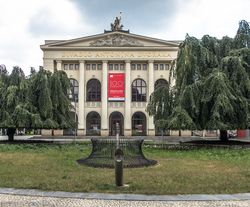
With seven theatres, the city boasts an extremely vibrant theatre scene. The most renowned venue is the Antonín Dvořák Theatre (Czech: Divadlo Antonína Dvořáka), which opened in 1907 after a construction period of just under two years. Today, the theatre serves as the main stage of theMoravian-Silesian State Theatre (Czech: Národní divadlo moravskoslezské). The Neo-Baroque building, designed by the Viennesearchitect Alexander Graf (1856–1931) has just over 800 seats; it features a reinforced concrete framework that was modern for its time and rests on a concrete slab, as the Antonín shaft – which was decommissioned in 1879 – lies just under 200 metres beneath the building. The mine ventilation chimney in front of the theatre, which is still in use, bears witness to this.
With the Jiří Myron Theatre (Czech: Divadlo Jiřího Myrona), named after the Czech actor and director (1884–1954), who worked in Ostrava from 1923 until his death, the Moravian-Silesian State Theatre has had an additional stage since 1986, located in the Czech House. Other theatres in the city include the Peter Bezruč Theatre (Divadlo Petra Bezruče), the Arena Chamber Theatre (Komorní scéna Aréna), the Ostrava Puppet Theatre (Divadlo loutek Ostrava) and the semi-professional Old Arena (Stará aréna). In the summer of 2016, the actor Albert Čuba (born 1983) leased the former Bio Rekord cinema (later the Mír cinema) and opened the Mír Theatre (Divadlo Mír) at this historic cultural venue in 2017.
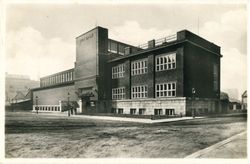
The city’s most important orchestra is the Janáček Philharmonic Orchestra of Ostrava, which ranks among the country’s most renowned orchestras. With the House of Arts (Czech: Dům umění) , built in 1926, Ostrava boasts an exhibition centre of supra-regional significance. Since 2017 , the Plato Exhibition and Information Centre has been showcasing modern art .
The city’s museum landscape reflects, in particular, Ostrava’s coal and steel heritage. Notable examples include the Dolní Vítkovice National Cultural Monument (Czech: Dolní Vítkovice), the museum at the Důl Michal mining site, and the Mining Museum in Landek Park (Czech: Landek Park – Hornické Muzeum). The Ostrava City Museum (Czech: Ostravské Muzeum) is housed in the old 16th-century town hall, right in the historic city centre. In recent years, the Centrum Pant has developed into an important venue for cultural, social and political exchange.
Education and Science
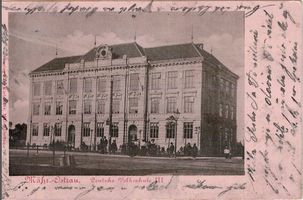
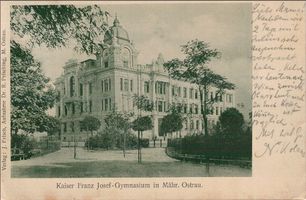
The largest university is the Technical University of Ostrava (Czech: Vysoká škola báňská – Technická univerzita Ostrava). It traces its origins back to a higher education institution for mining founded in 1849 in Příbram/Freiberg in Bohemia (Czech: Příbram).
The University of Ostrava (Czech: Ostravská univerzita) was founded in 1991 and emerged from the Ostrava Faculty of Education (Czech: Pedagogické fakulty v Ostravě) (2016: 8,543 students).[25]
The City’s Scientific Library (Czech: Vědecká knihovna) has been housed on a temporary basis in part of the New Town Hall since 1951. In 2006, plans were drawn up for a modern new building in the shape of a black cube (Czech: Černá Kostka), which, following many years of discussion and funding difficulties, is due to be constructed from 2020 onwards.
Urban development, architectural and cultural history
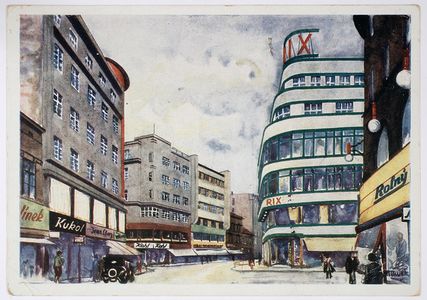
The flurry of building activity that began in the mid-19th century can be described as largely unsystematic and unplanned. It was entirely subordinated to the needs of the expanding smelting works and mines. Unlike in other industrial towns, no (administrative) centre emerged. Housing estates for workers and their families were often built in the immediate vicinity of the industrial sites, as was the Rothschilds’ castle, dating from 1848 (Czech: Rothschildův zámeček). The principle of separating residential and commercial districts did not take hold in Ostrava. Tenement blocks did not appear until the 1880s and 1890s. The first concept for orderly urban development, which can be traced back to the Viennesearchitect and urban planner Camillo Sitte (1843–1903), also dates from this period.
The city’s development into a major urban centre began in 1924 with the amalgamation of Moravian Ostrava with a number of surrounding localities, such as Witkowitz, Priwoz, Marienberg (known as Ellgoth [Czech: Lhotka], originally Teufelsdorf [Czech: Čertova Lhota]), Klein-Grabau/Hrabŭvka and Neudorf/Nová Ves, as well as Heinrichsdorf/Zábřeh, to form Greater Ostrau. As part of an administrative reform under the German occupation regime, neighbouring Silesian municipalities, such as Silesian Ostrava, were incorporated in 1941. After 1945, further municipalities were added, including Hannersdorf (Czech: Poruba, 1957), which was conceived as ‘New Ostrava’ and, by the early 1980s, with over 90,000 inhabitants, was the largest housing estate in Czechoslovakia. The first phases of construction were built in the Socialist Realism style and have been listed as historic monuments since 2003. The most striking feature is the double entrance archway, incorporated into a residential building, which was modelled on the General Staff Building on St Petersburg’s Palace Square, dating from 1819.
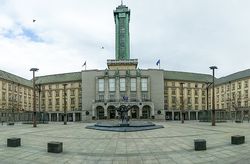
The architectural landmark of modern Ostrava is the New Town Hall, built between 1925 and 1930, with its striking 85.6-metre-high steel-and-glass tower. The front façade is adorned with four bronze statues, each over three metres high, which are intended to symbolise the four pillars of the city: mining, the steel industry, science and trade.
Depictions of the city are repeatedly dominated by industrial facilities, which have thus become a defining feature of Ostrava’s public image. Early illustrations of the ironworks in Witkowitz from the mid-19th century were produced, for example, by Ernst Wilhelm Knippel (1811–1900). Also worth mentioning are the later works of Jan Zrzavý (1890–1977), Vladimír Kristin (1894–1970) and Jan Václav Sládek (1909–1992). Particularly well-known are the three oil paintings by Oskar Kokoschka (1886–1980) created in 1937, such as ‘Mährisch-Ostrau II’, which has been part of the permanent exhibition at the Ostrau House of the Arts since 2010.
Press history
The film *The Pit of Buried Ideas* (Šachta pohřbených idejí) by Rudolf Myzet (1888–1964) and Antonín Ludvík Havel (1894–1968) is regarded as Czechoslovakia’s first socially critical feature film. After its completion, the film was briefly banned by the mark and premiered in early 1922. As the film depicts numerous aspects of Ostrava that no longer exist today, it also serves as an important document of the city’s history.
Bibliography
Among the best-known Czech authors to have explored the city and the region in their writing is František Sokol-Tůma (1855–1925). In works such as *Stories from Hell*[26] (Povídky z pekla) and, above all, the trilogy *The Black Kingdom* (Černé království), comprising the parts *In the Glow of Millions* (V záři milionů, 1900/1901, original title: *A Businessman*), ‘Down the Mine’ (Na šachtě, 1904) and ‘The Factory Manager’ (Pan závodní, 1909), he repeatedly explores not only Silesian rural life but also the world of miners and their families. His works, some of which can be classified as so-called ‘borderland literature’, such as ‘In the Borderlands’ (Na Kresách, 1922), are in part permeated by anti-German, anti-Polish and anti-Jewish sentiments. Vojtěch Martínek (1887–1960) produced no fewer than two Ostrava trilogies: *Black Earth* (Černá země, 1926–1932) and *The Stone Order* (Kamenný řád, 1942–1954). Vojtěch Martínek (1887–1960).
His birthplace, (Silesian) Ostrava, occupies an important place in the work of Ota Filip (1930–2018), who emigrated to West Germany in 1974 and later also wrote in German. In his first novel, *The Café on the Road to the Cemetery* (Cesta ke hřbitovu, 1968) , he depicts Silesia between 1938 and 1945. His autobiographical novel *Sedmý životopis* ( 2000 ) was published in German the following year under the title *Der siebente Lebenslauf *. Filip’s novel* * (*The Ascension of Lojzek Lapáček from Silesian Ostrava*; Czech: *Nanebevstoupení Lojzka Lapáčka ze Slezské Ostravy*) was published in 1973.
One of the best-known literary descriptions of the city comes from Ludvík Jahn, the main character in Milan Kundera’s (b. 1929) novel *The Joke* (*Žert*), published in 1967. Jahn is expelled from university for political reasons and is forced to prove himself for several years in the Ostrava coal mines. Authentic accounts of working conditions in the Ostrava coalfield during the communist era can also be found in Ivan Landsmann’s (1949–2017) novel *Bunte Schilderungen* (*Pestré vrstvy*), written whilst in exile in the Netherlands. Completed in 1986, the book was not published until 1999 and is partly written in the Ostrava dialect, which adds to the authenticity of the depictions.
Conditions in Ostrava are also reflected in the works of the prose writers Jan Balabán (1961–2010) and Jiří Hnát Daněk (1959–2017), as well as the poet Petr Hruška (born 1964). Another important contemporary writer from the city is Richard Sklář (born 1968), who also publishes under the pseudonym Bruno Ligocki. Marek Piętoň (born 1968) depicts Ostrava during the interwar and wartime periods in his 2016 novel *The Book of Esther* (*Kniha Ester*). In 2013, Ivan Motýl (born 1967) published the volume *Brikett: Ostrava Poetry and Poetry about Ostrava 1894–2013* (Briketa: Ostravská poezie a poezie o Ostravě 1894–2013). It brings together 163 poems by 120 authors, including, for example, Čeněk Ostravický (1869–1912), Jaroslav Seifert (1901–1986), Milan Kundera and Jan Skačel (1922–1989).
German-speaking authors have also helped shape the literature of the Moravian-Silesian region, most notably Maria Stona (née Maria Scholz, 1861–1944). The lady of Strzebowitz Castle (Czech: Třebovice), situated not far from Ostrava, turned the family seat into a centre of literary life in the region. Stona left behind an extensive body of work (novels, short stories, poems and travelogues). The town’s best-known Jewish writer is Ilse Weber (1903–1944). During the interwar period, various children’s books by her were first published in Ostrava; since the 1990s, her letters, songs and poems from Theresienstadt have been published.
Culture of memory and remembrance
378 First World War graves (148 Poles, 70 Czechs and Slovaks, 45 Italians and 37 Romanians) at the cemetery in Heinrichsdorf were exhumed in 1931 and transferred to the cemetery in Witkowitz, where a mausoleum had been erected for the fallen.
On 30 April 1947, the second anniversary of the city’s liberation, the central Soviet-Czech memorial in Komenský Park was unveiled. Since 1980, Tank 501 – which was the first to reach Moravian Ostrava as part of the 1st Czechoslovak Independent Tank Brigade – has stood below the historic town hall of Silesian Ostrava, having been converted into a memorial.
In the 1990s, a number of Ostrava residents who had been convicted and executed after 1948 for anti-communist activities were honoured posthumously.
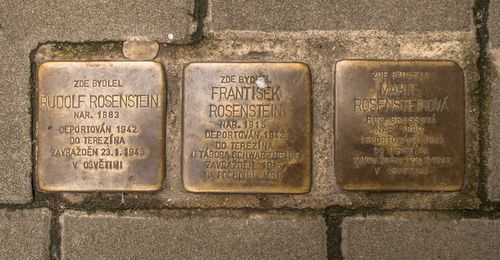
On 18 October 2009, a memorial to the victims of the deportation was unveiled at Ostrava Central Station; on 18 October 1939, around 1,000 Jewish men had been deported from Moravian Ostrava to Nisko on the San (Nisko Plan). In 2010, the first 27 Stolpersteine were laid in memory of murdered Jewish fellow citizens, with a further 26 added in 2015. On the site of the main synagogue, which was burnt down by the German occupying forces on 12/13 June 1939 by the German occupying forces, a new memorial to the approximately 8,000 Jews from Ostrava murdered during the Shoah was erected on 23 March 2017 in the town centre as part of the Temple Festival.
4. Discourses and controversies
Large sections of the German population did not accept the Czechoslovak state that emerged after 1918 and regarded the period leading up to its incorporation into the Greater German Reich in 1939 as foreign rule. Furthermore, the Germans levelled the accusation that the territorial reform of 1924 served not economic or administrative purposes, but purely political ones.
The temporary end of the Czechoslovak state in March 1939 was consequently welcomed by the Germans of Ostrava.
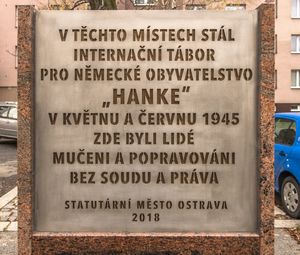
In the recent past, there has been fierce controversy – which continues to this day – surrounding the erection of a commemorative plaque for the Germans from Ostrava who perished or were resettled after the Second World War. In autumn 2017, Ostrava’s mayor, Tomáš Macura, announced that a commemorative plaque would be erected in 2018 at the site of the former Hanke internment camp in the Priwoz district, in memory of its at least 231 victims. The aim was to contribute to coming to terms with the dark chapters of the city’s own history, about which many people knew very little. This decision had been preceded by protracted and contentious discussions within the city. The memorial plaque was ceremonially unveiled on 15 June 2018 and bears the inscription: “In the post-war period, the ‘Hanke’ internment camp for the German population was located on this site. In May and June 1945, people were tortured and murdered here without any legal basis.”
5. Bibliographical references
Bibliography
- Daniel Baránek: Židé na Ostravsku [Jewish Life in the Ostrava Region]. Ostrava 2017.
- Moravian Ostrava. The City of Coal and Iron. Topographical and Promotional Almanac of Our Towns. Translated from the Czech by Gustav Steiger. Olomouc 1940.
- Lubomír Nenička: The Second Republic in the Ostrava Region 1938–1939. Opava 2010.
- Marek Otisk (ed.): Město v nás. Příběhy ostravských Židů [The City Within Us: Stories of the Jews of Ostrava]. Ostrava 2004.
- Nina Pavelčíková : The Ostrava Region during the Years of Nazi Occupation (1938–1945) [The Ostrava Region during the Years of Nazi Occupation (1938–1945)]. Opava 1990 (Publication of theSilesian Institute of the Czechoslovak Academy of Sciences 30).
- Blažena Przybylová et al.: Ostrava. History / Culture / People. Prague 2013.
- Anna Spunda: Moravian Ostrava. Editedby the Working Group for Local History in Moravian Ostrava. Reichenberg 1922.
- Martin Strakoš: New Ostrava and its satellite towns. Chapters from the History of Architecture 30.–50s of the 20th century [New Ostrava and its Satellites. Excerpts from the History of Architecture from the 1930s to the 1950s]. Ostrava 2010.
Web links
- www.ostrava.cz/en (English-language website of the statutory city)
- www.ostravainfo.cz/de/ (official city guide for Moravian Ostrava)
- www.herder-institut.de/bildkatalog/wikidata/Q8385 (images of Moravian Ostrava/Ostrava in the image archive of the Herder Institute, Marburg)
Notes
[1] Franz Wattolik: Contributions to the History of the Town of M.-Ostrau. Moravian Ostrau 1881, p. 155.
[2] Spunda: Moravian Ostrava, p. 4.
[3] Vladimír Spáčil: Moravian Ostrava. In: Joachim Bahlcke, Winfried Eberhard, Miloslav Polívka (eds.): Handbook of Historical Sites: Bohemia and Moravia. Stuttgart 1998, pp. 355–358, here p. 355.
[4] Jaroslav Valenta, Otakar Káňa: The Subversive Politics of the German Minority in Czechoslovakia, 1918–1939 [Irredentist Activities of the German Minority in Czechoslovakia in the Years 1918–1939]. In: Silesian Scientific Institute: Bulletin 27. Katowice 1961, pp. 31ff.
[5] Bohuslav Žárský:* * *Ostrava ve vzpomínkách* [Ostrava in Memories]. Ostrava 2017, p. 76; Petr Přendík: 29 August 1944: When the Allies Bombed Zábřeh nad Odrou [When the Allies Bombed Heinrichsdorf on the Oder on 29 August 1944]. In: Krásná Ostrava 03/2017, pp. 24–26.
[6] Martin Juřica: Ostrava in the years 1945–1989. In: Przybylová: Ostrava, pp. 499–575, here p. 502.
[7] Martin Otipka: The Ostrava–Opava Operation of 1945 as Recalled by Czech Veterans. Ostrava 2010, p. 41.
[8] Martin Juřica: Ostrava in the years 1945–1989. In: Przybylová: Ostrava, pp. 499–575, here p. 502.
[9] Boleslav Navrátil: Ostrava [Ostrau]. Prague 2007, p. 20.
[10] Up to and including 2001, according to: Jiřina Růžková, Josef Škrabal: Historický lexikon obcí ČR 1869–2005. 1. Díl [Historical Encyclopaedia of Municipalities of the Czech Republic, 1869–2005. Part 1], Prague 2006, pp. 736ff. URL: www.czso.cz/csu/czso/historicky-lexikon-obci-ceske-republiky-2001-877ljn6lu9 (accessed 12 August 2017). The historical data also includes those municipalities that were only incorporated into Moravian Ostrava at a later date, such as Přivoz (1924), Vítkovice (1924), Svinov (1957), Poruba (1957) and Zábřeh (1990).
[11] Český statistický úřad [Czech Statistical Office]: Počet obyvatel v obcích České republiky k 1. 1. 2016 [Population in the municipalities of the Czech Republic as at 1 January 2016], p. 116, www.czso.cz/documents/10180/32853387/1300721603.pdf/cba78096-1cf5-4fde-b20a-3074b2f135f9 (accessed 12 August 2017).
[12] Ivana Lesková: The population of Ostrava is declining. People are moving out of the city [More and more Ostrava residents are moving to the surrounding area]. In: Mladá Fronta dnes, 24 April 2018, p. 13 (regional edition for the Moravian-Silesian Region).
[13] Radoslav Daněk, Josef Šerka, Hana Šustková: The Long 19th Century – The Transformation of the Monarchy’s Industrial Centre. In: Przybylová: Ostrava, pp. 171–334, here p. 285.
[14] Ostrava City Council: Ostrava and the Ostrava–Karviná Coalfield. Berlin 1930, p. 9. (The ‘foreigners’ in column 7 were predominantly of Polish nationality.)
[15] Alois Adamus: Dějiny Města Ostravy. V přehledu až do r. 1860 [History of the City of Ostrava up to 1860]. Moravian Ostrava 1927, p. 82.
[16] Vladimír Spáčil: Moravian Ostrava. In: Joachim Bahlke; Winfried Eberhard: Handbook of Historical Sites: Bohemia and Moravia. Stuttgart 1998, pp. 355–358, here p. 356.
[17] Hugo Gold: History of the Jews in Moravian Ostrava. In: Hugo Gold: The Jews and the Jewish Communities of Moravia in the Past and Present. Berlin 1929, pp. 372–378, here p. 372.
[18] Gold: History of the Jews in Moravian Ostrava, p. 277.
[19] Gold: History of the Jews in Moravian Ostrava, p. 278.
[20] Šárka Glombíčková et al: Ostrava v rukou Nacistů [Ostrava in the Hands of the Nazis]. In: Blažena Przybylová et al.: Ostrava. History / Culture / People. Prague 2013, pp. 457–497, here p. 489.
[21] See Michal Frankl and David Lawson: ‘Jewish Ostrava: Virtual Community and Digital Archive. The Ostrava Group in London and the Jewish Museum in Prague’. In: *Judaica Bohemiae* XLVIII−1 (2013), pp. 93–103.
[22] Vladimír Spáčil: Moravian Ostrava. In: Joachim Bahlke; Winfried Eberhard: Handbook of Historical Sites: Bohemia and Moravia. Stuttgart 1998, pp. 355–358, here p. 356.
[23] Moravian Ostrava (Moravia). In: From the History of Jewish Communities in the German-speaking World (available online at www.jüdische-gemeinden.de/index.php/gemeinden/m-o/1251-maehrisch-ostrau-maehren, last accessed 15 September 2020).
[24] Jaroslav Klenovský: Židovske památky Ostravy [Jewish Traces in Ostrava]. Ostrava 1997/98.
[25] University of Ostrava: Facts and Figures 2016, Ostrava 2016.
[26] Hardly any of the works listed below are available in German translation. The German titles have been provided by the author of this article. The German translation renders the title of the Czech original as literally as possible.
Citation
Kai Witzlack-Makarevich: Moravian Ostrava/Ostrava. In: Online Encyclopaedia on the Culture and History of Germans in Eastern Europe, 2020. URL: ome-lexikon.uni-oldenburg.de/p32322 (as at 30 July 2021).
Terms of use for this article
Copyright © University of Oldenburg and the Federal Institute for the Culture and History of Germans in Eastern Europe (BKGE), all rights reserved. This work was produced as part of the project ‘Online Encyclopaedia on the Culture and History of Germans in Eastern Europe’ and may be reproduced and published provided the rights holders’ consent has been obtained. Please contact:
If you have any specialist comments or additions to the text, please contact the editorial team, citing relevant literature and source references.